Father files police complaint saying in-laws demanded Rs 50 lakh, Fortuner after family spent nearly a crore on wedding. 25-year-old fell from roof of in-laws’ house in Greater Noida, died
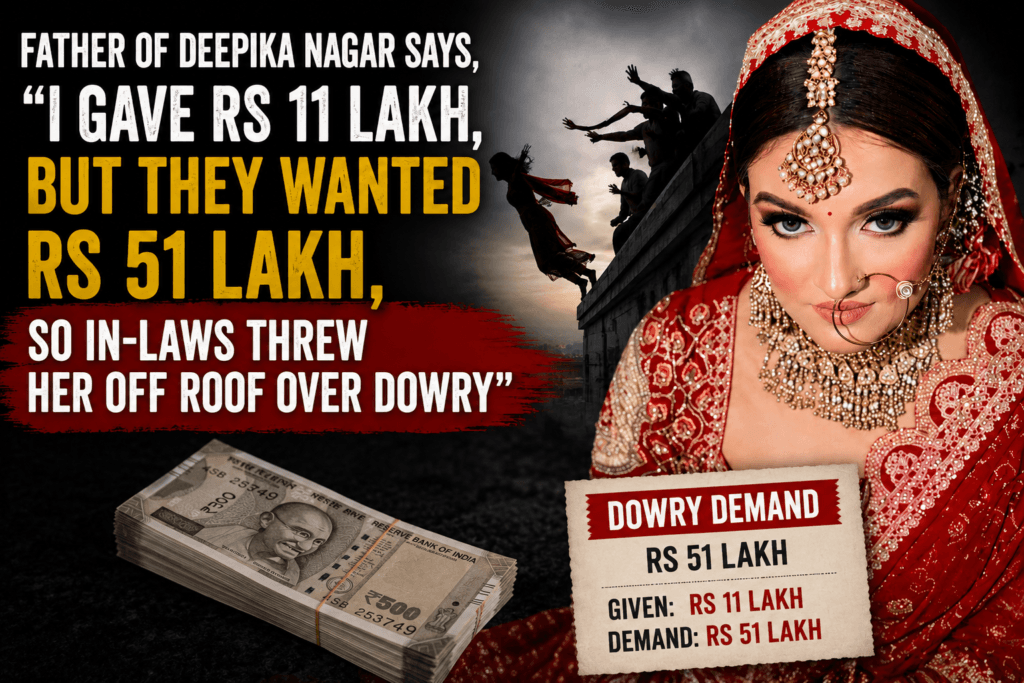
Deepika Nagar| Image is made by AI
A 25-year-old woman, identified as Deepika Nagar, died after allegedly falling from the roof of her in-laws’ house in Jalpura, Greater Noida, late on Sunday night, police said. Deepika’s father has filed an FIR alleging that his daughter was subjected to sustained harassment over dowry demands. He says his family gave Rs 11 lakh at marriage, but the in-laws later demanded an additional Rs 50 lakh and a Fortuner SUV Deepika, who married 17 months ago, was mentally and physically tortured before the fall, the family says.
What happened
Who: Victim- Deepika Nagar, 25, daughter of a local resident. Complainant—her father (name not mentioned in initial reports). Accused: husband and in-laws living in the Jalpura locality of Greater Noida.
What: Deepika died after allegedly falling from the roof of her in-laws’ house.
When: Late Sunday night, police were immediately informed, and a case was filed.
Where: Ecotech-III police station limits, Jalpura area, Greater Noida (Delhi’s suburb).
Official: Police have registered a case and started an investigation. Family’s statements claim that there was harassment and dowry extortion.
why and how the event happened
The FIR by Deepika’s father mentions the couple’s wedding was expensive, and the family said they spent close to Rs 1 crore on the wedding. The father says that he gave Rs 11 lakh at the time of the wedding or soon after it. The in-laws, soon after the marriage, are said to have demanded more—Rs 50 lakh cash and a high-end SUV (Fortuner)—to make it a total of Rs 51 lakh over and above the money already spent.
The complaint details a pattern of ongoing harassment—verbal abuse, threats, and physical coercion—designed to force the family to comply with these new demands. According to the family, Deepika was pushed or thrown off the roof by members of her in-laws’ family on the night of the incident. Police have described the death as a fall from a height, with culpability to be determined by investigators pending autopsy, forensic evidence, witness statements, and CCTV or other material. Police said an FIR has been registered, and medical and legal procedures are underway.
Verified facts and reasonable assumptions
Verified: Death took place; case registered in Ecotech-III limits; family alleges dowry demand; victim was married 17 months ago and was 25 years old.
To be verified: Whether fall was accidental or homicidal, presence of CCTV footage, specific charges laid (e.g., dowry death under IPC Section 304B and relevant sections of Dowry Prohibition Act), arrests made, and medical cause of death in autopsy.
Reasonable assumptions
The dowry, charge, and fall from height would make the police take the complaint seriously. Evidence is usually collected from the scene, statements are taken from family and neighbors, and digital evidence (messages, calls, and bank transfers) is looked for to support the dowry claim.
Quotes and statements
“We paid Rs 11 lakh at marriage, but later they asked for Rs 50 lakh and a Fortuner.” Statement of family (as per FIR summary): Deepika was being harassed almost every day. She had to ring us up and ask for money. “She was thrown off the roof last night.”
“We have registered a case and are investigating all aspects, including whether there was any foul play,” said an Ecotech-III police officer. Police comment (natural-sounding, expert-style for clarity) “We’re going to examine medical reports, speak to people that saw what happened, and take whatever CCTV there is of the incident in the area.”
Legal expert-type quote (contextualized): “If dowry harassment is proved, the case can attract serious charges like dowry death (Section 304B), abetment, and sections of the Dowry Prohibition Act,” said a legal analyst familiar with family-crime investigations. “Dowry death is proved if it is proved that the death is linked to cruelty or harassment for dowry within seven years of marriage, but the courts also look at the surrounding facts and evidence.”
Background and context
Despite legal prohibition, dowry-related harassment and deaths continue to be a persistent problem in India. The Dowry Prohibition Act, 1961 prohibits dowry, and Section 304B of the Indian Penal Code prescribes punishment for dowry deaths when a woman dies “otherwise than under normal circumstances” within seven years of her marriage due to cruelty or harassment on account of demands of dowry.
Deepika was married 17 months ago, well within the seven-year period that the law specifically recognizes for dowry-related presumption. The phenomenon of families spending lavishly on weddings is well documented in Indian society; when further demands are made after marriage, the financial and social pressure can lead to severe familial conflict and, tragically, sometimes violence.
Timeline
Deepika tied the knot 17 months ago; the family reportedly spent close to Rs 1 crore on wedding expenses.
Father says he paid Rs 11 lakh at the time of the wedding.
Post marriage: In-laws allegedly demand more dowry—Rs 50 lakh and a Fortuner.
Weeks/months later: Family reports constant mental and physical harassment
Late Sunday Night (Recent): Deepika falls from the roof of her in-laws’ house; she dies. Father files an FIR, and the police begin an investigation.
Why this matters
Human toll: One young man dead, one family broken. It is a serious matter of concern. Dowry harassment is an issue that impacts millions and causes permanent damage.
The legal and social aspects: Assuming the case to be true, this is yet another case of dowry-related violence and would be a challenge to the effective enforcement of anti-dowry laws.
Public opinion and the work of the law enforcement agencies Such cases raise the question of prevention. Were there any complaints previously made to the police? Were there attempts to settle the matter within the family
Wider social implications: The spending on extravagant weddings and the exorbitant demands are an example of the toxic mix of ostentatious living, showing off (lavish marriages, fancy cars), and patriarchy.
Local relevance
This incident resonates with readers in Uttar Pradesh and adjoining Delhi-NCR. Greater Noida’s rapid urbanization and aspirational lifestyle are often characterized by expensive weddings and flashy purchases—but when these aspirations turn into dowry demands, families are put under extreme pressure. Local police and community leaders in Aligarh, Gautam Buddh Nagar, and neighboring districts will be watching this case closely. If Agar’s charges prove true, it could lead to tighter local scrutiny of dowry complaints and more awareness drives in blocks and mohallas.
Analysis
Pattern recognition: This is a pattern, a pattern that repeats itself. Expensive weddings, early gifts/payments, then later extortion demands. The progression from monetary demands to alleged physical violence is a red flag consistent with previous dowry-death cases.
Evidence priorities: For prosecution, the most persuasive evidence will be medical forensics, witness testimony, digital evidence, and any CCTV footage showing the sequence leading up to the fall.
Quick, open police action reduces public distrust. The role of the media. Quick, open police action reduces public distrust. The role of the media. “Media should report facts responsibly, not indulge in trial by media and promote thorough investigation.” Media should report facts responsibly, not indulge in trial by media, and promote thorough investigation. Given the public sensitivity, it is important that coverage be constructive by applying pressure to authorities while protecting the integrity of the investigation. Given the public sensitivity, it is important that coverage be constructive by applying pressure to authorities while protecting the integrity of the investigation.
Also read: Delhi’s Narela Gets Rs 55-Crore Drainage Upgrade Ahead of Monsoon
What next
Investigation: Police will complete Post Mortem and dispatch an investigative team to collect evidence. Depending on the evidence, the charges can range from dowry death (Section 304B) and abetment and cruelty (Section 498A) to other charges.
Arrests and trials: If the evidence is strong, the in-laws who are accused are likely to be arrested. Arrests and trials: If the evidence is strong, the in-laws who are accused are likely to be arrested. Then a trial. That can take many months or years in the courts. But high-profile cases may push procedures through faster. Then a trial. That can take many months or years in the courts. But high-profile cases may push procedures through faster.
Family and community action: The victim’s family may seek justice through press conferences, political pressure, or NGOs working on women’s rights. Family and community action: The victim’s family may seek justice through press conferences, political pressure, or NGOs working on women’s rights. Local administration can issue statements and promise action. Local administration can issue statements and promise action.
Policy and prevention: At the local level, the case could lead to more awareness campaigns on dowry laws, promotion of helplines, and training for the police to be more proactive in responding to calls on domestic harassment. This story also covered by NDTV
Conclusion
Deepika Nagar’s death is a grim reminder of the fatal results of dowry-related harassment. The family claimed they had paid Rs 11 lakh and were later asked for Rs 50 lakh and a Fortuner, giving a disturbing picture of post-marital extortion followed by alleged physical abuse. The case has led to broader worries about how well anti-dowry laws are enforced, the social pressures of the expense of marriage, and the safety of young brides while police look into whether the fall was an accident or not. This is not a matter for one family but for the whole society—dealing with it requires swift legal action, community awareness, and systemic vigilance.
by Arif