Dehradun Police has rolled out a new weekend traffic plan for 9 and 10 May 2026, dividing the Asharodi–Mussoorie route into five “super zones,” 10 zones, and 18 sectors to manage heavy tourist and pilgrim traffic and avoid city‑wide jams.
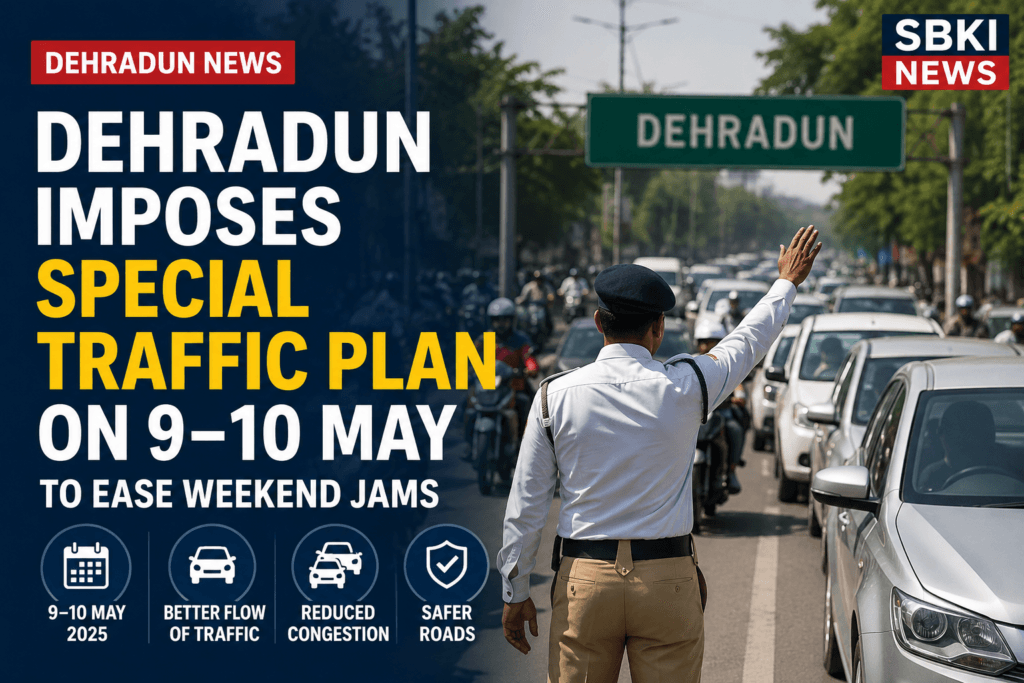
Dehradun traffic police enforcing the special weekend traffic plan on the Asharodi–Mussoorie route to prevent congestion and long‑drawn jams.
On Saturday, 9th May, and Sunday, 10th May 2026, a unique traffic system will be put into effect in the entire city of Dehradun for the weekend rush to Mussoorie, Rishikesh, and Chakrata. According to this system, the route between Asharodi and Mussoorie has been demarcated into five super zones, ten zones, and eighteen sectors for the first time ever in history so that traffic can move in an organized manner rather than getting stuck in chokepoints.
The plan has been executed by the Dehradun Police under the directives of the SSP Pramender Dobhal, while SP City Paramod Kumar and SP Traffic Lokjeet Singh have worked out the specific route diversion plan. The police force has been posted to various points of traffic duty from the headquarters and other wings of the police department.
Why and How Was
Reasons for the implementation of this scheme
The Dehradun-Mussoorie road route happens to be amongst the busiest weekend corridors of North India following the formation of the Delhi-Dehradun Economic Corridor (Dhaatkaali). On an average weekend, 15,000 vehicles ply the route from Dehradun en route to Mussoorie, Rishikesh, and Chakrata, with many being holidaying tourists from the Delhi/NCR region and beyond, in addition to pilgrims and families from local areas.
Given the large number of vehicles using the route, the traditional “wait-and-watch” policy would be inadequate in managing the traffic flow. Several spots such as ISBT, Shimla Bypass, St Jude Chowk, Kamla Palace Balliwala Flyover, Bulloowala Cant, Johdi Village, and Kuthalgarh are often seen getting clogged up with traffic, resulting in delays of several hours for the travelers.
The objective of the scheme is to avoid the following:
Chronic jams, Delayed travel for the tourists and residents,Inconvenience to the common man. It must be mentioned here that the local administration intends to create an image of a “tourist-friendly and well-planned city” in the hills, which has prompted them to adopt a more sophisticated zonal diversionary method instead of a mere signal-based regulation mechanism. The plan’s rationale
The entire Asharodi-Mussoorie route has been divided into five superzones.
Route Map and Diversion Plans
1. From Delhi–Dehradun Economic Corridor (Dhaatkaali) to Mussoorie
Plan A: Main Route
Dhaatkaali → RTO Checkpost → Transport Nagar T-junction → ISBT → Shimla Bypass → St Jude Chowk → Kamla Palace Balliwala Flyover → Bulloowala Cant T-junction → Supply Depot → Johdi T-junction → Purkul Village T-junction → Kuthalgarh → Mussoorie
Plan B: Alternative/Diversion Route
Transport Nagar T-junction → Laxmi Dharmkanta T-junction → St Jude Chowk → Kamla Palace → Bulloowala Chowk → Cant Chowk → Circuit House T-junction → Bijapur village → Kimaahi → Hathi Pawan → Mussoorie
In reality, should the city roads become too congested, the police will be forced to direct motorists to take the alternative route in order to prevent gridlock on the main roads.
2. From Delhi–Dehradun Economic Corridor to Chakrata
Route:
Dhaatkaali → RTO Checkpost → Transport Nagar T-junction → GMS Road → St Jude Chowk → Naya Gaon → Singhniwala → New Dehradun Pounta Flyover → Laangha Road → Chakrata
The route is popularly used by pilgrim and tourist traffic traveling to Chakrata-Snan Ghat-Kedarnath or hill tourist traffic visiting Chakrata on weekends.
3. Route Backward and Some Major Routes
Mussoorie-Asharodi Route:
Kuthalgarh → Purana Rajpur Road → Saini Mandir → Diversion → Dilaram EC Road → Fountain Chowk → Rishikesh Bridge → ISBT → Asharodi
Mussoorie-Rishikesh Route:
Kuthalgarh → Purana Rajpur Road → Saini Mandir → Kirshali Chowk → Kalāmadh Maldevta → Thano Road → Bhaniyavala T-junction → Rishikesh
It is important to note that these routes are planned in such a way that both incoming and outgoing vehicles would not clash against each other at critical points like St. Jude, Kamla Palace, Bulloowala, and Maldevta.
Police Deployment and Special Arrangements
Major intersections, markets, and tourist destinations like ISBT, Shimla bypass, Kamla palace, Bulloowala, and Maldevta have been identified as important duty locations for traffic management.
An ample amount of traffic personnel has been mobilized from the main police station as well as its different branches for this particular weekend, ensuring their presence at every major intersection rather than at only a few selected “problem areas.”
Barriers, signboards, and temporary guidance boards shall be established where the diversion starts, and continuous traffic management will take place at these locations.
Live updates will also be shared through helpline numbers and the official social media accounts of the police department, allowing motorists to know beforehand the most suitable routes to avoid congestion.
The officers have been advised to ensure a smooth flow of traffic rather than merely stopping it.
Background and Context
Traffic during weekends to Mussoorie and Rishikesh has increased drastically over the last few years due to the following reasons:
Construction of the Delhi-Dehradun Economic Corridor/expressway is reducing the travelling time between Delhi-NCR and 4-5 hours.
Marketing of “Weekend Hill-Getaway” packages by travel agencies/online travel agencies.
Increased popularity of short spiritual and adventure trips (Rishikesh for Yoga/raw adventure, Mussoorie for pleasant weather and sightseeing, and Chakrata for natural serenity).
Previously, Dehradun used to manage its traffic only with some traffic policing measures and diversion, but the present road network in Dehradun will not be able to cater to 15,000+ cars weekly without any systematic plan. The Asharodi-Mussoorie zonal approach marks the first initiative to treat the entire corridor as a “traffic corridor,” not merely an assortment of random streets.
Why This Matters
To tourists and pilgrims, the above plan would mean:
Reduced travel time; less chance of getting stuck in traffic for 2-3 hours.
Proper direction; they will know in advance which route to follow and where diversion is applicable.
Less stressful; there are no unpleasant surprises and unexpected “you can’t go ahead” messages.
For local residents of Dehradun and its adjoining towns, it would mean:
Lower pollution and honking from residential roads since traffic is directed towards specified routes.
Safer movement across major intersections due to police presence and better traffic discipline.
The feeling that the authorities are serious about traffic management and not only post about major accidents or VIP visits.
From the urban planning and tourism points of view, this plan would be a small but significant step towards the following:
Developing Dehradun-Mussoorie as a tourist-friendly belt.
Minimizing the “nauseating” experience on weekends when tourists comment, “Roads are lovely, but traffic is unbearable.”
Read also : ICE Arrests Shocker: Indian Man In Child Abuse Case, Another In $60,000 Theft; Both In US
Local Relevance
The weekend tourism in India is booming. People from Delhi-NCR, UP, Haryana, Rajasthan, Punjab, and even Bihar will happily drive 4-6 hours just for a weekend getaway at any of these destinations.
For the typical family of North India, it offers an economical alternative to luxury hill stations such as Shimla, Manali, and Nainital, and that is precisely why even a minor change in traffic flow can result in saving thousands of man-hours.
Furthermore, the plan demonstrates how the traffic flow management system in smaller cities is now being made increasingly efficient, in the same way that larger cities have done for themselves through the metro-city approach of managing their traffic.
Analysis
The primary lesson is that the traffic problem in Dehradun is not simply an increased number of vehicles but rather a lack of proper management of vehicle flow on the limited and hilly roads.
What makes this plan good:
It imposes structure on the situation rather than responding to its symptoms.
It utilizes the available force of policemen efficiently and not as “signal-guarding” personnel.
It recognizes that the problem is systematic (jamming every weekend) rather than occasional.
However, there are problems as well:
The majority of motorists disregard the diversion plan and attempt to take shortcuts via narrow pathways, creating another traffic jam.
If the alternate route signs are poorly developed or communicated, there might be some confusion leading people into a wrong turn.
If there are no changes in the city’s infrastructure in the future (additional flyovers, one-way traffic, or bypasses), the traffic plan is limited.
Overall, the traffic strategy proposed here is a brilliant stop-gap solution, not a long-term one. | This story also covered by Dainick jagran
What Happens Next?
Some possible future scenarios include the following:
If the plan is successful during the period from 9 to 10 May, the government may choose to replicate the same zonal-sectory approach for other weekend plans, even extending the strategy to the char-dham season.
The police may start using the nomenclature of Plan A/Plan B consistently so that motorists, as well as app-based services, can rely on their names easily.
It will also set a trend for other hill cities to develop their own strategies to regulate weekend traffic.
Eventually, they may have to develop advanced traffic management systems, such as variable message signs, traffic apps, and better coordination with travel websites.
However, only time will tell whether this plan will be consistently implemented in the coming months or if it is going to become a crucial element of traffic planning in Dehradun.
Conclusion
In summary, the novel traffic management system implemented by the Dehradun Police Force on 9 and 10 May 2026 appears to be a clear effort to manage the traffic on one of the busiest highways in North India. The division of the highway from Asharodi to Mussoorie into five super-zones, ten zones, and eighteen sectors, in addition to the alternate paths of travel for the traffic flow coming from the Delhi-Dehradun highway, should minimize congestion, enhance movement, and raise the level of contentment of tourists, devotees, and citizens.
This plan may act as a good role model for other hill stations in India that have a high volume of traffic due to the limited road network.
By M.A. Arif