Deadly hantaviruses, carried by infected rodents, are a serious threat worldwide with high death tolls. Find out how to stay safe as concerns rise in Asia and the Americas.
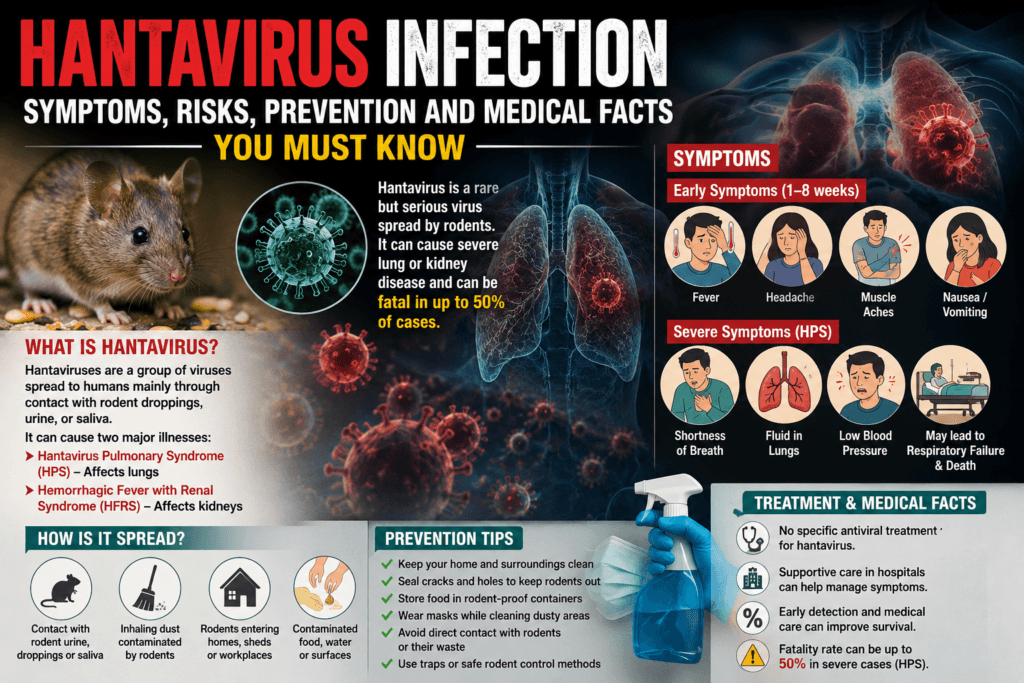
Hantavirus Infection Infographic – Symptoms, Transmission Risk, Prevention, and Important Medical Facts on the Rodent-Borne Virus. [Image Credit: AI-Generated, Representative Image]
In a stark reminder of nature’s hidden dangers, hantaviruses—a family of rodent-borne pathogens—continue to threaten human lives worldwide, causing severe illnesses with fatality rates as high as 50% in the Americas. These zoonotic viruses are mainly transmitted through contact with the urine, feces,, or saliva of infected rodents and can cause serious and even fatal diseases such as Hantavirus Cardiopulmonary Syndrome (HCPS) and Hemorrhagic Fever with Renal Syndrome (HFRS). Cases are relatively rare,, but the high lethality of cases makess them a major public health concern, especially in rodent-prone areas. There is no specific cure or vaccine,, so prevention through rodent control is key,” says the World Health Organization (WHO).
Why and How Hantaviruses Strike
Hantaviruses belong to the family Hantaviridae in the order Bunyavirales. Each strain is associated with a specific rodent reservoir, and these viruses establish lifelong infections with no disease in the host. Infection primarily occurs by inhaling aerosolized virus from rodent excreta during activities such as cleaning sheds or farming or forestry work. It is less often transmitted by bites. HPS is caused by viruses in the Americas and starts with flu-like symptoms (fever, headache, and muscle aches), progressing to respiratory failure and shock within days. HFRS affects the kidneys and causes hemorrhages in Europe and Asia.
The why is pretty much ecology—rodents love to live with humans, especially after disasters or in rural areas. For instance, the Andes virus in South America is unique in that it is the only one to cause rare human-to-human transmission through close contact, such as in Argentina and Chile. WHO estimates 10,000 to 100,000 infections annually worldwide; HFRS in Asia (China andand South Korea) is most severe, but rates are falling.
Voices from the Frontline: Experts Warn on Hantavirus
“Early detection and rodent-proofing homes are our best weapons against this silent killer,” says Dr. Maria Van Kerkhove, WHO’s technical lead on emerging diseases. In a recent update, she stressed, “Hantavirus isn’t airborne like COVID, but one whiff of contaminated dust can change everything.”
Local Indian health expert Dr. Rajesh Gupta from AIIMS echoes, “Yeh rodent-borne issue India mein bhi chhupa hua khatra hai, especially monsoon ke time jab chuhe badhte hain.” From the Americas, a survivor from a 2023 US outbreak shared, “I cleaned my garage without masks—the next day, fever hit like a truck.”” ICU saved me, but friends weren’t so lucky.” These voices underscore the urgency.
Read Also: Deadly Hantavirus Outbreak on Cruise Ship Leaves 40 Passengers Offloaded at St Helena
Hantavirus Case Timeline and Background Details
Hantaviruses emerged on radar in 1978 when the Sin Nombre virus killed 14 in the US Four Corners region during an El Niño-driven rodent boom—HCPS fatality hit 52%. Timeline highlights:
1930s: HFRS isolated from Chinese troops in Manchurian fighting.
1950s: The Korean War kills thousands and is called “Korean Hemorrhagic Fever.”
1993: Sin Nombre outbreak in the US alerts the world to New World hantaviruses.
2000s Chile confirms Andes virus human-to-human transmission.
2010s-2020s: Peak HFRS in Asia (>30,000 annual cases in China; now declining); thousands of cases in Europe due to Puumala virus in Scandinavia/Baltics.
2025: WHO ramps up One Health surveillance as climate change boosts rodent populations.
India has sporadic cases that are often confused with leptospirosis in flood-affected Uttar Pradesh and Bihar.
Why This Matters
This is not just an exotic disease story: hantaviruses kill despite low incidence because of high lethality: <1-15% in Asia/Europe andand 20-50% in the Americas. For families, one infected rodent in the attic is a disaster. Economically, outbreaks disrupt farming in Asia (millions affected annually) and tourism in national parks. Worldwide it overloads ICUswithout antivirals, just oxygen, dialysis,, and monitoring. “This is a very important public health issue,, as the change in climate is likely to expand the rodent habitat. According to models, this could lead to an increase in cases by 20-30% by 2030.
Hantavirus Risks for India
Monsoon floods in the villages and cities of Bharat, particularly in states like UP, force rodents inside the house—ideal for hantavirus. UP cities and like areas are at high risk due to rural farming and poor-ventilation homes. Experts suspect that the recent floods in Bihar that have triggered a surge in fever cases resembling dengue and leptospirosis are underreporting hantavirus. “Humare yahan chuhe ghar mein ghus aate hain; cleaning karte waqt mask nahi pehnte! Yeh deadly ho sakta hai,” warns a local doc. ICMR promotes rodent traps, partners with Swachh Bharat for prevention
In-Depth Analysis
Logically, we have underdiagnosis: early flu symptoms are confused with Dengue, COVID, and flu; only rodent history gives us a hint. Lab tests (IgM serology, RT-PCR) are the gold standard, but BSL-4 labs are few and far between in India. More access to ICUs means fewer deaths. That’s why Asia does better than America in remoteness. Human-to-human risk is very low (only in the Andes), so no pandemic panic. Outbreaks cluster after rodent blooms following heavy rains / earthquakes. OPINION: One Health is the priority for governments—rodent control > vaccines (none licensed). Data shows prevention reduces exposure by 90%
| Disease Type | Region | Fatality Rate | Annual Cases (Est.) |
|---|---|---|---|
| HCPS | Americas | 20-50% | Hundreds |
| HFRS | Asia/Europe | <1-15% | 10,000s |
What Future Outlook?
Short-term: WHO surveillance improves early alerts; India could witness ICMR campaigns in flood zones. In the long term, climate models show rodent outbreaks, perhaps doubling cases in Asia. Promising vaccine trials (e.g., DNA-based for Hantaan) in Korea—Phase III by 2028? Eco-controls may come from rodent genomics. Look for apps that incorporate risk mapping. If neglected, urban sprawl may urbanize the threat.
Summary
Hantaviruses remind us that nature’s balance is fragile, with rodents as unwitting vectors driving HCPS/HFRS nightmares globally. The Americas had kill rates of 50% and thousands in Asia. Prevention is the key: cleaning safely, sealing homes, and maintaining hygiene. No shortcuts. India’s got to go local, mix tech with desi smarts. This little rat, they say, can be a great danger. Share this to save a life.