A Rajasthan-registered Creta carrying three young occupants was caught in strong water currents near Kandoli Bridge in Prem Nagar; SDRF conducts all-night search, recovers two bodies and rescues an injured woman.
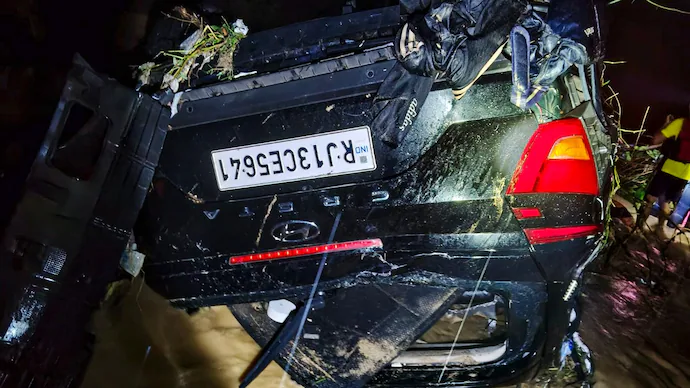
Damaged remains of a car recovered after being swept away by strong rainwater near Kandoli Bridge on Poundha Road in Dehradun’s Prem Nagar. Image Credit: IndiaToday
Two people died and a young woman was rescued after their SUV was swept away by strong monsoon currents in Dehradun’s flood-hit Prem Nagar area late on Monday night, prompting a prolonged search and rescue operation by the State Disaster Response Force (SDRF), officials said.
The incident occurred near Kandoli Bridge on the Lower Kandoli–Paundha Road under the Prem Nagar police station area. The vehicle, a Hyundai Creta bearing registration number RJ 13 CE 5641, was reportedly carrying a young man and two women when it was caught in the fast-moving water and swept away.
After receiving information about the incident, an SDRF team from Dakpathar rushed to the spot and launched a search operation that continued through the night despite difficult weather conditions and powerful monsoon flows.
During the operation, the SDRF team located Sahaj (also reported as Sahaj Kaur), daughter of Gulshan Baweja, nearly two kilometres from the accident site. She was found injured, rescued and handed over to the police for further assistance.
The search also led to the recovery of two bodies. One of the deceased was identified as 20-year-old Akshay, a resident of Jaipur, Rajasthan, and a third-year engineering student at the University of Petroleum and Energy Studies (UPES) in Dehradun. The identity of the other deceased woman was not immediately known in initial reports; later accounts named her as Kanak Sachdeva, 21, also from Jaipur.
From Prem Nagar to Kandoli Bridge
According to police and SDRF accounts:
Location: Near Kandoli Bridge, Lower Kandoli–Paundha Road, Prem Nagar, Dehradun, Uttarakhand.
Time: Late Monday night into early Tuesday morning; SDRF was alerted around 2:55 am.
Vehicle: Hyundai Creta, Rajasthan-registered (RJ 13 CE 5641).
Occupants: Three young people—one man and two women—from Jaipur, Rajasthan.
Weather context: Heavy to very heavy rain in Dehradun district; rivers flowing close to or above warning levels; orange alert for rainfall.
The vehicle was reportedly attempting to cross a rain-swollen drain or low-lying stretch on Pondha/Paundha Road when it was caught in the strong current and swept away. This story was also covered by The IndiaToday.
SDRF personnel combed the area and its surroundings through the night, battling difficult weather and powerful monsoon flows.
Why and How the Accident Happened
While a formal investigation is yet to establish the exact sequence, several factors appear to have contributed:
Intense rainfall: Dehradun recorded heavy to very heavy rain, with an orange alert in place; local drains and nullahs turned into fast-flowing streams.
Flash-flood-like conditions: The area around Kandoli Bridge and Lower Kandoli is prone to sudden water accumulation during heavy showers, creating deceptive currents.
Night driving in poor visibility: The incident occurred late at night, when visibility is reduced and it is harder to judge water depth and flow.
Possible risk-taking: Initial reports suggest the Creta, along with a second SUV, was crossing the flooded Pondha road when both were swept away; this indicates drivers may have underestimated the force of the water.
An SDRF team from Dakpathar, led by Assistant Sub-Inspector Suresh Tomar, immediately launched a search and rescue operation after receiving information.
Rescue Operation
The SDRF’s response unfolded as follows:
Alert time: Around 2:55 am, after reports that the vehicle had been swept away.
Deployment: A Team from the Dakpathar SDRF post moved to the spot near Kandoli Bridge.
Search challenges:
Strong monsoon currents
Dark, rainy night
Debris and muddy water
Uncertain location of occupants
Breakthrough: The team located Sahaj about two kilometres downstream from the accident site, injured but alive.
Recovery: The bodies of the other two occupants were recovered later; one was identified as Akshay, 20, a UPES student from Jaipur; the other as a young woman, later named in some reports as Kanak Sachdeva, 21.
The recovered bodies were handed over to the police for necessary legal proceedings and post-mortem.
Quotes and Official Statements
SDRF official: “Three people – one male and two females – were travelling in the vehicle when it was swept away by the strong current.”
Police account: “The incident occurred near Kandoli Bridge on the Lower Kandoli–Paundha Road under the Prem Nagar police station area… The Creta, bearing registration number RJ 13 CE 5641, was reportedly carrying a young man and two women.”
Weather department context: An orange alert for heavy to very heavy rain was in place; rivers, including Tonnes and Yamuna, were flowing close to or above warning levels.
Local media reports: “Two women and a man were travelling in the vehicle when it was swept away by the strong current… An SDRF team from Dakpathar… immediately launched a search and rescue operation.”
These statements highlight both the severity of the weather and the speed of the emergency response.
Monsoon Fury in Uttarakhand and Dehradun
Uttarakhand has been grappling with relentless monsoon rain, triggering landslides, house collapses and flash-flood-like situations across several districts.
In the 24 hours preceding the Dehradun incident:
Statewide deaths: At least seven to eight people died in rain-related incidents across Uttarakhand, including landslides and house collapses.
Dehradun impact:
Roads blocked due to landslides and falling boulders, including on the Dehradun–Mussoorie highway.
Several rural roads remained blocked after heavy rain damaged roads and houses.
Rivers such as Tonnes and Yamuna flowed close to or above warning levels.
School closures: An orange alert for heavy to very heavy rain prompted the closure of schools from Classes 1 to 12 and Anganwadi centres in Dehradun district.
The Prem Nagar incident is part of a broader pattern of monsoon-related accidents in the state, where vehicles attempting to cross flooded stretches have been swept away in the past.
Timeline of the Incident
Sunday–Monday, August 30–31, 2026:
Heavy to very heavy rain in Dehradun district; orange alert issued.
Rivers Tonnes and Yamuna flow close to or above warning levels; several roads are blocked.
Monday night/Tuesday early hours (September 1, 2026):
Around 2:55 am: SDRF receives information that a vehicle has been swept away near Kandoli Bridge on Pondha/Paundha Road.
Immediate response: SDRF team from Dakpathar, led by ASI Suresh Tomar, launches search and rescue.
Through the night: Personnel comb the area despite strong currents and poor visibility.
Early morning, September 1:
Rescue: Sahaj found an injured person about two kilometres downstream; rescued and handed to police.
Recovery: Bodies of Akshay, 20, and a young woman (later named as Kanak, 21) recovered, both from Jaipur.
Post-recovery: Bodies handed to police for legal proceedings; vehicle recovered in damaged condition.
Why This Matters
Yeh issue kaafi important hai because it highlights the deadly combination of extreme rainfall, urban drainage failures and risky driving behaviour during monsoon.
Young lives lost: Two 20–21-year-old students from Jaipur died; a third was injured, leaving families shattered.
Monsoon risk: The incident shows how quickly a routine drive can turn fatal when drains and nullahs become flash-flood channels.
Emergency response: SDRF’s all-night operation under difficult conditions underscores the importance of trained disaster teams in hilly, flood-prone regions.
Infrastructure gaps: Repeated incidents of vehicles being swept away point to the need for better drainage, warning signs and barriers at vulnerable spots.
Public awareness: Many drivers still underestimate the force of flowing water; even shallow but fast currents can move an SUV.
For commuters and students in hill towns and flood-prone cities, this is a painful reminder that “thoda paani hai” can be dangerously misleading.
India Angle
India records hundreds of monsoon-related deaths every year, with Uttarakhand, Himachal Pradesh, Maharashtra, Karnataka and several northeastern states particularly vulnerable.
Key issues highlighted by the Dehradun case:
Orange/red alerts: Despite weather warnings, normal movement continues; schools may close, but roads often remain open without adequate restrictions.
Urban drainage: Many city drains cannot handle intense rainfall, turning into fast-flowing streams that sweep away vehicles.
Inter-state travel: The victims were from Rajasthan, studying in Dehradun; monsoon risks affect not just locals but also students and tourists.
Disaster response: SDRF and local police play a critical role, but prevention—through infrastructure and public messaging—is equally important.
Yeh case dikhta hai ki sirf rescue teams par depend karna kaafi nahi hai; citizens ko bhi monsoon safety ko seriously lena hoga.
Analysis
This incident is not an isolated tragedy. It reflects a recurring pattern:
Underestimation of water force: Drivers often believe SUVs can handle flooded roads; in reality, even 30–45 cm of fast-moving water can destabilise and carry away a vehicle.
Night-time risk: Poor visibility and fatigue increase the chance of misjudging depth and current.
Lack of barriers and signage: Vulnerable stretches like Kandoli Bridge need clear warnings, barricades and, in some cases, temporary closure during heavy rain.
In my view, preventing such deaths requires:
Real-time alerts: Push notifications to drivers about flooded stretches and no-go zones during heavy rain.
Physical measures: Raised barriers, depth markers and automatic closure of low-lying roads when water crosses a threshold.
Public campaigns: Simple messages—“Do not drive through flowing water,” “Turn back, don’t risk it”—repeated every monsoon.
Enforcement: Penalising drivers who ignore closure signs and educating ride-sharing and taxi operators about monsoon protocols.
Without these, every heavy-rain episode will produce more Kandoli Bridge-style tragedies.
What Next
The case will now move through investigative and administrative channels.
Likely developments:
Police inquiry: Authorities will examine the exact circumstances—speed, route choice, whether warning signs existed, and if the road should have been closed.
Inquest and post-mortem: Formal procedures to establish cause of death and document injuries.
Infrastructure review: Local administration may review drainage and flood-prone spots on Lower Kandoli–Paundha Road and similar stretches.
Monsoon advisories: District authorities may issue stronger advisories against crossing flooded roads, especially at night.
Community response: Universities and resident associations may hold monsoon-safety sessions for students and drivers.
For citizens, practical steps include:
Avoid flooded roads: If you cannot see the road surface, do not enter the water.
Heed alerts: Treat orange/red rain alerts seriously; avoid non-essential travel.
Share location: During monsoon commutes, share live location with family.
Report hazards: Inform local authorities about dangerous drains, missing barricades or broken culverts.
Conclusion
Two young people died and a third was injured after their Rajasthan-registered Creta was swept away by strong monsoon currents near Kandoli Bridge in Dehradun’s Prem Nagar, prompting an all-night SDRF rescue operation.
The victims—Akshay, 20, a UPES engineering student, and Kanak, 21, both from Jaipur—lost their lives, while Sahaj, 18, was rescued about two kilometres downstream.
The incident underscores the deadly risks of driving through flooded stretches during heavy rain and the urgent need for better infrastructure, warnings and public awareness in monsoon-prone regions.
Yes, tragedy should be a wake-up call: every flooded road is a potential death trap, and no shortcut is worth a life.
Written By A. Jack