Nepal Police and NDRRMA update toll to 1,222 dead, 4,875 missing; joint security forces rescue 11,993 people as China reports 21 dead and 541 missing in Tibet’s Gyirong county.
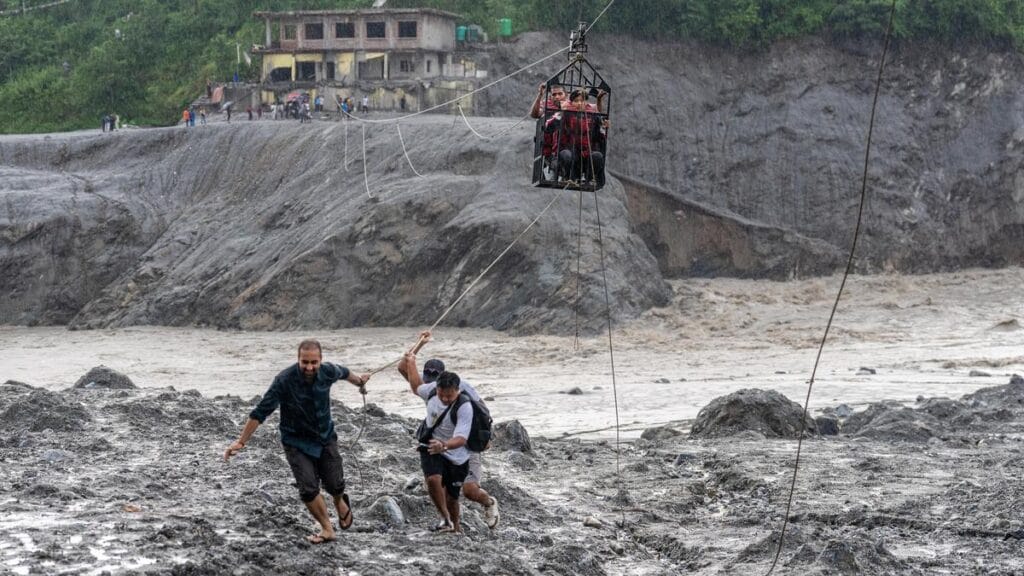
Rescue workers and volunteers search through debris along flood-hit riverbanks in Nepal. Image Credit: TheHindu.
Nepal Flash Floods: The death toll from Nepal’s devastating flash floods has surged to 1,222 as more bodies were recovered from eight districts affected by the disaster, while 4,875 people remain missing a week after the floods wiped out towns and villages across the country, Nepal Police said.
Among the missing, 583 are foreigners from dozens of countries, underscoring the international scale of the tragedy. Joint security forces—including the Nepal Army, Armed Police Force and Nepal Police—have so far rescued 11,993 people using helicopters and land routes, mobilising around 21,314 security personnel for search and rescue operations.
On the Chinese side, the death toll in the flash flood that struck Gyirong county in Tibet near the Nepal border has increased to 21, with 541 others still missing, Chinese officials said on Wednesday.
The National Disaster Risk Reduction and Management Authority (NDRRMA) provided a district-wise breakdown of recovered bodies, with Chitwan accounting for the highest number, followed by Nawalparasi East and West, Nuwakot, Rasuwa, Gorkha, Dhading and Tanahu.
What Happened
The disaster began on Wednesday, August 26, 2026, after a massive ice-and-rock avalanche and glacial collapse in the high Himalayas near the Nepal–Tibet border. This story was also covered by TheHindu.
A sudden surge of freezing water, ice and debris swept through the Bhotekoshi and Trishuli river valleys, destroying settlements, hydropower project sites, roads, bridges and tourism infrastructure.
By Wednesday, September 2, official figures showed:
Death toll in Nepal: 1,222 confirmed dead, according to Nepal Police and NDRRMA.
Missing in Nepal: 4,875 people unaccounted for, including 583 foreigners.
Rescued in Nepal: 11,993 people evacuated or brought to safety by joint security forces using helicopters and land routes.
Security deployment: Around 21,314 security personnel mobilised for search, rescue and relief.
District-wise body recovery (NDRRMA):
Chitwan: 348 bodies
Nawalparasi East: 218 bodies
Nawalparasi West: 208 bodies
Nuwakot: 155 bodies
Rasuwa: 127 bodies
Gorkha: 69 bodies
Dhading: 60 bodies
Tanahu: 38 bodies
On the Tibetan side:
Gyirong county: 21 confirmed dead, 541 missing as of Wednesday noon.
Rescue Operations
Rescue teams from Nepal, India, China and other countries are working in extremely difficult conditions to reach missing persons and recover bodies.
Key developments:
Helicopter evacuations: The Nepal Army and security forces have used helicopters extensively to airlift stranded tourists, pilgrims, hydropower workers and local residents from cut-off areas.
Land routes restored: China has fully reopened the only road leading to the Gyirong border crossing into Nepal, a week after sections were washed away, enabling heavier equipment and more rescuers to reach the core disaster zone.
Foreign nationals: Among the 4,875 missing in Nepal, 583 are foreigners; on the Chinese side, about 260 of the 541 missing are estimated to be foreign citizens.
Identification bottleneck: Of the bodies recovered so far in Nepal, only 95 have been identified and handed over to families; post-mortem and legal identification procedures have been completed for 1,113 bodies.
The technical complexity of reaching trapped workers, combined with unstable debris, adverse weather and high water levels, has made this one of the most challenging rescue operations in the region’s recent history.
Prime Minister’s Climate Link and International Response
Nepal Prime Minister Balendra Shah has explicitly linked the Bhotekoshi flood to climate change, citing rising temperatures in the Himalayan region and calling for global support. 1042
In recent statements, Shah said:
“The flood in the Bhotekoshi river in Rasuwa was not an ordinary flood… climate change is a global contribution and disaster response remains a global responsibility.”
He has urged the international community to recognise the increasing risks in the Himalayas and to support Nepal with finance, technology and capacity-building for disaster resilience.
China, meanwhile, has mounted a multi-pronged rescue effort in Gyirong, deploying firefighters, police, military personnel and heavy equipment, and restoring key road access to the port area.
Quotes and Official Statements
Nepal Police / NDRRMA: “The death toll has surged to 1,222… 4,875 people remain missing… 11,993 people have been rescued… 21,314 security personnel have been mobilised.”
District-wise recovery: “348 dead bodies from Chitwan, 218 from Nawalparasi East, 208 from Nawalparasi West, 155 from Nuwakot, 127 from Rasuwa, 69 from Gorkha, 60 from Dhading and 38 from Tanahu.”
Chinese authorities: “21 dead and 541 missing in Gyirong county… road access to the core disaster area has been secured; search expanded.”
Identification status: “Post-mortem and legal identification procedures completed for 1,113 bodies; only 95 handed over to relatives so far.”
These statements reflect both the human tragedy and the enormous logistical challenges facing responders.
Why the Floods Were So Devastating
The disaster began with a glacial collapse and ice-rock avalanche in the high Himalayas near the Nepal–Tibet border.
Such events can release massive volumes of water, ice and debris in a short time, creating a wall of floodwater that moves rapidly down narrow river valleys.
Key factors that increased the impact:
Steep terrain: The Bhotekoshi and Trishuli valleys are narrow and steep, amplifying the speed and force of the flood.
Settlements near rivers: Many hotels, guesthouses, hydropower sites and villages are located close to the riverbanks.
Cross-border infrastructure: Roads, bridges and the Gyirong border crossing complex were heavily damaged or destroyed.
Tourist and pilgrim traffic: The area is a key route for Kailash Mansarovar pilgrims and adventure tourists, increasing the number of people at risk.
Hydropower projects: Several under-construction and operational projects in Trishuli and Rasuwa were hit, trapping workers in tunnels and camps.
The combination of natural forces, human settlement patterns and climate-driven glacier instability turned a geological event into a humanitarian catastrophe.
Timeline
Wednesday, August 26, 2026: Ice-rock avalanche and glacial collapse trigger catastrophic flash floods in the Bhotekoshi and Trishuli river valleys.
Immediate aftermath: Hundreds killed, roads and bridges destroyed, hydropower sites damaged, many tourists and workers stranded.
August 27–31: Death toll rises past 900–1,100; more than 3,000–4,000 reported missing; rescue operations intensify; mass burials begin in Chitwan.
September 1–2: Death toll reported at 1,114–1,222 in successive updates; 4,875 missing; 11,993 rescued; 583 foreigners unaccounted for.
September 2–3: China confirms 21 dead, 541 missing in Gyirong; reopens key road to disaster zone; expands deep searches.
Why This Matters
Yeh disaster kaafi important hai because it affects not only Nepal but also India, China and the wider region.
Human cost: More than 1,200 confirmed dead and nearly 5,000 missing means thousands of families are waiting for news of loved ones.
Regional connectivity: The floods damaged a key border crossing and major highways, disrupting trade and travel between Nepal, India and China.
Energy infrastructure: Hydropower projects in Trishuli and Rasuwa were hit, potentially affecting Nepal’s power generation and investment climate.
Tourism and pilgrimage: The Kailash Mansarovar route and adventure-tourism circuits were severely disrupted, impacting livelihoods and travel plans.
Climate-risk warning: Glacial collapses and flood surges are likely to become more frequent as the Himalayas warm, making disaster planning critical.
For India, the impact is direct: many Indians were in the affected zone, and floodwaters have carried debris and bodies into Indian rivers downstream.
India Angle
India has a strong stake in this disaster.
Indian nationals affected: Hundreds of Indians were reported missing in early lists; rescue operations have evacuated many, while families continue to seek updates through MEA and state governments.
Pilgrims and tourists: A significant number of Kailash Mansarovar pilgrims and adventure tourists from India were travelling through the affected routes.
Downstream impact: Floodwaters from Nepal flow into Indian rivers, with bodies recovered in several districts of Uttar Pradesh and Bihar, complicating identification.
Rescue cooperation: India has deployed tunnel-rescue and forensic teams, provided relief material and coordinated closely with Nepalese authorities.
Diaspora concern: Families across India are tracking updates on missing relatives, with Indian missions and state governments coordinating information.
This situation shows how closely linked India and Nepal are in terms of people, rivers and disaster response.
Analysis
The disaster is a stress test for:
Nepal’s disaster-management capacity
Cross-border coordination with India and China
Rescue logistics in difficult Himalayan terrain
Communication with families of missing persons
Long-term rebuilding finance and planning
Two issues stand out:
Identification bottleneck: With 1,113 bodies processed but only 95 handed over, the system is overwhelmed. DNA sampling, regional data-sharing and simplified procedures are critical.
Climate narrative: PM Shah’s explicit attribution to climate change strengthens Nepal’s case for international climate finance and loss-and-damage support but must be backed by robust scientific studies.
In my view, the focus must remain on:
Saving lives: Continuing high-risk searches where survivors may still be trapped.
Identifying victims: Expanding DNA sampling and cross-border data-sharing to help families.
Climate justice: Using this tragedy to push for concrete commitments on Himalayan climate adaptation and disaster funding.
Without these, the cycle of disaster–response–forgetting will repeat.
What Next
The coming days and weeks will focus on:
Continued search operations: Teams will keep looking for missing persons in remote valleys, along riverbanks and inside tunnels.
Tunnel and debris rescue: High-risk operations in hydropower tunnels and debris fields will continue, with international support.
Weather monitoring: Fresh rain or rising water levels could trigger new floods or landslides, so alerts will remain active.
Identification efforts: DNA samples, photographs and personal effects will be used to identify as many victims as possible.
Rehabilitation: Temporary shelters, food, medical care and psychological support will be needed for survivors.
Infrastructure repair: Roads, bridges, power lines and communication networks will be prioritised, including the Gyirong–Nepal corridor.
International aid: Nepal is likely to receive financial and technical assistance from India, China, multilateral banks and other partners.
For Indians, the focus will remain on tracing missing relatives, supporting evacuation efforts and preparing for any downstream flood risk.
Conclusion
Nepal’s flash floods have killed at least 1,222 people, left 4,875 missing and forced the rescue of 11,993 individuals as operations enter their second week.
Rescue teams are drilling through debris and entering tunnels to reach trapped workers, while mass burials of unidentified victims continue as forensic teams struggle to cope.
Prime Minister Balendra Shah has linked the disaster to climate change, calling it a global responsibility, while China reports 21 dead and 541 missing in Gyirong and reopens key access routes.
Yes, the disaster is a stark reminder of the Himalayas’ vulnerability and the need for stronger regional cooperation. For now, the priority remains saving lives, finding the missing and supporting survivors.
Written By A. Jack