Over 16 hours after a five-storey building collapsed near Saket Metro station in South Delhi, rescue teams are still searching through the debris as four persons died in the incident. The building housed a coaching centre, cafes and offices and construction work was reportedly being carried out on the upper floor when the collapse happened.
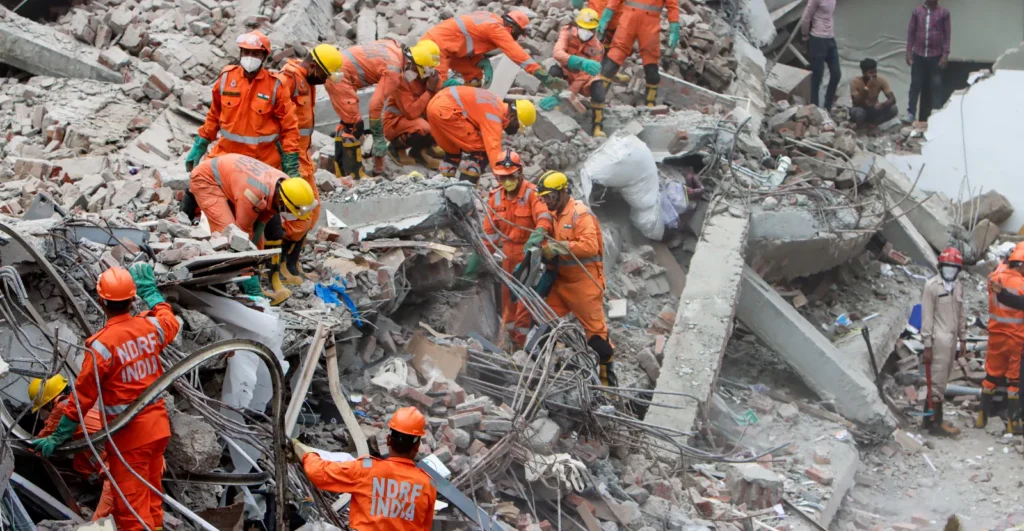
Rescue workers search through debris after a five-story building near Saket Metro station collapsed, killing four people and trapping several others. [Image credit: PTI]
A tragic building collapse near the Saket Metro station in South Delhi has left four people dead and triggered a large-scale rescue operation that has now stretched beyond 16 hours. The five-story building came down last evening, leaving several people trapped beneath the debris and prompting emergency teams to rush to the site.
Officials said more than 10 people have been rescued so far and taken to nearby hospitals for treatment. The building reportedly housed a coaching institute, cafes, and offices, and construction work was underway on the upper floor at the time of the collapse. The incident has raised urgent questions about building safety, unauthorized construction, and oversight in one of Delhi’s busy urban zones. Yeh incident kaafi disturbing hai because it happened in a place that was supposed to be used for study, work, and daily business—not disaster.
What Happened
According to the available reports, the five-story structure near the Saket Metro station suddenly collapsed, reducing the building to rubble and sending debris crashing onto an adjoining tin-shed canteen. The canteen was reportedly frequented by students preparing for medical entrance examinations, making the collapse even more alarming. NDTV has covered the full story.
The force of the collapse left multiple people trapped under the debris, and rescue operations began immediately. Heavy machinery, hydraulic cutters, victim-location cameras, and sniffer dogs have been deployed to find survivors. These are standard tools in urban rescue operations when the debris is dense and survival windows may be limited.
Witnesses described hearing screams from beneath the rubble and seeing a thick cloud of dust after the collapse. One resident said the building came down within moments, while people nearby ran in panic as some were trapped before they could escape. Such eyewitness accounts suggest the collapse was sudden, leaving little time for evacuation.
At least 10 people have been rescued so far and taken to hospitals. With four confirmed dead, the focus has now shifted from emergency response to accountability. The question many residents are asking is simple: how did a busy building, used by coaching centers and offices, end up collapsing in the first place?
Why the Building May Have Failed
Officials have said construction work was reportedly underway on the upper floor at the time of the incident. While the exact cause is still under investigation, structural stress, weak maintenance, unauthorized changes, or unsafe construction practices are among the factors typically examined in such cases.
The fact that the building housed multiple commercial uses—a coaching institute, cafes, and offices—means the structure likely saw regular footfall. If construction was happening above while people were inside below, the risk factor would naturally increase. In urban India, mixed-use buildings are common, but they can become dangerous when structural modifications are not properly approved or supervised.
There is also a wider issue of building compliance in densely populated cities like Delhi. Over time, buildings may be altered, repaired, or expanded without adequate structural audits. If safety inspections are delayed or ignored, the danger remains hidden until a collapse occurs. That is why many such incidents are later found to involve a combination of weak oversight, poor compliance, and unsafe construction practices rather than a single isolated mistake.
Rescue Operation Underway
Rescue teams have been working continuously since last night, using heavy equipment to clear debris carefully and search for people trapped below. Hydraulic cutters are being used where larger machinery could cause more harm, while victim-location cameras and sniffer dogs are helping teams identify possible signs of life.
This kind of operation is slow and delicate. Every move matters because rescuers must balance speed with safety. If the rubble is unstable, one wrong action can cause another collapse or injure both survivors and rescue personnel. That is why these operations often take many hours, especially when a building has crumbled into a tightly packed pile of debris.
Delhi Chief Minister Rekha Gupta visited the site and reviewed the rescue work. Her office said a criminal case has been registered at Mehrauli Police Station, and a magisterial inquiry is being ordered under the leadership of the District Magistrate of the South District. The government has also directed officials to inspect nearby dilapidated and hazardous buildings and take strict action where necessary. That is a strong signal that the collapse may trigger a broader safety crackdown.
Official Response and Legal Action
According to officials, a case of culpable homicide has been registered against the owner of the building, and raids are underway to arrest him. That legal step suggests authorities are treating the collapse not as a mere accident, but as a potentially criminal act linked to negligence or reckless disregard for safety.
The Chief Minister also ordered strict action against unauthorized buildings and directed departments to identify responsible officials. This is important because building collapse cases often raise the question of enforcement failure. If a building was unsafe, why was it allowed to operate? If construction was underway, was it approved? Were inspections conducted properly? These are the questions that a magisterial inquiry will likely try to answer.
In India, such cases often lead to a mix of criminal charges, administrative probes, and departmental accountability. The process can take time, but the immediate concern is whether further casualties can be prevented and whether other risky buildings in the area can be secured quickly.
Background and Context
Delhi has seen repeated concerns over unsafe structures, especially in densely packed commercial and residential neighborhoods. As the city grows vertically and older properties are repurposed for coaching centres, offices and eateries, pressure on building integrity increases. Sometimes structures are modified without proper structural review, creating hidden danger.
This is particularly relevant in areas near metro stations and commercial hubs, where footfall is high and buildings are used intensively. A coaching institute or office space may host dozens or even hundreds of people on a normal day. The local report that the building could have accommodated 200 to 300 employees on working days makes the incident even more frightening. The collapse happened on the weekend, which likely reduced casualties. On a weekday, the toll could have been much worse.
That context matters because building safety is not just about one site. It is about how city systems manage construction approvals, fire safety, structural audits, and occupancy rules. When one building collapses, the danger often points to a larger urban governance problem.
Timeline
Last evening: The five-story building near Saket Metro station collapses.
Soon after: Rescue teams begin searching for trapped people.
Overnight: Heavy machinery, sniffer dogs, and victim-location cameras are deployed.
By morning: More than 10 people are rescued and taken to hospitals.
More than 16 hours later: Rescue operations continue, with four confirmed dead.
Today: The Chief Minister visits the site and orders a criminal case, magisterial inquiry, and building inspections nearby.
Also Read: Ghaziabad Encounter: Main Accused in Bakrid Stabbing Case Killed After Shooting at Police
Why This Matters
This matters because building collapses are not random tragedies; they are often preventable. When a commercial building collapses in a crowded part of a capital city, it exposes flaws in planning, enforcement, and safety compliance. That makes the issue larger than one structure or one neighborhood.
It also matters because families, students, and workers depend on these buildings every day. A coaching center or office is supposed to be a normal part of life, not a place where people fear for survival. Yeh issue kaafi important hai because it touches public safety, civic accountability, and the trust people place in urban infrastructure.
India Angle
The India angle here is deeply relevant because building collapses have become a recurring urban safety concern across several Indian cities. Rapid construction, mixed-use buildings, weak inspections, and commercial pressure often create a dangerous combination. Delhi, as the national capital, carries special responsibility because incidents here draw attention to how cities across India manage building rules.
In Hinglish, seedhi baat yeh hai: log padhai, kaam, aur business ke liye building mein aate hain, lekin agar structure hi unsafe ho, toh risk sabke liye same hota hai. This is why the Saket collapse will resonate with people in Mumbai, Noida, Gurugram, Kolkata, and other crowded cities too. It is a reminder that urban safety is not a luxury; it is basic governance.
Analysis
My opinion is that the biggest issue here is not only the collapse itself but also the possibility that warning signs were missed earlier. If construction were underway on the upper floor, then questions about permissions, structural checks, and supervision would become unavoidable. In many Indian cities, building safety rules exist on paper, but enforcement is patchy. That gap is often where tragedy enters. The swift move to register a criminal case and order inquiries is necessary, but it should also lead to systemic action. Otherwise, the city will repeat the same cycle: shock, rescue, blame, and then forgetfulness. This incident should push authorities to inspect other mixed-use buildings before another disaster happens.
What Next
The next stage will focus on three things: rescue, investigation, and enforcement. Rescue teams will continue searching until officials are confident that no one remains trapped under the debris. The inquiry will then examine whether poor construction, illegal modifications, or negligence caused the collapse.
Police and administrative authorities are expected to question the building owner, builders, and any officials linked to approvals or inspections. Nearby unsafe buildings may also face immediate inspection or sealing. If violations are found, more criminal and administrative action could follow. The wider outcome may be a citywide safety drive, especially around older commercial buildings and coaching hubs.
Conclusion
The collapse of a five-story building near Saket Metro station has left four people dead, many rescued, and several families shaken by fear and grief. What should have been an ordinary commercial and academic space has turned into a scene of destruction, raising serious questions about urban safety and accountability.
As rescue teams continue their work and the government orders inquiries, the bigger lesson is clear: building safety cannot be treated as a background issue in a fast-growing city. Delhi’s latest tragedy is a reminder that when regulation fails, the cost is counted in human lives.
Written By A. Jack