The collapse occurred amid heavy rain, and waterlogging and thunderstorm warnings across Delhi, adding to an already tense evening. Emergency teams managed to cut through concrete slabs, bricks and twisted iron rods to reach those still trapped, rescuing two people from the rubble.
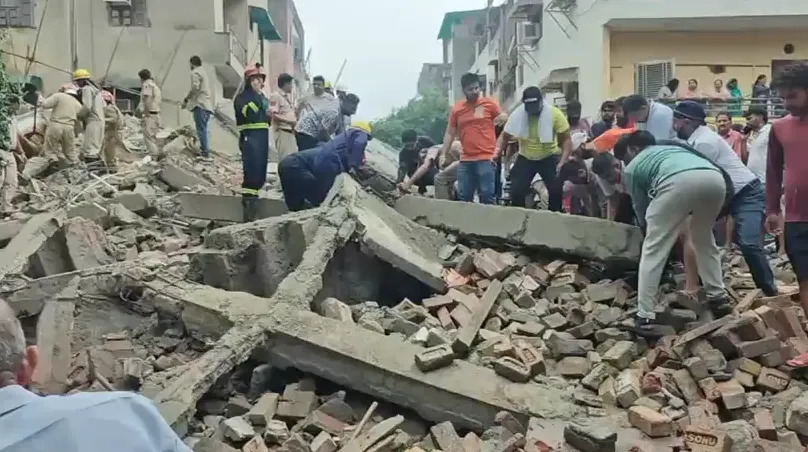
Rescue teams and local residents search through debris after an under-construction building collapsed in Delhi’s Rohini area during heavy rain. Image Credit: NDTV
Delhi Building Collapse in Rohini: A deadly building collapse in Delhi’s Rohini area on Wednesday evening has left one person dead and several others feared trapped after an under-construction three-storey structure came crashing down in heavy rain. The incident was reported around 4.20 pm, after which the fire department deployed four fire tenders and emergency teams moved in quickly to begin rescue work. Two people were pulled from the debris, while police, the NDRF and local residents continued efforts to locate anyone still trapped.
The collapse took place at a time when the capital was already grappling with heavy rainfall, waterlogging and weather alerts from the India Meteorological Department. The timing matters because it suggests that worsening weather conditions may have contributed to the danger or, at the very least, made rescue operations much more difficult. Yeh incident kaafi serious hai because it is not just a structural failure — it is a life-and-death emergency happening in the middle of a rain-hit city.
What Happened
According to initial reports, the under-construction building was a three-storey structure in Rohini 16 that collapsed on Wednesday evening following intense rainfall. The Fire Department received the first information at around 4.20 pm. Four fire tenders were sent to the spot, and soon after, the police, NDRF and other emergency teams joined the operation. This story is also covered by NDTV.
Among those pulled from the rubble was Ram Kishore, 42, who was rescued and taken to hospital, where he was declared brought dead. Another labourer, Ravi, 35, identified as a POP worker, was rescued safely. The building owner, Ram Dua, is suspected to be trapped beneath the debris, and officials said some labourers may still be inside the collapsed structure.
The fact that the owner may himself be trapped adds an unusual and tragic dimension to the case. The police have also registered a case against the building owner, suggesting that authorities are already examining possible negligence, construction violations or other safety lapses. While the final cause of the collapse will need a detailed investigation, the immediate picture is clear: the structure failed suddenly, and people paid the price.
How the Rescue Operation Unfolded
The rescue operation began with confusion, panic and urgent calls for help. Residents rushed to the site after hearing a loud crash from the collapse. What followed was a desperate attempt to clear debris using bare hands, bricks, broken slabs and whatever tools were available.
Locals reportedly removed rubble while crying voices were heard from beneath the collapsed structure. Rescue workers then established contact with one trapped person and supplied drinking water. Delhi Police even arranged an oxygen cylinder from a nearby hospital and kept oxygen flowing to the trapped individual while he remained under the debris. That decision likely saved a life, because in collapse incidents, time and breathable air are critical.
Emergency teams also used hydraulic cutters and specialised equipment to remove heavy concrete slabs without further injuring anyone below. This detail shows how technically challenging such rescues are. One wrong move can cause additional collapse, so every action has to be slow, careful and coordinated. The image of locals working alongside professional rescuers is powerful, but it also underlines a deeper truth: in India, emergency response often depends on both institutional systems and community action.
Why the Building May Have Failed
At this stage, the exact cause of the collapse has not been officially determined, but several factors are already visible. The building was under construction, which means the structure may not have been fully stabilised. Heavy rainfall can weaken temporary supports, saturate soil, affect foundations and put pressure on incomplete structures. If construction quality, supervision or safety checks were weak, the risks would have been even higher.
The Delhi Development Authority said the area was denotified in 2016 and handed over to the local body, adding that building activities in such denotified areas are monitored by them. That statement suggests there may be jurisdictional and regulatory questions over who was responsible for oversight. When building control is split across agencies, accountability can become messy. And in a city as dense as Delhi, that mess can become dangerous very quickly.
It is also worth noting that this collapse happened at a time when Delhi had red and orange weather alerts in place. The IMD warned of thunderstorms, lightning and heavy rain over the next few hours, with wind speeds expected to touch 40 kmph in some areas. That kind of weather can make unstable structures even riskier. In simple words, the rain may not have been the only cause, but it likely acted as a trigger.
Background and Context
Delhi’s monsoon season often exposes weak infrastructure, poor drainage and construction risks. Waterlogging is common in several parts of the city, and now this collapse adds a more severe layer of concern. When it rains heavily, the capital does not just struggle with traffic and flooded roads; it also faces threats to buildings, particularly those under construction or in vulnerable zones.
The incident also comes as several parts of Delhi were already submerged in knee-deep water, including Sadar Bazar, Nasirpur, Greater Kailash, Badarpur, Teliwara, Mahavir Bazar, Swarup Nagar and Kushak Road. That level of waterlogging is not just inconvenient. It can affect access for ambulances, fire tenders and rescue teams. So even when emergency services are deployed quickly, city conditions can slow them down.
This is where the bigger civic picture becomes important. Delhi has repeatedly seen how rainfall interacts with construction quality, poor drainage and administrative fragmentation. Building collapses during monsoon are not new in Indian cities, but every such case should force a hard look at local enforcement, safety norms and inspection systems. Yeh issue kaafi important hai because the cost of weak oversight is human life.
Timeline
Wednesday afternoon: Heavy rain continues across Delhi.
Around 4.20 pm: The Fire Department receives information about a building collapse in Rohini 16.
Shortly after: Four fire tenders are deployed at the site.
Rescue phase begins: Police, NDRF and local residents join the operation.
During rescue: Ram Kishore is pulled out and later declared brought dead at the hospital.
Same operation: Ravi, a POP worker, is rescued safely.
Ongoing: The building owner Ram Dua is suspected to be trapped, and search efforts continue.
Later in the day: IMD maintains red and orange alerts as rain and thunderstorms remain likely.
Also Read: Delhi-NCR Rain Alert: Heavy Monsoon Showers Trigger Waterlogging as IMD Issues Orange Warning
Why This Matters
This matters because it is a direct example of how weather and construction safety can collide in a city like Delhi. One collapse can kill workers, trap families, block roads and overwhelm emergency response. For people living or working in under-construction zones, this story is a reminder that structural safety is not optional. It is a basic need, same as electricity or water.
It also matters because the incident may expose gaps in building regulation. If a structure under construction can collapse during rain, the question is not only what the weather did but also whether the site was safe in the first place. That is where civic authorities, builders and inspectors all come under the spotlight. Public confidence drops when people feel a building can give way without warning.
For the wider city, the impact is even broader. In monsoon conditions, every failure affects ambulance routes, local movement and rescue capacity. When a city is already waterlogged, a collapse becomes harder to handle. So this is not just a local tragedy — it is a warning about urban preparedness.
India Angle
For Indian readers, this incident fits into a much larger conversation about monsoon safety in rapidly growing cities. In Hinglish, seedhi baat yeh hai: jab heavy rain aati hai, toh sirf roads nahi, buildings bhi test hote hain. Delhi’s collapse will resonate in cities across India where construction is booming but safety checks often lag behind.
The India angle is also about accountability. In many cities, people live near construction sites, work on half-finished buildings or move through areas where drainage and structural safety are both weak. That makes incidents like this deeply relatable, because they are not rare urban accidents — they are part of a bigger pattern. People want development, but they also want basic safety. Dono saath chalne chahiye.
This case may also push more awareness around weather-linked construction risk. During heavy rain, builders need to secure sites properly, inspect temporary supports and stop unsafe work. If that does not happen, the danger spreads beyond workers to neighbours, passersby and rescue teams.
Analysis
My opinion is that the most troubling part is the possibility that this collapse was preventable. Under-construction buildings should be inspected and secured far more strictly during heavy rain. If the structure was already weak, then the rain simply exposed the weakness. If warnings existed and nothing was done, that would be even more serious.
I also think the rescue story is important because it shows how critical local coordination can be. Locals, police, fire services and NDRF all played a role. The oxygen cylinder detail stands out because it shows how small interventions can be life-saving in collapse situations. In emergencies, good response often comes from practical, on-the-ground decisions rather than big speeches.
From an editorial angle, this is the kind of story that needs follow-up. The immediate rescue is only the first chapter. The more important chapter is why the building collapsed and whether proper safety rules were ignored.
What Next
The next step will be the continuation of the rescue operation and the search for anyone still trapped. Emergency teams will likely keep clearing debris carefully while checking for signs of life. Once that phase is complete, investigators will begin a more detailed examination of the building’s design, construction stage and approval status.
The police case against the building owner suggests legal scrutiny is already underway. If negligence is established, more action may follow. Authorities may also inspect nearby under-construction buildings to check whether similar risks exist elsewhere in the area.
There is also likely to be renewed pressure on civic agencies to tighten monsoon-time construction oversight. In a city like Delhi, this can mean stricter site inspections, better rain preparedness and quicker stop-work action when safety is in doubt. The hope is that one tragedy will lead to stronger prevention elsewhere.
Conclusion
The collapse of an under-construction building in Rohini is a grim reminder of how dangerous monsoon conditions can become when construction safety is weak. One person has died, others are feared trapped and rescue teams are still working through dangerous debris in difficult weather. With heavy rain, waterlogging and thunderstorm alerts already affecting Delhi, the incident has become part of a larger civic emergency. The immediate focus remains on saving lives, but the longer-term question is unavoidable: could this collapse have been prevented? In a city as large and crowded as Delhi, that question must be answered honestly.
Written By A. Jack