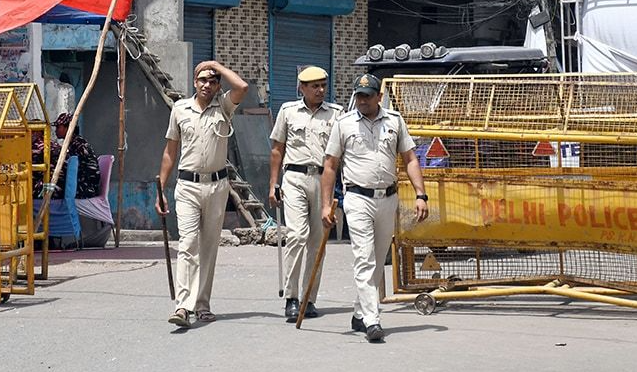
Three Indraprastha Gas Limited pump workers die after a truck’s CNG cylinder explodes during refuelling in Outer Delhi; police and fire officials begin probe into the exact cause.
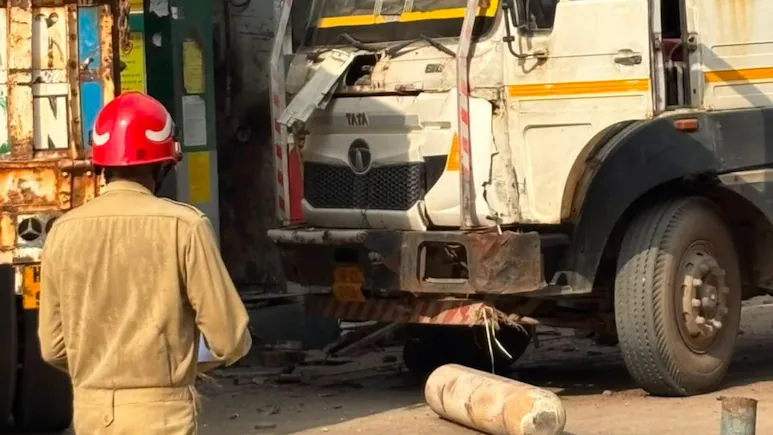
Police and fire personnel at the CNG station near Tikri Kalan Metro Station in Outer Delhi after a truck cylinder exploded during refuelling. Image Credit: NDTV
Three people were killed and three others injured after a truck’s CNG cylinder exploded while it was being refilled at a fuel station near Tikri Kalan Metro Station in Delhi on Wednesday, August 19, 2026.
All three deceased were employees of the CNG filling station. The blast occurred around 3.20 pm during the refuelling process, triggering panic in the area and damaging the truck, a car and a two-wheeler.
The Delhi Fire Service received a call at 3.37 pm and deployed six fire tenders, while senior police officers from the Outer Delhi district, including the DCP, ACP and Mundka police station team, reached the site.
Victims Identified
The three workers who died have been identified as:
Manish, 25, a resident of Baba Haridas Colony in west Delhi
Brahmjeet, 34, a resident of Nizampur
Sunny, 30, a resident of Nizampurtribuneindia+2
Manish was filling CNG into the truck when the explosion occurred. He was taken to Sanjay Gandhi Hospital but later succumbed to his injuries. Sunny and Brahmjeet, who were admitted to different hospitals, also died during treatment. This story was also covered by NDTV.
The injured were identified as Surjeet, Sanjay and Vipin. Surjeet and Sanjay were admitted to CD Global Hospital in Mundka and were reported to be in serious condition. Vipin, the truck driver, sustained comparatively minor injuries.
How the Explosion Happened
According to the preliminary police version, the truck had arrived at the CNG station for refuelling. While compressed natural gas was being filled into the truck’s cylinder, the cylinder exploded with a powerful blast.
Six people were reportedly standing near the truck at the time. All suffered injuries of varying severity, and three later died.
The force of the explosion damaged:
The truck whose cylinder exploded
A nearby car
A two-wheeler parked or standing near the fuel station
The exact cause has not yet been established. Investigators are expected to examine the condition of the truck’s cylinder, the refuelling nozzle and hose assembly, gas-pressure controls, safety valves, station equipment, maintenance records and the sequence followed during the filling process.
At this stage, it would be premature to conclude whether the blast resulted from a defective cylinder, over-pressurisation, a leak, a valve failure, human error, poor maintenance, or another technical factor.
Emergency Response at Tikri Kalan
The explosion occurred near Tikri Kalan Metro Station in the Mundka area of Outer Delhi, an industrial and transport-heavy zone on Delhi’s western edge. The Delhi Fire Service was alerted at 3.37 pm, around 17 minutes after the reported time of the blast. Six fire tenders were rushed to the location.
Police teams promptly secured the site to prevent a secondary incident. Fire officials carried out precautionary measures, checked surrounding fuel infrastructure and ensured that the immediate danger was brought under control.
Large teams of police and fire personnel remained deployed as the area was cleared, vehicles were inspected and evidence was collected. The presence of compressed gas infrastructure makes every such incident sensitive because even after an explosion, nearby cylinders, pipelines or refuelling systems may pose continuing risk.
Statements and Official Updates
A senior Delhi Police officer said the blast occurred while CNG was being filled into the truck. The officer said Manish, who was filling gas into the truck’s CNG cylinder, suffered fatal injuries. Sunny and Brahmjeet later succumbed after being admitted to hospital. A Delhi Fire Service official said six people near the truck were injured and shifted to nearby hospitals for treatment.
The police said the situation at the site was under control, but an investigation has been launched to determine the precise cause of the explosion. As of the latest reports, two of the injured remained serious at CD Global Hospital in Mundka.
Why CNG Safety Matters
Compressed Natural Gas, or CNG, is widely used in Delhi for autos, taxis, buses, cars, commercial fleets and increasingly for goods vehicles. It is considered cleaner than petrol and diesel because it produces lower tailpipe emissions.
However, CNG is stored at very high pressure. This makes the integrity of the cylinder, valve, pipeline, nozzle, seal and pressure-regulation system critical. A properly certified CNG cylinder, filled through a compliant station system, is designed to operate safely. But risks can rise if there is:
Cylinder corrosion, damage or unauthorised modification
Expired hydrostatic testing or poor maintenance
A faulty valve or pressure relief device
Damage caused by an accident or rough handling
Unsafe repair work
A leak during refuelling
Failure to follow prescribed refuelling procedures
Inadequate inspection of commercial vehicles
The Tikri Kalan tragedy highlights why these safety checks cannot be treated as routine paperwork. At a busy commercial refuelling station, a fault can affect workers, drivers, nearby customers and passing vehicles in seconds.
Timeline
August 19, 2026, around 3.20 pm: A truck arrives at the CNG station near Tikri Kalan Metro Station in Outer Delhi for refuelling.
During CNG filling: The truck’s CNG cylinder explodes while gas is being pumped into it.
Immediately after blast: Six people standing near the truck suffer injuries; the explosion damages the truck, a car and a two-wheeler.
3.37 pm: Delhi Fire Service receives the emergency call and dispatches six fire tenders.
Emergency response: Outer Delhi police officers, including the DCP, ACP and Mundka SHO, reach the location along with fire and medical teams.
Hospitalisation: Victims are shifted to Sanjay Gandhi Hospital, Jeevan Jyoti Hospital and CD Global Hospital in Mundka.
Casualties confirmed: Manish, Sunny and Brahmjeet die of their injuries; Surjeet and Sanjay remain serious, while Vipin sustains minor injuries.
Investigation begins: Police and fire officials begin examining the cause of the CNG cylinder explosion and safety compliance at the station.
Also Read: Delhi SIR: Form Submission Window Closes; 47.7 Lakh Voters Set to Be Missing From Draft Roll
Why This Matters
Yeh incident kaafi important hai because Delhi’s transport system depends heavily on CNG, and every refuelling-point accident raises concerns about public and worker safety.
Human cost: Three pump workers lost their lives while performing routine duties at a fuel station.
Worker safety: CNG station employees are exposed to high-pressure gas systems every day and need strong training, protective equipment and emergency protocols.
Commercial vehicle risk: Trucks may face higher wear and tear than private vehicles, making cylinder inspection and testing especially important.
Public safety: The blast happened near a Metro station and damaged nearby vehicles, showing the risk to people in busy urban corridors.
Clean-fuel confidence: Delhi’s shift toward CNG is essential for pollution control, but public trust depends on visible and consistent safety enforcement.
CNG itself is not inherently unsafe. But high-pressure fuel systems demand zero compromise on cylinder certification, station maintenance and operating procedures.
India Angle
India is expanding the use of CNG, compressed biogas and other cleaner fuels to reduce pollution and dependence on conventional petrol and diesel.
Delhi-NCR remains one of the country’s largest CNG markets. Thousands of autos, taxis, buses, delivery vehicles and private cars depend on CNG stations every day.
The Tikri Kalan explosion is therefore not only a local criminal or accident case. It is a reminder that the clean-mobility transition must be supported by strong safety infrastructure.
Across India, authorities and gas companies need to focus on:
Periodic cylinder testing and certification
Digital tracking of cylinder age and test history
Mandatory checks for commercial and freight vehicles
Emergency training for pump staff
PPE and safety-zone enforcement during refuelling
Proper maintenance of nozzles, hoses and pressure systems
Rapid emergency response plans
Independent audits of high-volume CNG stations
Yeh fuel transition tabhi successful hoga jab “clean” ke saath “safe” bhi equally important ho.
Analysis
The most important question is whether this was an isolated equipment failure or a preventable safety lapse.
The investigation should not stop at identifying the immediate mechanical trigger. It must examine the wider chain of responsibility:
Was the truck’s CNG cylinder validly certified?
Was it due for hydrostatic testing?
Was the vehicle inspected before filling?
Were proper exclusion zones maintained around the truck?
Were workers trained to identify warning signs?
Did the CNG station follow standard operating procedures?
Was emergency equipment functional and readily accessible?
There is also a labour angle. The three people who died were filling-station staff. Their families deserve a transparent inquiry, compensation and a clear explanation of whether safety protocols protected them adequately.
In my view, this tragedy should lead to a safety audit of CNG stations and commercial CNG vehicles across Delhi-NCR, especially facilities located near markets, Metro stations and high-density traffic routes.
What Next
Several steps are expected in the coming days:
Forensic inspection: Police and technical experts will examine the damaged truck cylinder, valves, hoses and station infrastructure.
Cylinder certification check: Investigators are likely to verify whether the truck’s cylinder had valid testing and fitness records.
Safety audit: The fuel station may be inspected for compliance with gas-handling and emergency-response norms.
Hospital updates: Authorities are expected to provide further updates on the condition of Surjeet and Sanjay, who were reported serious.
Legal action: An FIR or further legal proceedings may follow if negligence, unsafe operations or defective equipment are established.
Compensation: Families of the deceased workers are likely to seek compensation from the station operator, employer, insurer or other responsible agencies.
Broader checks: Delhi authorities may order inspections at other CNG stations, particularly those handling commercial trucks and large fleets.
Conclusion
The CNG cylinder blast near Tikri Kalan Metro Station has left three fuel-pump workers dead and three people injured, turning a routine truck-refuelling operation into a devastating tragedy.
Manish, Brahmjeet and Sunny were working at the station when the cylinder exploded. Their deaths underline the risks faced daily by workers around high-pressure fuel systems.
The exact cause is yet to be established. But the investigation must be rigorous, transparent and focused on preventing another such incident—not just identifying a single point of failure.
Delhi’s move toward cleaner transport is necessary, but worker and public safety cannot be an afterthought. Tikri Kalan ka yeh blast ek painful reminder hai: every CNG refill must follow the highest standards, because one lapse can cost lives.
Written By A. Jack