Additional Sessions Judge Saurabh Pratap Singh Laler remands Hindutva influencer to Tihar Jail till September 21; FIR expanded to include SC/ST Act and POCSO charges
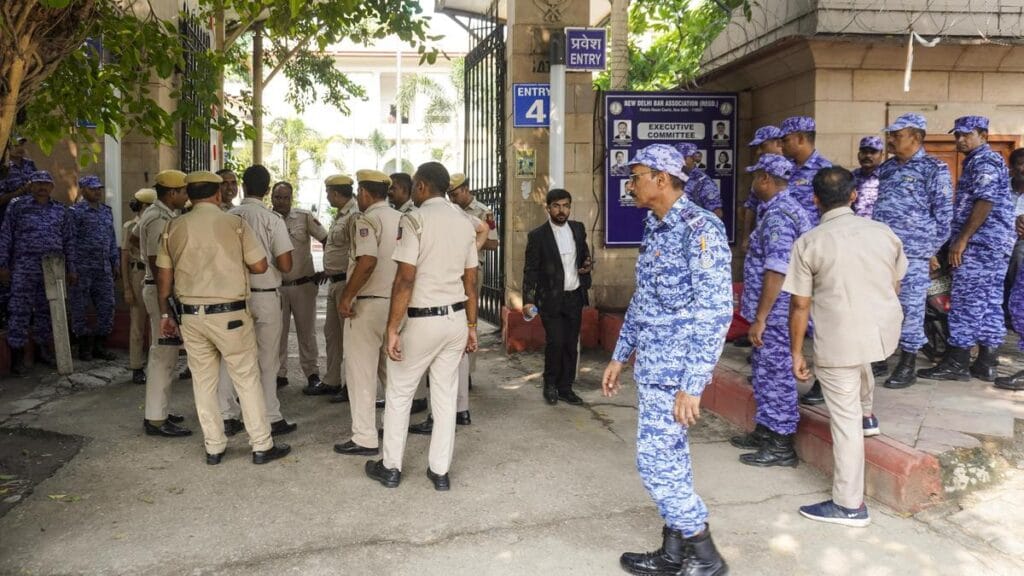
This Image is only for illustrations. Image Credit: TheHindu
A Delhi court on Monday, September 7, sent self-styled right-wing social media influencer Swatantra Bhardwaj to 14 days of judicial custody in connection with the alleged assault on Sanjay Azad, the father of a teenage Cockroach Janta Party (CJP) activist, during a protest at Jantar Mantar on June 23, 2026.
Bhardwaj was produced through video conferencing before Additional Sessions Judge Saurabh Pratap Singh Laler at Patiala House Courts, following the completion of his one-day police custody. The court granted the investigating agency’s plea for 14 days of judicial custody, and Bhardwaj will now remain in Tihar Jail until September 21, when he is scheduled to be produced before the court again.
In a parallel development, the Delhi High Court rejected Bhardwaj’s habeas corpus plea challenging his arrest, with the bench observing that since he is in judicial custody under a court order, he must approach the trial court for relief. The FIR against Bhardwaj has been expanded to include provisions of the Scheduled Castes and Scheduled Tribes (Prevention of Atrocities) Act and criminal intimidation, while a separate case under the Protection of Children from Sexual Offences (POCSO) Act has been registered following allegations of rape threats against the minor activist Nishu Azad.
The Jantar Mantar Assault and Its Aftermath
The controversy traces back to June 23, 2026, when the Cockroach Janta Party (CJP) organized a protest at Jantar Mantar. Sanjay Azad, a 38-year-old Dalit man, had accompanied his 14-year-old daughter Nishu Azad, a CJP activist, to the demonstration.
According to police investigations and witness statements, an altercation ensued between Sanjay Azad and Bhardwaj, who was allegedly present at the protest with supporters. During the scuffle, Bhardwaj and another accused, Suraj Kumar, allegedly assaulted Sanjay Azad, causing head injuries that required medical treatment.
The incident remained relatively low-profile until early September, when Bhardwaj appeared on a video podcast and brazenly admitted to the assault. In the viral clip, Bhardwaj boasted: “I cracked the skull of…(the) father. It should be a case of attempted murder. He had seven stitches on his head.
The podcast admission triggered immediate outrage, with opposition leaders, press bodies, and civil society groups demanding Bhardwaj’s arrest and the addition of non-bailable charges. Delhi Police initially pushed back, with DCP (New Delhi) Anant Mittal stating in an X post that claims of a “cracked skull” were “misinformation” and “completely baseless,” citing medical examination reports. This story was also covered by The Hindu.
However, after a September 4 protest by CJP leaders, joined by MPs Chandrashekhar Azad and Pappu Yadav, at Parliament Street Police Station, police changed course. A delegation met with Parliament Street Police Station officials and secured commitments to add attempt-to-murder charges, SC/ST Act provisions, and investigate threats made to the minor girl. Late that evening, police registered a POCSO case based on the 14-year-old’s complaint alleging rape threats from Bhardwaj and his supporters.
Official Statements and Legal Proceedings
Delhi Police, in a statement, confirmed Bhardwaj’s detention from Bulandshahr on September 4 and said he attempted to flee on a Bullet motorcycle but was caught by a special crime branch team. “Based on video evidence, witness testimonies, and medical records, we are examining the applicability of additional charges, including attempt to murder and SC/ST Act provisions,” a senior officer said.
On the POCSO case, police said: “Late on Friday evening, an FIR was registered under sections of the Protection of Children from Sexual Offences (POCSO) Act, 2012, and for criminal intimidation based on the girl’s complaint alleging rape threats and harassment from the accused and his supporters.”
At Monday’s court hearing, Additional Sessions Judge Saurabh Pratap Singh Laler heard arguments from both the prosecution and defense before remanding Bhardwaj to judicial custody. The Delhi Police Crime Branch had moved an application seeking 14 days’ judicial custody of Bhardwaj, which was allowed by the court.
The Delhi High Court, meanwhile, rejected Bhardwaj’s habeas corpus plea, with the bench observing, “He is in judicial custody under court orders. He can move the trial court.” The court’s refusal to entertain the plea means Bhardwaj must now seek relief from the trial court handling his case.
Background
The June 23 Jantar Mantar protest was part of a series of student-led demonstrations against the Delhi government and BJP-led establishment over issues including unemployment, education policy, and alleged corruption. CJP, a satirical political party founded by Abhijeet Dipke, has gained traction among young activists for its irreverent take on mainstream politics.
Bhardwaj, a self-styled “Hindutva influencer” from Patna’s Kankarbagh, has built a following on social media through provocative content targeting opposition figures, minority communities, and student activists. In the podcast, he claimed connections to top BJP leaders, naming Union Minister Chirag Paswan, Delhi Minister Kapil Mishra, and Prime Minister Narendra Modi as allies who could protect him from legal consequences.
These claims drew sharp criticism from opposition parties. Congress leader Jairam Ramesh posted on X: “An influencer boasts of cracking a man’s skull, claims political protection, and walks free for two months. What does this say about law and order in Delhi? “AAP leader Saurabh Bhardwaj (unrelated to Swatantra) demanded a judicial probe, asking, ‘Who is protecting this accused?'” Why was the FIR diluted initially?”
The case has also sparked broader debates about influencer accountability and the weaponization of social media. Bhardwaj’s boastful admission on camera created irrefutable evidence that made police inaction untenable. But the fact that it took a viral video—and a protest by MPs and opposition leaders—to trigger serious action speaks volumes about how justice is rationed in India.
From Assault to Judicial Custody
June 23, 2026: Sanjay Azad and his 14-year-old daughter attend CJP protest at Jantar Mantar; alleged assault by Swatantra Bhardwaj and Suraj Kumar; Azad sustains head injuries, treated at hospital.
June 23 (Evening): FIR registered at Parliament Street Police Station under BNS sections 115(2) and 126(2) only; Bhardwaj and Kumar briefly detained, then released with notices.
June–August 2026: Case remains dormant; Bhardwaj posts on social media claiming political protection from Kapil Mishra, Chirag Paswan, and Narendra Modi.
Early September 2026: Bhardwaj appears on a video podcast, admits to “cracking skull” of Azad, and boasts about escaping jail; the video goes viral, sparking outrage.
September 4 (Morning): CJP, Indian Youth Congress, and MPs Chandrashekhar Azad and Pappu Yadav protest at Parliament Street Police Station demanding arrest, attempt-to-murder charges, SC/ST Act, and POCSO case.
September 4 (Afternoon): Delhi Police assure protesters of action within 72 hours; agree to add stringent charges; special crime branch tracks Bhardwaj to Bulandshahr.
September 4 (Evening): Bhardwaj was detained from Dhameda Nara village in the Chola police station area after attempting to flee on a motorcycle; a POCSO FIR was registered based on the minor’s complaint.
September 5: Bhardwaj produced before court; granted one-day police custody for interrogation.
September 7: Bhardwaj produced before Additional Sessions Judge Saurabh Pratap Singh Laler; remanded to 14 days judicial custody till September 21; Delhi HC rejects habeas corpus plea.
September 21 (scheduled): Bhardwaj is to be produced before court again; a chargesheet may be filed if the investigation is complete.
Why This Matters
Yeh issue kaafi important hai for multiple reasons. First, it exposes a disturbing pattern of impunity for right-wing activists who claim political protection while committing violence against marginalized communities. Bhardwaj’s boastful claims—that Kapil Mishra “saved” him and that he has “danda and shoes of Delhi Police”—suggest a nexus between influencers, politicians, and law enforcement that undermines the rule of law.
Second, the initial dilution of the FIR—filing only simple hurt and wrongful restraint charges despite video evidence and medical reports—raises questions about bias in policing, especially when the victim is Dalit. The SC/ST Act exists precisely to deter such violence, yet it was added only after public pressure and a high-profile protest.
Third, the POCSO angle is chilling. Threatening a 14-year-old girl with rape is not just criminal intimidation—it’s psychological terrorism designed to silence dissent. If the state had not acted, what message would that send to other young activists, especially girls, considering protest participation?
India Angle
For readers across India, yeh sirf Delhi ki kahani nahi hai—yeh ek national trend ban chuka hai. From the 2020 Delhi riots to the Palghar mob lynching, cases involving right-wing accused often see delayed FIRs, diluted charges, and prolonged bail processes. Meanwhile, dissenters—students, journalists, and activists—face swift action under UAPA, sedition, and other stringent laws.
Agar aapko lagta hai ki yeh issue sirf CJP ya opposition ko concern karta hai, toh sochiye dobara. The erosion of equal protection under law affects every citizen. When influencers can boast of violence and political connections without consequence, it normalizes vigilantism and undermines faith in institutions.
The Dalit angle is particularly significant. Atrocities against Dalits remain endemic across India, with conviction rates under the SC/ST Act hovering below 30%. Adding these provisions to the FIR is a necessary step, but the real test is whether the prosecution follows through or the case drags on for years while the accused roams free.
Analysis
The podcast admission was a strategic blunder by Bhardwaj. By boasting on camera, he created irrefutable evidence that made police inaction untenable. But the fact that it took a viral video—and a protest by MPs and opposition leaders—to trigger serious action speaks volumes about how justice is rationed in India.
The political connections Bhardwaj claimed are worth examining. While Kapil Mishra and Chirag Paswan have not publicly responded, the mere mention of their names suggests a perceived shield that emboldens such actors. Whether these claims are true or exaggerated, the perception of protection is itself dangerous—it signals to other influencers that violence can be monetized and politicized without cost.
From a legal standpoint, the addition of POCSO charges is a game-changer. Unlike simple hurt, POCSO offenses are non-bailable and carry mandatory minimum sentences. Combined with attempt-to-murder and SC/ST Act provisions, Bhardwaj faces a potentially lengthy prison term if convicted.
The role of CJP and opposition parties in forcing police action cannot be overstated. Without the September 4 protest, the case might have remained buried. This is both encouraging—it shows collective action works—and alarming, because it suggests justice is contingent on political pressure rather than procedural fairness.
Legal Proceedings and Broader Implications
In the immediate term (next 14 days):
Judicial custody: Bhardwaj will remain in Tihar Jail until September 21, when he is scheduled to be produced before the trial court again.
Charge sheet filing: The Delhi Police Crime Branch must file a charge sheet within 60-90 days of FIR registration, depending on the severity of charges.
Bail hearings: Bhardwaj’s legal team is likely to file for bail, arguing that the evidence is circumstantial and the podcast admission was taken out of context.
Investigation completion: Police will finalize evidence collection, including medical reports, witness testimonies, video footage from Jantar Mantar, and the podcast confession.
Longer-term (weeks to months):
Trial proceedings: If charges are framed, the case will move to trial, where prosecution must prove guilt beyond reasonable doubt.
Political fallout: Opposition parties may use the case to question BJP’s commitment to Dalit rights and women’s safety in Delhi ahead of upcoming elections.
Influencer accountability: The case could set a precedent for holding social media influencers legally accountable for boastful admissions and threats made online.
Police reform: Persistent questions about initial inaction may prompt internal inquiries or broader debates on bias in FIR registration and charge framing.
For citizens, the advice is clear:
Document everything: In cases of assault or threats, preserve video evidence, medical records, and witness contacts.
Report promptly: File FIRs immediately; delays can compromise evidence and weaken cases.
Seek legal aid: Contact lawyers, civil society groups, or human rights organizations for support.
Stay informed: Follow court proceedings and police updates to understand case progress.
Final Thoughts
The judicial custody of Swatantra Bhardwaj is a small victory for accountability—but it came at a steep cost. Two months of inaction, a viral confession, and a mass protest were required to trigger what should have been immediate action.
For Sanjay Azad and his daughter Nishu, the fight is far from over. A judicial custody remand is not a conviction, and the Indian legal system is notorious for delays that favor the accused. But the addition of POCSO, the SC/ST Act, and attempt-to-murder charges sends a message: violence against Dalits and threats against minors will not be treated lightly.
The bigger question is whether this case becomes a turning point or just another footnote. Will political patronage be exposed and punished? Will influencers think twice before boasting of violence on camera? Will police register FIRs promptly without needing protests?
For now, the judicial custody clock is ticking. Whether Bhardwaj ends up convicted or back on social media claiming victimhood will tell us a lot about who really holds power in Delhi—and India.
Written By A. Jack