
SETE admits conditions “should not have been accepted” as women employees replaced by men; BAPS issues apology, French politicians condemn incident as violation of gender equality
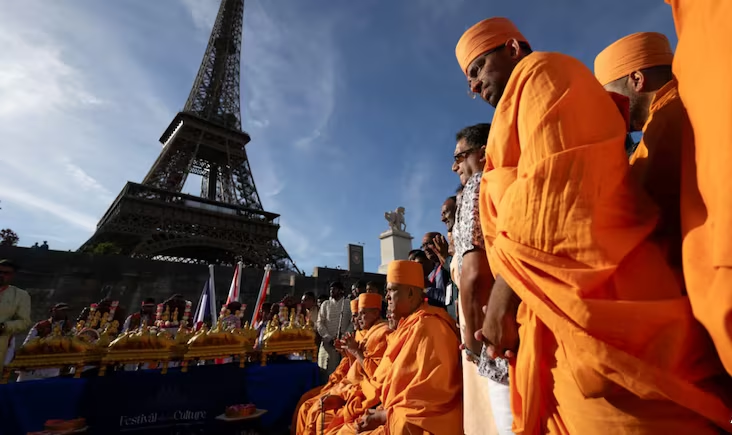
This Image is only for illustrations. Image Credit: NDTV
The Eiffel Tower, one of the world’s most visited monuments, was forced to close on Monday after staff went on strike to protest the alleged “sidelining” and “replacement” of female employees during a private visit by a Hindu religious delegation days earlier, workers and management confirmed.
The dispute stems from a private visit last week by a delegation of about 100 people linked to BAPS (Bochasanwasi Akshar Purushottam Swaminarayan Sanstha), a Hindu religious group whose representatives were in France for festivities related to the inauguration of a temple in the Paris suburbs. In a statement, Eiffel Tower staff condemned “professional instructions that led to female employees being sidelined, replaced, and rendered invisible based on their gender” during the visit by the delegation.
SETE, the operating company that runs the Paris landmark, acknowledged that the Hindu delegation had requested the visit be organized to limit “interactions with women” and said that “these conditions should not have been accepted. ” The conditions “were not in line with SETE’s values, nor with the principles of equality between men and women,” the company said, promising to accept the “consequences.”
Paris Mayor Emmanuel Gregoire said that an investigation would be launched “as soon as possible,” while French equality minister Aurore Berge, far-right presidential candidate Marine Le Pen, and centrist rival Gabriel Attal all condemned the incident as a violation of French republican values.
The BAPS Visit and Management’s Accommodation
The controversy centers on a private visit by a BAPS delegation to the Eiffel Tower on Saturday, September 5, 2026, during normal opening hours. BAPS monks follow an extremely strict celibacy rule and do not interact with women at all, according to the organization’s religious practices.
According to staff union representatives and SETE’s own acknowledgment, the delegation requested that the visit be organized in such a way as to limit “interactions with women.” In response, Eiffel Tower management accommodated the request by issuing instructions to female employees—both direct SETE staff and employees of contractors—to “make themselves invisible” during the delegation’s passage through the monument.
Union representative Diane Davoine told Reuters: “During the visit of this delegation, women were asked to leave their places of work in order to place men there.” Some female employees were asked to leave their posts and withdraw to other areas. At some posts, they were replaced by male employees. All female employees were also instructed not to enter or cross certain areas while the delegation was present, SETE said. This story was also covered by NDTV.
The instructions affected not only SETE’s direct employees but also female staff working for contractors at the monument, amplifying the scope of the discrimination. When the details became known to the broader workforce, anger spread rapidly, culminating in Monday’s strike that forced the tower’s closure.
Official Statements and Political Reactions
SETE’s Acknowledgment: The operating company issued a statement acknowledging the delegation’s request and admitting fault. “The delegation had requested that the visit be organized in such a way as to limit ‘interactions with women,'” SETE told AFP. “These conditions should not have been accepted. They were not in line with SETE’s values, nor with the principles of equality between men and women.” The company promised to accept the “consequences” of its decision, though specific disciplinary measures were not detailed.
Staff Union Statement: In a powerful statement, Eiffel Tower staff condemned the instructions they received. “Instructions were given to female employees of the Eiffel Tower and to female employees of contractors to make themselves invisible in order to welcome this delegation,” the staff said, adding they were “shocked to have been put in such a situation.” “Some were asked to leave their posts and withdraw to other areas. In some posts they were replaced by men. And all female employees were instructed not to go through or cross certain areas while the delegation was present.”
BAPS Response: The Hindu group, which consecrated its first major temple in France on Sunday, near Paris, issued a statement after the protest, saying it respects the concerns raised and takes them seriously. “Given the size of our delegation, the visit was organized in coordination with the Eiffel Tower teams at the start of normal opening hours in order to limit as much as possible any disruption for other visitors. To our knowledge, at no time was access to the Eiffel Tower denied to anyone,” the statement read.
French Political Outrage: The incident drew condemnation from across the French political spectrum. Paris Mayor Emmanuel Gregoire said an investigation would be launched “as soon as possible.” “It is urgent that all light be shed on the facts that led to this protest,” Gregoire wrote on X. French equality minister Aurore Berge also reacted angrily: “In France, we do not ask women to erase themselves. No dogma, no religion is above the laws of the Republic.”
Background
BAPS (Bochasanwasi Akshar Purushottam Swaminarayan Sanstha) is a Hindu denomination within the Swaminarayan tradition, known for its strict monastic code that includes celibacy and avoidance of contact with women for its monks. The organization has built grand temples worldwide, including the recently consecrated facility in the Paris suburbs, which held its inauguration festivities over the weekend.
France’s principle of laïcité (secularism) is enshrined in its constitution and laws, mandating strict separation of religion and state. French republican values emphasize gender equality as a fundamental principle, with laws prohibiting discrimination based on sex in employment and public accommodations. The incident at the Eiffel Tower—a monument owned by the City of Paris and operated by a company with public contracts—raises questions about whether these principles were violated.
The Eiffel Tower receives nearly seven million visitors a year, according to its website, making it one of the world’s most-visited paid monuments. It is operated by SETE, a company owned primarily by the City of Paris, giving the incident added significance as a matter of public governance.
From BAPS Visit to Tower Closure
September 5, 2026 (Saturday): BAPS delegation of about 100 people makes a private visit to the Eiffel Tower during normal opening hours; management instructs female staff to “make themselves invisible.”
September 5–6: Female employees replaced by men at some posts; women instructed not to cross certain areas; details spread among the workforce.
September 7 (Sunday): BAPS consecrates the first major temple in France near Paris; the Eiffel Tower staff learns the full extent of instructions given to female employees.
September 7 (Monday morning): Eiffel Tower staff go on strike; tower closed to visitors; union issues statement condemning gender discrimination.
September 7 (Afternoon): SETE issues a statement acknowledging the delegation’s request, admitting “these conditions should not have been accepted.”
September 7 (Evening): Paris Mayor Emmanuel Gregoire announces investigation; French politicians across the spectrum condemn the incident.
September 7 (Night): BAPS issues a statement offering “sincere apologies” to anyone “hurt or inconvenienced.”
September 8 (Tuesday): The Eiffel Tower reopens as normal; an investigation is ongoing; consequences for management decisions are pending.
Why This Matters
Yeh issue kaafi important hai for multiple reasons. First, it strikes at the heart of gender equality in the workplace. Female employees were told to “make themselves invisible”—a phrase that echoes historical patterns of women being erased from public spaces. In 2026, at one of the world’s most iconic monuments, this is shocking.
Second, the incident tests the limits of religious accommodation in secular societies. France’s laïcité principle is clear: no religion is above the laws of the Republic. Yet, companies often try to accommodate religious practices in the name of customer service or cultural sensitivity. When does accommodation become discrimination?
Third, the economic impact is significant. The Eiffel Tower generates substantial revenue for Paris—closing it for a day costs lakhs of euros in lost ticket sales, concessions, and associated tourism spending. This isn’t just about principles; it’s about money.
For France, a country that prides itself on being the birthplace of universal human rights, this incident is embarrassing. How can France lecture other nations on women’s rights when its own iconic monument asks female staff to “step out of sight”?
India Angle
For Indian readers, this story has multiple layers. On one hand, there’s pride: a Hindu organization building a grand temple in France, attracting delegations, and gaining global recognition. BAPS has invested crores in the Paris temple, showcasing Hindu architecture and culture to the world.
But on the other hand, there’s scrutiny. The incident has drawn international attention to BAPS’s monastic practices, particularly the strict celibacy rules that prohibit monks from interacting with women. While these practices are deeply rooted in Hindu tradition, they clash with Western values of gender equality.
Agar aapko lagta hai ki yeh sirf France ki problem hai, toh sochiye dobara. Indian companies operating globally—IT firms, hotels, airlines—increasingly face similar dilemmas. How do you balance religious practices with workplace equality? The Eiffel Tower incident offers a cautionary tale.
The BAPS apology is significant. By acknowledging concerns and offering “sincere apologies,” the organization is signaling awareness of the sensitivity. But the damage is done—the incident has been covered by major international media, from BBC to NDTV, sparking debates about religion, gender, and cultural accommodation.
Analysis
SETE’s decision was legally and ethically wrong. French law prohibits gender discrimination in employment. By accommodating the delegation’s request to limit interactions with women, SETE violated its own values and French republican principles. There’s no gray area here—this was discrimination, pure and simple.
The “cultural sensitivity” argument doesn’t hold. Yes, BAPS monks follow strict celibacy rules. But visiting a public monument in France means accepting French laws and norms. If you can’t interact with women, maybe you shouldn’t visit mixed-gender workplaces. That’s not intolerance—it’s basic respect for local laws.
The scale of the discrimination is alarming. This wasn’t one or two women asked to step aside. It was systematic: female employees were told to leave posts, replaced by men, and instructed not to cross certain areas. This is institutional sexism, not a minor accommodation.
The political reaction is unanimous—and that’s rare. From far-right Marine Le Pen to centrist Gabriel Attal to equality minister Aurore Berge, everyone condemned the incident. When France’s fractious political class agrees on something, you know it’s serious.
BAPS’s apology is necessary but insufficient. Yes, they apologized. But the damage to their reputation is done. Future visits to Western monuments will now be scrutinized. Religious organizations must understand that global presence comes with global responsibilities.
What Next
In the immediate term (next 1–2 weeks):
Paris investigation: Mayor Gregoire’s office will investigate the circumstances of the visit, including who approved the arrangements and why.
SETE disciplinary action: The company promised to accept “consequences”—likely meaning internal investigations, possible suspensions or dismissals of managers who approved the arrangements.
Union negotiations: Staff unions will likely demand guarantees that such discrimination will not recur, possibly including written policies on religious accommodation.
Media scrutiny: International coverage will continue, with analysis of France’s gender equality laws and religious accommodation policies.
Longer-term (weeks to months):
Policy reforms: SETE and possibly other Paris monuments may revise policies on private visits, religious accommodation, and gender equality in the workplace.
Legal review: French equality authorities may review whether the incident violated anti-discrimination laws, potentially leading to fines or sanctions.
BAPS protocol changes: The organization may develop new guidelines for delegations visiting mixed-gender public spaces in Western countries.
Broader debate: The incident will fuel ongoing debates in France and Europe about laïcité, religious accommodation, and gender equality.
For workplaces globally, the lesson is clear:
No religious accommodation can override gender equality.
Written policies are essential. Companies must have clear guidelines on what accommodations are permissible.
Train managers. Frontline staff need to understand the legal and ethical boundaries.
Listen to employees. When workers protest, management should listen—not dismiss.
Final Thoughts
The Eiffel Tower’s closure on Monday is more than a news story—it’s a symbol. A symbol of what happens when institutions forget their values in the name of accommodation. A symbol of women’s resistance to being “made invisible.” A symbol of France’s commitment to gender equality, even when it’s inconvenient.
SETE admitted it was wrong. BAPS apologized. French politicians condemned the incident. But the real test is what happens next.
Will SETE implement meaningful reforms? Will BAPS develop better protocols for future visits? Will France’s investigation lead to accountability?
For the female employees who were told to “make themselves invisible,” this strike is a victory. They stood up for their dignity, their rights, their place in the workplace. The Eiffel Tower may be made of iron, but it’s the women who made it stand tall again.
Written by A. Jack