The order comes after a one-day plantation drive during which more than one lakh trees and shrubs were planted across Delhi with indigenous species selected for biodiversity. DDA wants officers to be directly responsible for survival rates, not just for the number of trees planted.
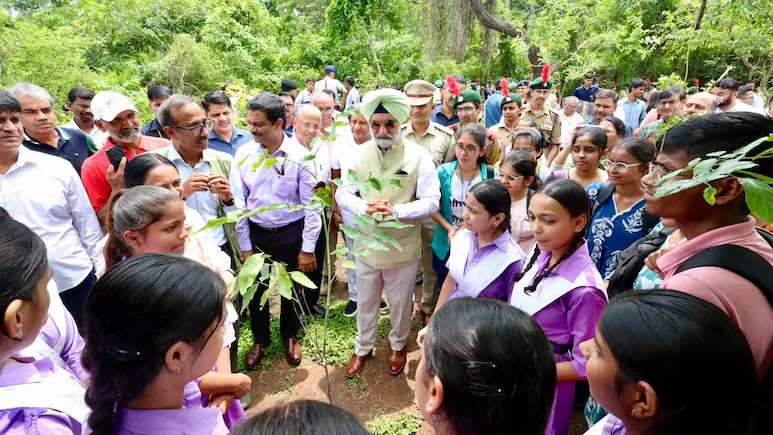
Delhi officials and volunteers plant saplings during a citywide green drive. Image Credit: NDTV
Delhi is moving beyond the culture of one-day plantation drives with a new accountability framework that makes officers directly responsible for the survival of saplings. Lieutenant Governor Taranjit Singh Sandhu has directed the Delhi Development Authority (DDA) to appoint a nodal officer for every plantation site, tasking them with monitoring and ensuring the growth of more than one lakh saplings planted across 77 locations in the capital.
The direction was issued as the DDA conducted a single-day plantation drive on Friday, planting over one lakh trees and shrubs across the city. The move signals a shift from counting how many trees are planted to tracking how many actually survive and mature, a long-standing gap in urban afforestation efforts.
What the new accountability system means
Under the new system, each plantation site will have a designated nodal officer who will be held accountable for the survival of the saplings under their supervision. The DDA said the officers will be responsible for regular monitoring, maintenance and ensuring that the young trees receive adequate water, protection and care. This story was also covered by NDTV.
This is a significant change because, in many past drives, the focus has been on the number of saplings planted rather than their long-term survival. Trees often die due to lack of watering, grazing, encroachment or poor species selection. By making officers answerable for survival, the administration is trying to ensure that the ecological investment actually translates into green cover.
Yeh issue kaafi important hai because planting trees is only the first step; keeping them alive is what truly creates environmental benefits. If officers know they will be held accountable, they are more likely to ensure proper follow-up.
How the plantation drive was conducted
The Lieutenant Governor led the plantation programme at Kamla Nehru Ridge, where around 200 people participated, including college and school students, morning walkers and members of resident welfare associations. The DDA said indigenous species such as Dhok, Amaltas, Dhak and Gamhar were planted at the Ridge. These species were selected for their suitability to Delhi’s ecology and their role in supporting biodiversity.
Simultaneous plantation exercises were held at 76 other locations, including Sanjay Van, Aravalli Biodiversity Park, Aastha Kunj, Dilshad Garden Deer Park and district parks in Hauz Khas, Paschim Puri and Vasant Udyan. Parks and green belts in Narela were also covered. The agency said the trees and shrubs used at the different locations were selected according to site-specific plantation plans, meaning the species were chosen based on soil, water availability and local ecological needs.
Mr Sandhu also visited the Serpentine Lake and Butterfly Conservatory at Kamla Nehru Ridge and reviewed hydrological restoration work being undertaken in the area. That indicates the drive is not just about planting trees but also about restoring ecosystems, including water bodies and habitats for wildlife.
Why this drive is different
The Lieutenant Governor asked the DDA to go beyond one-day plantation exercises and establish a system for the regular maintenance and monitoring of newly planted saplings. He also directed the DDA to conduct such drives regularly and replicate the initiative across other Ridge areas in Delhi.
He said young people should play a central role in the programmes so that future generations become stakeholders in protecting and restoring the Capital’s ecology. That emphasis on youth involvement is important because long-term environmental change requires community ownership, not just government action.
By linking officer accountability to survival rates, the administration is trying to close the gap between planting and nurturing. In the past, many saplings have died within months due to neglect. If officers are answerable, they are more likely to ensure watering schedules, fencing against grazing and protection from encroachment.
Background and context
Friday’s exercise forms part of DDA’s target to plant 23 lakh trees and shrubs under Delhi’s Mission 70 Lakh Plantation. The wider campaign was launched on July 7 under the “Ek Ped Maa Ke Naam” initiative, which encourages citizens to plant trees in honour of their mothers.
The DDA had said earlier in July that it had planted more than 6.62 lakh trees and shrubs across 675 parks, four Ridge zones, six biodiversity parks and several green corridors. The plantation target for Delhi’s Ridge areas during the current season is 181,700 trees and shrubs, according to the agency.
The Ridge is ecologically critical for Delhi, acting as a green lung that helps regulate temperature, support biodiversity and recharge groundwater. Protecting and expanding the Ridge is a key part of the city’s environmental strategy, which is why the Lieutenant Governor has asked for the initiative to be replicated across other Ridge zones.
Timeline
July 7: “Ek Ped Maa Ke Naam” initiative launched under Mission 70 Lakh Plantation.
Early July: DDA reports over 6.62 lakh trees planted across parks, Ridge zones and biodiversity parks.
Friday: Single-day plantation drive plants over one lakh trees and shrubs at 77 locations.
Same day: The Lieutenant Governor directs the DDA to appoint nodal officers for each site and hold them accountable for sapling survival.
Next: Regular monitoring and maintenance to begin; initiative to be replicated across other Ridge areas.
Also Read: Delhi Plans ‘Property Aadhaar Card’ For Every Land Parcel Under New Land Records Bill
Why This Matters
This matters because urban afforestation only works if trees survive. Planting one lakh saplings is impressive, but if half die within a year, the ecological benefit is halved. By making officers accountable, Delhi is trying to ensure that the investment in saplings translates into real green cover.
It also matters because the Ridge and other green zones are under constant pressure from encroachment, construction and pollution. Strengthening these areas with native species can help restore biodiversity, improve air quality and reduce heat stress in the city.
For residents, the impact is direct. More surviving trees mean cleaner air, better shade and healthier neighbourhoods. In simple Hinglish, jab ped zinda rehenge, tabhi hawa saaf hogi aur garmi kam hogi.
India angle
For Indian readers, this story is directly relevant because urban tree plantation drives are common across the country, but survival rates are often low. Many cities announce large numbers of planted trees, but few track how many actually grow.
The India angle also includes the policy innovation. If Delhi’s officer-accountability model works, it could be replicated in other states and cities. That would shift the national conversation from “how many trees were planted” to “how many trees survived.”
There is also the youth angle. By involving students and young volunteers, the drive is trying to build a generation that values and protects green spaces. That is essential for long-term environmental sustainability.
Analysis
My opinion is that the move is a positive step, but its success will depend on enforcement. If officers are truly held answerable for survival rates, it will change how plantation drives are planned and executed. If the accountability is only on paper, the old pattern of high planting and low survival may continue.
I also think the focus on indigenous species is crucial. Native trees like Dhok, Amaltas, Dhak and Gamhar are better adapted to Delhi’s climate and require less water and maintenance. That increases the chances of survival and supports local biodiversity.
What Next
The immediate next step will be the appointment of nodal officers for each of the 77 sites and the creation of monitoring mechanisms to track sapling survival. The DDA will likely develop a reporting system where officers must submit regular updates on watering, fencing and maintenance.
Over the next few months, the survival rates of the saplings will be closely watched. If a high percentage survives, it will validate the new approach. If many die, questions will be raised about implementation and resource allocation.
Longer term, the initiative could be expanded to other Ridge areas and green zones across Delhi. If the model proves successful, it may influence how other cities approach urban afforestation, shifting the focus from planting numbers to survival outcomes.
Conclusion
Delhi’s new directive making officers accountable for the survival of one lakh saplings marks a significant shift in how the city approaches urban afforestation. By linking responsibility to survival rates, the administration is trying to ensure that plantation drives translate into real, lasting green cover.
The single-day drive across 77 locations, with native species and community participation, is a strong start. But the real test will be in the months and years ahead, as the saplings grow and face the challenges of urban life. If Delhi gets this right, it could set a benchmark for other Indian cities to follow.
Written By A. Jack