NSUI president Vinod Jakhar files PIL seeking time-bound hostel development policy and structural and fire-safety audits of private PGs; the court directs MCD to audit all PGs within one week and lists matter for September 25
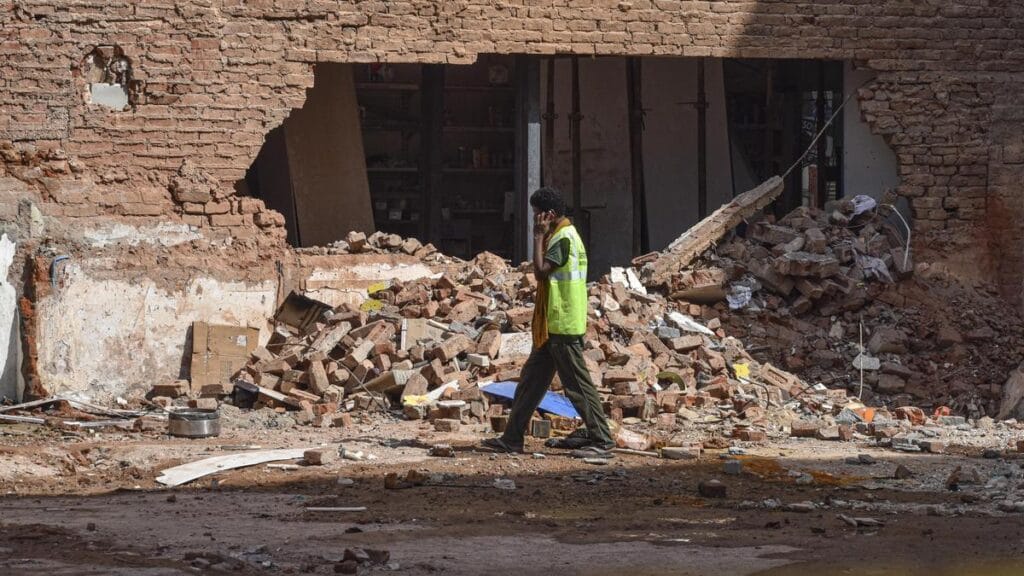
Satya Niketan PG building collapse that killed seven people. Image Credit: The Hindu
The Delhi High Court on Wednesday, September 9, issued notices to the Central government, the Delhi government, and Delhi University (DU) on a Public Interest Litigation (PIL) seeking the formulation of a comprehensive policy to establish safe, affordable, and adequate hostel facilities for students of Delhi University across the Capital, following the September 6 collapse of a multi-story building being used as student PG accommodation at Satya Niketan that killed seven people, including five students.
A Division Bench of Chief Justice Devendra Kumar Upadhyaya and Justice Tejas Karia directed the respondents to file their replies by September 25, when the matter will be taken up for hearing along with another PIL on the same incident seeking an independent probe and formulation of a policy to regulate PG/hostel facilities in the city. The court also directed the Municipal Corporation of Delhi (MCD) to conduct an audit of PGs and hostels within one week to ascertain whether they are operating with valid permissions and in compliance with building bye-laws.
The PIL, filed by National Students’ Union of India (NSUI) president Vinod Jakhar through advocate Vimal Tyagi, raised the issue of an “acute and long-standing shortage of affordable and adequate institutional hostel accommodation for students studying at Delhi University. “The petition sought directions to authorities to undertake a comprehensive college-wise assessment of existing hostel capacity and residential requirements and formulate a phased and time-bound University of Delhi Hostel Development Policy or master plan.
The PIL and the Satya Niketan Tragedy
The PIL was filed in the immediate aftermath of the September 6 collapse of a five-story PG building in Satya Niketan, which killed seven people, including five Delhi University students, and injured several others. The building, operating as “Hostel Daze,” was an illegal structure that had been expanded far beyond permissible limits, with no structural safety certifications or fire-safety clearances. This story was also covered by TheHindu.
The petition argues that inadequate institutional accommodation forces thousands of students to rely on private PGs, rented rooms, and shared apartments, many of which operate in illegal or unsafe structures. With Delhi University’s on-campus hostel capacity meeting only a fraction of student demand, students have no choice but to rent accommodation in areas like Satya Niketan, where illegal construction is rampant and safety oversight is minimal.
Key Demands of the PIL:
College-wise Assessment: Authorities must undertake a comprehensive assessment of existing hostel capacity and residential requirements for each DU college.
Time-Bound Hostel Development Policy: Formulation and implementation of a phased, time-bound University of Delhi Hostel Development Policy or master plan for establishing and expanding adequate, safe, and affordable institutional hostel facilities.
Construction/Expansion of Hostels: Authorities should consider construction or expansion of hostels in colleges having available land.
Cluster Hostels: Where individual colleges face genuine land constraints, common or cluster hostels should be established on suitable government or university land for students of neighboring colleges.
Interim Safety Measures: Pending development of adequate institutional hostel infrastructure, authorities should undertake structural and fire-safety audits of private PGs and student hostels operating around DU colleges and formulate an appropriate registration or periodic inspection mechanism.
The court, while hearing the PIL, also directed DU to provide details of outstation students and available hostel facilities, seeking to understand the scale of the accommodation crisis.
Official Statements and Court Directions
Delhi High Court’s Observations: The bench, while issuing notices, emphasized the urgency of addressing student accommodation safety. Chief Justice Devendra Kumar Upadhyaya and Justice Tejas Karia directed the MCD to conduct an audit of PGs and hostels within one week, seeking to identify illegal structures and safety violations.
The court also directed the respondents—Centre, Delhi government, and DU—to file their replies by September 25, indicating that the matter will be heard urgently along with another PIL seeking an independent probe into the Satya Niketan collapse and formulation of a policy to regulate PG/hostel facilities in Delhi.
NSUI President’s Statement: Vinod Jakhar, NSUI president and petitioner, said, “The acute and long-standing shortage of affordable and adequate institutional hostel accommodation for students studying at Delhi University forces thousands of students to rely on private PGs, many of which operate in illegal or unsafe structures. The Satya Niketan tragedy is a stark reminder of the consequences of this neglect. We seek a time-bound policy to ensure every DU student has access to safe, affordable hostel accommodation.
Advocate Vimal Tyagi’s Submissions: Advocate Vimal Tyagi, representing the petitioner, submitted that since construction of permanent hostel infrastructure would require time, authorities should, as an interim safety measure, undertake structural and fire-safety audits of private PGs and student hostels operating around DU and formulate an appropriate registration or periodic inspection mechanism. He emphasized that students cannot be left vulnerable to illegal builders and negligent PG operators.
DU’s Hostel Crisis and Satya Niketan’s Illegal Construction Epidemic
Delhi University, one of India’s largest universities with over 130,000 students, has long faced an acute shortage of on-campus hostel accommodation. Only a fraction of students—estimated at less than 15-20%—can be accommodated in university hostels, forcing the majority to rely on private PGs, rented rooms, and shared apartments in areas like Satya Niketan, Mukherjee Nagar, Rajendra Nagar, and Hudson Lane.
Satya Niketan, located near Delhi University’s South Campus, has become a hub for student accommodations, with hundreds of PG hostels and rented apartments catering to the university’s large student population. However, the area has also been notorious for illegal construction, with building owners routinely exceeding height limits, adding basements, and converting residential properties into high-density hostels without proper approvals.
The September 6 collapse of the five-story PG building in Satya Niketan exposed the dark underbelly of this unregulated market. The building, operating as “Hostel Daze,” was an illegal structure that had been expanded far beyond permissible limits, with no structural safety certifications or fire-safety clearances. Seven people died, including five students, and several others were injured.
The Delhi High Court’s intervention following the collapse has been a watershed moment. On September 7, the court directed the MCD to conduct a high-level inquiry into the collapse and ordered a comprehensive audit of all PG accommodations and hostels under its jurisdiction within one week. The audit must verify whether PGs operate with valid permissions, comply with building bye-laws, and ascertain the number of students residing in each facility.
From Collapse to Court Notice
September 6, 2026, 1:30 PM (approx.): a five-story PG building collapses in Satya Niketan; seven people killed, including five DU students; several injured.
September 6–7, 2026: 27-hour rescue operation by NDRF, Delhi Fire Service, and Delhi Police; death toll confirmed at seven.
September 7, 2026: Delhi High Court directs MCD to conduct a high-level inquiry into the collapse and orders an audit of all PGs and hostels within one week.
September 8, 2026: NSUI president Vinod Jakhar files PIL in Delhi High Court seeking comprehensive policy for DU hostel facilities and safety audits of private PGs.
September 9, 2026: Delhi High Court issues notices to the Centre, the Delhi government, and DU on PIL; directs respondents to file replies by September 25.
September 9, 2026: Court directs MCD to conduct an audit of PGs and hostels within one week; seeks DU data on outstation students and available hostel facilities.
September 25, 2026 (scheduled): Matter to be heard along with another PIL seeking independent probe and policy to regulate PG/hostel facilities in Delhi.
Why This Matters
Yeh issue kaafi important hai for multiple reasons. First, it exposes the vulnerability of students in private PG accommodations. Thousands of DU students rely on private PGs because university hostels cannot accommodate them. When these PGs operate in illegal, unsafe structures, students’ lives are at risk. The Satya Niketan tragedy is proof.
Second, the PIL highlights institutional accountability. Delhi University has a duty of care towards its students, even when they live off-campus. The university cannot disclaim responsibility by saying PGs are “private” accommodations. When institutional capacity is inadequate, the university must ensure alternative accommodations are safe.
Third, the case tests urban governance. The MCD’s audit of PGs within one week is a massive undertaking. Will it be thorough or superficial? Will violators be penalized or protected? The audit’s credibility will determine whether this becomes a turning point or just another judicial directive.
For Delhi—a city aspiring to be a global education hub—such incidents are a black mark. If the city cannot ensure safe housing for its students, what does that say about its priorities?
India Angle
For readers across India, yeh sirf Delhi ki problem nahi hai—yeh ek national epidemic ban chuka hai. From Mumbai’s PGs to Bengaluru’s hostels, from Chennai’s rented apartments to Kolkata’s student lodges, unsafe student accommodation is a pan-India problem.
Agar aapko lagta hai ki yeh issue sirf DU tak limited hai, toh sochiye dobara. India has over 40 million higher education students, millions of whom live in private accommodations with minimal safety oversight. Universities disclaim responsibility, municipalities lack enforcement, and parents assume the system works. It doesn’t.
The Delhi High Court’s order for a citywide PG audit sets a precedent that other high courts across India may follow. If MCD’s audit reveals widespread violations, it could trigger similar judicial interventions in Mumbai, Bengaluru, Pune, and other cities with large student populations.
The proposed PG regulation framework—including mandatory licensing, police verification, structural stability certificates, fire-safety certification, and compulsory registration—could become a model for other states. If Delhi implements this effectively, it could transform student housing safety across India.
Analysis
The PIL’s demands are reasonable. College-wise assessment, time-bound hostel development policy, and cluster hostels for land-constrained colleges—these are not radical ideas. They’re basic planning measures that should have been implemented decades ago.
The interim safety measures are critical. Structural and fire-safety audits of private PGs, registration mechanisms, and periodic inspections—these can save lives immediately, even before permanent hostels are built. Students cannot wait 5-10 years for hostel construction; they need protection now.
The MCD audit is a test of enforcement capacity. Can the corporation inspect thousands of PGs in one week? Will it have the manpower, technical expertise, and political will to identify violations and take action? Or will this become another box-ticking exercise?
DU’s response will be telling. The university must provide data on outstation students and available hostel facilities. This will reveal the scale of the crisis. If DU admits it can accommodate only 15-20% of students, it must commit to expanding capacity or regulating private alternatives.
The center’s role is often overlooked. The University Grants Commission (UGC) can mandate minimum hostel capacity for universities. The Ministry of Education can fund hostel construction through schemes like RUSA (Rashtriya Uchchatar Shiksha Abhiyan). Will the Centre step up, or will it leave this to the Delhi government and DU?
What Next
In the immediate term (next 1–2 weeks):
MCD audit: Municipal Corporation teams will inspect PGs and hostels across Delhi, documenting compliance status, violations, and occupancy levels.
DU data submission: Delhi University must provide details of outstation students and available hostel facilities to the court.
Government replies: The Centre, Delhi government, and DU must file their replies to the PIL by September 25, outlining their positions and proposed actions.
September 25 hearing: Court will hear the matter along with another PIL seeking an independent probe and policy to regulate PG/hostel facilities.
Longer-term (weeks to months):
Hostel Development Policy: If the court directs, DU must formulate a time-bound Hostel Development Policy or master plan, with specific targets for construction/expansion of hostels.
PG Regulation Framework: The Delhi government may propose mandatory licensing, police verification, structural stability certificates, fire-safety certification, and compulsory registration for all PGs.
Cluster Hostels: Where individual colleges face land constraints, common or cluster hostels may be established on suitable government or university land.
National influence: Other states may adopt Delhi’s model, pressured by public demand for student housing safety.
For students and parents, the advice is clear:
Verify PG safety: Before renting accommodation, check for structural integrity, fire exits, valid licenses, and safety certifications.
Report violations: If you notice illegal construction or safety hazards, report to MCD or Delhi Police immediately.
Demand accountability: Universities and municipalities must be held responsible for ensuring safe student housing.
Stay informed: Follow Delhi High Court proceedings to understand new safety regulations and hostel development plans.
Final Thoughts
The Satya Niketan collapse is not just a tragedy—it’s a failure. A failure of planning, of enforcement, of priorities. Seven young lives were lost because Delhi University couldn’t accommodate them, because MCD didn’t enforce building norms, and because private PGs operated with impunity.
The Delhi High Court’s notice on the PIL is a start. The MCD audit is necessary. But justice for the deceased requires more than notices and audits. It requires systemic change.
Will DU formulate a time-bound Hostel Development Policy? Will MCD enforce building norms? Will the Centre fund hostel construction? Will parents demand safer accommodations?
The answers to these questions will determine whether Satya Niketan becomes a turning point—or just another footnote in Delhi’s long history of preventable tragedies.
For now, the audit begins. Replies are due by September 25. And thousands of DU students continue to live in unsafe PGs, hoping the system will change before another building collapses.
Written By A. Jack