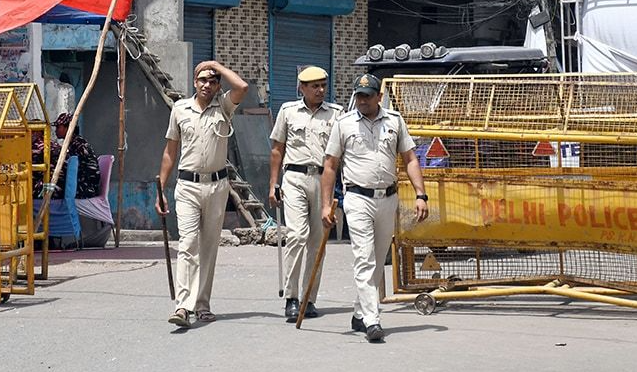
Three truckloads of construction waste dumped to level basement with ground floor; critical load-bearing wall removed for shop space on day of collapse; owner’s son, PG operator, labor contractor sent to 2-day police custody
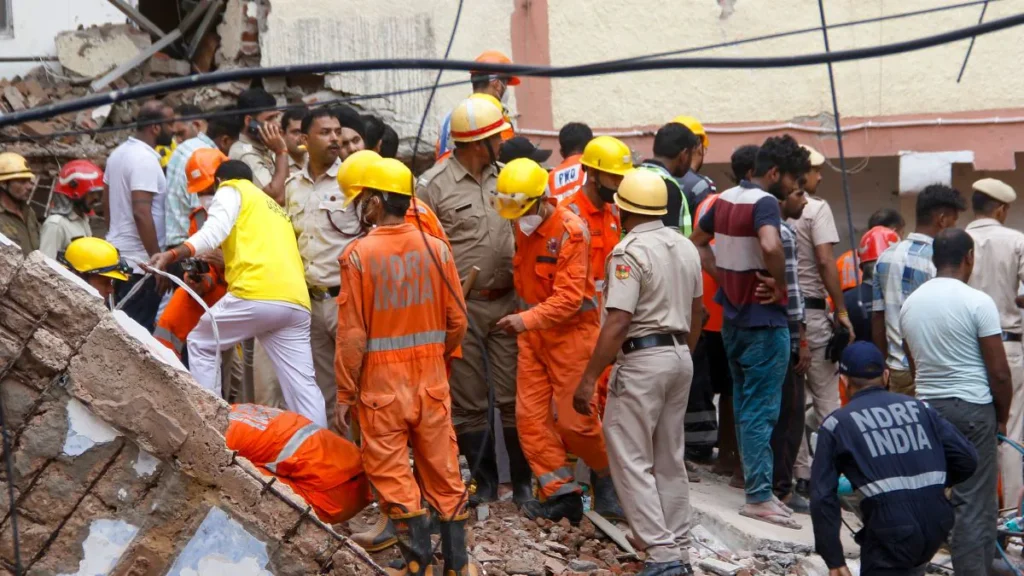
Rescue workers and investigators examine the rubble of the collapsed five-story PG building in Satya Niketan. Image Credit: NDTV
A detailed investigation into the catastrophic building collapse in southwest Delhi’s Satya Niketan has identified two critical factors that led to the 50-year-old structure’s weakening and eventual fall on Sunday, September 6, killing seven people, including five students: the dumping of three truckloads of construction debris in the basement to level it with the ground floor and the removal of a load-bearing wall on the ground floor to create additional space for a shop.
Officials said renovation work had been underway in the building for over a week before the collapse, with water accumulating in the basement and weakening the already fragile structure. In a decision that would prove fatal, the building’s owners decided to eliminate the basement space entirely by filling it with construction debris (malba) and leveling it with the ground floor.
Simultaneously, on the day of the collapse, a wall on the ground floor that was obstructing space intended for a shop was removed, further compromising the building’s structural integrity. “The building could not withstand the load after the wall was removed and ultimately collapsed,” a senior police officer said.
The First Information Report (FIR) in the case has revealed that Hariram Gupta, 81, and his brother built additional floors in the decades-old building despite knowing it was already weak, then handed over operations to others, including Sudhanshu Gupta (also known as Sudhanshu Lovneesh), who marketed it as ‘Hostel Daze’ PG. On Wednesday, the Patiala House Court granted police two days’ custody of Mahesh Gupta (the owner’s son), PG operator Sudhanshu, and labor contractor Sanoj Kumar for further interrogation.
A Deadly Combination of Illegal Renovation and Structural Negligence
The collapse of the five-story building in Satya Niketan was not a sudden structural failure but the result of deliberate, negligent actions taken over the preceding 8-10 days. Police investigations, based on statements from arrested labor contractor Sanoj Kumar and technical assessments, have reconstructed the sequence of events that led to the tragedy.
Basement Renovation Work: According to police, repair work in the basement had been ongoing for 8-10 days before the collapse. The basement, which was part of the original 50-year-old structure, had accumulated water and waste over time, weakening the foundation. Instead of properly draining the water and reinforcing the structure, the owners decided to eliminate the basement entirely. This story was also covered by NDTV.
“The work involved raising the basement level to that of the ground floor, for which around three truckloads of debris had been dumped into the basement,” police said. This debris—construction waste, rubble, and malba—added enormous weight to an already compromised foundation. A 50-year-old building with water damage was not designed to bear the additional load of three truckloads of construction waste.
Wall Removal for Commercial Space: On the day of the collapse, a critical decision was made to remove a wall on the ground floor that was obstructing space intended for a shop. Police investigations suggest this was likely a load-bearing wall, essential for supporting the upper floors.
“The additional load in the basement and the removal of the wall took a toll on the stability of the building and contributed significantly to its collapse,” officials said. When the wall was removed, the building lost a critical support element. Combined with the weight of debris in the basement, this created a perfect storm for structural failure.
Labor Contractor’s Testimony: Sanoj Kumar, the labor contractor arrested from Kasganj, Uttar Pradesh, told police he had been assigned the work by Mahesh Gupta, son of building owner Hariram Gupta. Kumar said he was being paid Rs 2,800 per day to oversee the basement renovation work. His statement confirms that the Gupta family was directly involved in authorizing and supervising the renovation work that ultimately caused the collapse.
Illegal Construction History: The FIR reveals that Hariram Gupta and his brother had built additional floors in the decades-old building despite knowing it was already weak. The building, originally constructed with a basement plus ground floor, was illegally expanded to five stories—far exceeding the permissible height for the Satya Niketan area, which typically allows only three stories.
Official Statements and Arrests
Delhi Police have arrested five people in connection with the collapse: building owner Hariram Gupta (81), his wife Urmila Gupta (75), their son Mahesh Gupta (52), PG operator Sudhanshu Lovneesh (31), and labor contractor Sanoj Kumar (35).
Court Custody Orders: On Monday, a Delhi court sent Hariram and Urmila Gupta to 14 days of judicial custody, while Mahesh Gupta was remanded to two days of police custody. On Wednesday, the Patiala House Court granted police two days’ custody of Mahesh Gupta, PG operator Sudhanshu, and labor contractor Sanoj Kumar for further interrogation.
Judicial Magistrate Kautuk Bharadwaj of Patiala House Court passed the order after Delhi Police sought three-day custody of the three accused. Police need to question them about the sequence of renovation work, financial arrangements, and whether proper structural assessments were conducted before authorizing the basement filling and wall removal.
PG Operator’s Role: Sudhanshu Lovneesh, a Delhi University pass-out who ran seven PG accommodations in and around Satya Niketan, was arrested on Tuesday. Police said Hariram Gupta had hired him around 10 days before the collapse and was paying him Rs 2,800 a day to manage the PG operations. Sudhanshu allegedly left the spot immediately after the collapse, fearing students’ fury and police action.
Labor Contractor’s Arrest: Sanoj Kumar, 35, a resident of JJ Camp, Moti Bagh, and originally from Manikpur village in Bihar’s Banka district, was apprehended in Uttar Pradesh’s Kasganj and brought to Delhi for questioning. He was allegedly overseeing repair work in the basement when the collapse occurred.
Satya Niketan’s Illegal Construction Epidemic and Student Housing Crisis
Satya Niketan, located near Delhi University’s South Campus, has long been a hub for student accommodations, with hundreds of PG hostels and rented apartments catering to the university’s large student population. However, the area has also been notorious for illegal construction, with building owners routinely exceeding height limits, adding basements, and converting residential properties into high-density hostels without proper approvals.
The Gupta family’s building was a textbook example of this illegal construction epidemic. Originally a modest structure, it was illegally expanded to five stories—far exceeding the three-story limit typically permitted in Satya Niketan. Despite knowing the building was weak, the owners continued to add floors and rent rooms to students, prioritizing profit over safety.
The MCD has issued demolition notices for numerous illegal structures in Satya Niketan over the years, but enforcement has been patchy. In many cases, political connections, bureaucratic inertia, and corruption have allowed violators to operate with impunity.
The Delhi High Court’s intervention following the collapse has been a watershed moment. On Monday, the court directed the MCD to conduct a high-level inquiry into the collapse and ordered a comprehensive audit of all PG accommodations and hostels under its jurisdiction within one week. The audit must verify whether PGs operate with valid permissions, comply with building bye-laws, and ascertain the number of students residing in each facility.
From Renovation to Collapse to Arrests
August 27–29, 2026 (approx.): Renovation work begins in the basement of a five-story PG building in Satya Niketan; water and waste accumulate, and owners decide to fill the basement with debris.
September 1–5, 2026: Three truckloads of construction debris dumped in the basement to raise the level to the ground floor; basement renovation work continues.
September 6, 2026, Morning: Wall on ground floor removed to create space for shop; building already weakened by water accumulation and debris load.
September 6, 1:30 PM (approx.): A five-story building collapses suddenly; locals report a “sudden tremor”; immediate rescue efforts begin.
September 6, 2:00 PM–September 7, 5:10 PM: 27-hour rescue operation by NDRF, Delhi Fire Service, and Delhi Police; seven people rescued dead, 12 rescued alive.
September 7, 2026: Delhi Police arrest building owner Hariram Gupta (81) in Bhiwadi, Rajasthan; wife Urmila (75) and son Mahesh (52) arrested in Delhi.
September 7, Evening: Hariram and Urmila were sent to 14 days of judicial custody; Mahesh was remanded to 2 days of police custody.
September 8–9, 2026: Delhi Police arrest PG operator Sudhanshu Lovneesh (31) and labor contractor Sanoj Kumar (35) from Kasganj, UP.
September 9, 2026: Patiala House Court grants police 2-day custody of Mahesh Gupta, Sudhanshu, and Sanoj Kumar for further interrogation.
September 9, 2026: MCD begins demolition of illegal structures in Satya Niketan; Delhi CM Rekha Gupta orders citywide crackdown on illegal PG construction.
September 10, 2026: Supreme Court to hear plea on time-bound inspection and safety audit of PG accommodations across Delhi.
Why This Matters
Yeh issue kaafi important hai for multiple reasons. First, it exposes the deadly consequences of illegal construction in student housing. Seven people died—five of them students—because a 50-year-old building was illegally expanded, negligently renovated, and rented out without safety checks. This wasn’t an accident; it was a preventable tragedy.
Second, the investigation reveals a pattern of criminal negligence. The owners knew the building was weak but added floors anyway. They authorized basement filling with three truckloads of debris despite water damage. They removed a load-bearing wall for commercial space on the day of collapse. Each decision increased the risk; together, they caused catastrophe.
Third, the case highlights the vulnerability of students in private PG accommodations. With limited on-campus hostel capacity, Delhi University students are forced to rely on private PGs, many of which operate in legally dubious conditions. Universities disclaim responsibility, municipalities lack enforcement, and parents assume the system works. It doesn’t.
For Delhi—a city aspiring to be a global capital—such incidents are a black mark. If the city cannot ensure safe housing for its students, what does that say about its priorities?
India Angle
For readers across India, yeh sirf Delhi ki problem nahi hai—yeh ek national epidemic ban chuka hai. From Mumbai’s building collapses to Bengaluru’s illegal layouts, from Chennai’s encroached structures to Kolkata’s aging tenements, Indian cities are riddled with unsafe buildings that violate norms with impunity.
Agar aapko lagta hai ki yeh issue sirf monsoon season tak limited hai, toh sochiye dobara. Climate change is making extreme weather more frequent, and aging infrastructure cannot withstand the stress. What happened in Satya Niketan could happen anywhere—unless systemic reforms are implemented.
The student housing angle is particularly concerning. India has over 40 million higher education students, millions of whom live in private accommodations with minimal safety oversight. Universities often disclaim responsibility, municipalities lack capacity, and parents assume the system works. It doesn’t.
The Delhi High Court’s order for a citywide PG audit sets a precedent that other high courts across India may follow. If MCD’s audit reveals widespread violations, it could trigger similar judicial interventions in Mumbai, Bengaluru, Pune, and other cities with large student populations.
The Supreme Court’s involvement elevates this from a local tragedy to a national issue. On September 10, the apex court will consider issues related to the Satya Niketan collapse, including whether time-bound inspections and safety audits of PG accommodations should be mandated across India. This could lead to nationwide building safety regulations for student housing.
Analysis
The evidence points to criminal negligence. Three truckloads of debris in a water-damaged basement. Removal of a load-bearing wall for commercial space. Illegal floors added to a 50-year-old structure. These aren’t unfortunate accidents; they’re deliberate, reckless decisions.
The owners knew the risks. The FIR states Hariram Gupta and his brother built additional floors “despite knowing that it was already weak. ” This is not ignorance; it’s willful disregard for human life.
The labor contractor’s testimony is damning. Sanoj Kumar said he was paid Rs 2,800 per day by Mahesh Gupta to oversee basement work. This confirms the Gupta family authorized and supervised the renovation that caused the collapse.
The MCD’s enforcement failure is systemic. How did a five-story illegal structure operate for years in a three-story zone? Where were the building inspectors? The High Court’s audit order is necessary, but it should have happened years ago.
What Next
In the immediate term (next 2–7 days):
Police interrogation: Mahesh Gupta, Sudhanshu, and Sanoj Kumar will be questioned about the sequence of renovation work, financial arrangements, and structural assessments.
Technical analysis: Forensic engineers will analyze debris samples, structural remnants, and renovation plans to determine exact failure points.
MCD audit: Municipal Corporation teams will begin citywide inspection of all PG hostels within one week, as ordered by the Delhi High Court.
Demolition drive: MCD has begun demolishing illegal structures in Satya Niketan; CM Rekha Gupta has ordered use of bulldozers against illegal PG construction citywide.
Longer-term (weeks to months):
Chargesheet filing: Police must file a chargesheet within 60-90 days; charges may include culpable homicide, criminal negligence, and violations of building bye-laws.
Trial proceedings: If charges are framed, the case will move to trial, where prosecution must prove guilt beyond reasonable doubt.
Policy reforms: The Delhi government may propose stricter building safety norms, mandatory structural audits for old buildings, and enhanced penalties for illegal construction.
Supreme Court intervention: The Apex court may issue nationwide guidelines for PG safety audits, building inspections, and student housing regulations.
For students and parents, the advice is clear:
Verify building safety: Before renting PG accommodation, check for structural integrity, valid permissions, and occupancy limits.
Demand accountability: Universities and municipalities must be held responsible for ensuring safe student housing.
Stay informed: Follow Delhi High Court and Supreme Court proceedings to understand new safety regulations.
Final Thoughts
The collapse of Hostel Daze in Satya Niketan is not just a tragedy—it’s a failure. A failure of governance, of enforcement, of priorities. Seven young lives were lost because a 50-year-old building was illegally expanded, negligently renovated, and rented out without safety checks.
The arrests of Hariram, Urmila, Mahesh Gupta, Sudhanshu Lovneesh, and Sanoj Kumar are a start. The MCD audit ordered by the High Court is necessary. But justice for the deceased requires more than arrests and inquiries. It requires systemic change.
Will Delhi learn from this? Will MCD finally enforce building norms? Will universities take responsibility for student housing? Will parents demand safer accommodations?
The Supreme Court’s hearing on September 10 will be a critical moment. If the apex court mandates nationwide safety audits for student housing, it could save thousands of lives. If it issues strong guidelines on illegal construction enforcement, it could transform urban governance.
For now, rescue teams have packed up their equipment. Families mourn their losses. And seven students will never return home.
Written By A. Jack