SC issues notice on PIL arguing Jantar Mantar is no longer fit for protests due to access, movement and supply disruptions, even as recent NEET and CJP agitations highlight the site’s continuing political significance.
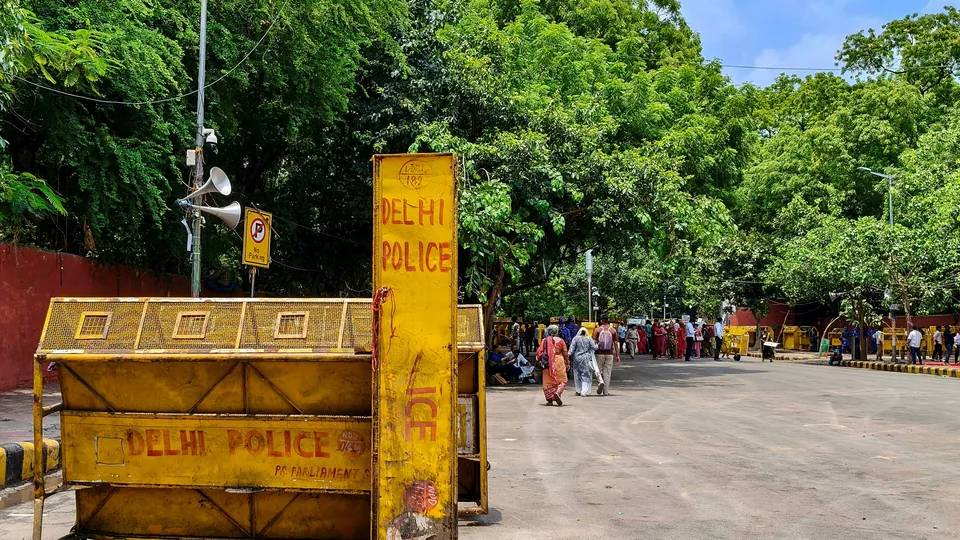
Jantar Mantar in central Delhi, the designated protest site, is now under scrutiny as the Supreme Court hears a PIL questioning. Image Credit: Hindustan Times
The future of protests at Jantar Mantar, Delhi’s iconic and long-standing demonstration site, is now under judicial scrutiny. The Supreme Court on Monday agreed to hear a public interest litigation (PIL) claiming that Jantar Mantar is no longer a suitable protest site because agitations there cause inconvenience to local residents and disrupt the supply of essential products. A bench comprising Chief Justice Surya Kant and Justices Joymalya Bagchi and V Mohana issued notices to the Centre and other respondents on the plea filed by Satish Chand Kaushik, seeking alternative arrangements for agitations in the national capital.
The bench asked Solicitor General Tushar Mehta to take instructions on the PIL and reply to the plea. During the hearing, the CJI noted that the petition raises concerns related to access and movement in the area, including the supply of medical essentials. “It has been stated in the plea that Jantar Mantar is not a proper site anymore for such protests due to ingress and egress issues. Supply of medical essentials, etc. I think this is important… Please take instructions, Mr Solicitor. Issue notice and list this separately,” the CJI said, according to news agency PTI.
Why the plea claims Jantar Mantar is no longer suitable
The PIL argues that Jantar Mantar, located in the heart of New Delhi near Parliament Street and Connaught Place, has become impractical for large-scale protests due to persistent ingress and egress issues. The petitioner contends that frequent agitations block key roads, affect local residents and disrupt the supply of essential products, including medical supplies, to nearby areas. This story was also covered by The Hindustan Times.
The counsel for the petitioner also referred to a proposed political march, submitting that Aam Aadmi Party chief Arvind Kejriwal “called a town hall and decided to march to the Prime Minister’s residence,” and saying that “another July 20 incident should be avoided.” The top court declined to comment on the proposed event. However, CJI Surya Kant said, “They know how to handle it. If they cannot, come to us for mishandling. I am sure they will handle it.”
The plea seeks alternative arrangements for protests that do not choke central Delhi’s traffic and residential zones while still preserving the fundamental right to peaceful assembly. It suggests that the government identify other designated sites with better infrastructure, wider approach roads and less impact on daily life.
Yeh issue kaafi important hai because it touches on the balance between the right to protest and urban liveability in a crowded capital.
Recent protests that kept Jantar Mantar in the spotlight
Jantar Mantar, located in the heart of the national capital, recently witnessed massive protests against the NEET-UG paper leak. The agitation, led by the Cockroach Janta Party (CJP) and climate activist Sonam Wangchuk, saw a sea of students and even their families protesting against the irregularities in the exam system and the NEET paper leak.
Wangchuk was on a hunger strike for several days before being taken to a hospital as his health condition severely deteriorated. The mass movement, with key faces including CJP founder Abhijeet Dipke, spokespersons Saurav Das and Ashutosh Ranka, and AISA’s Noha Bora, demanded the resignation of the education minister.
CJP’s proposed protest march to the Parliament on July 20 turned chaotic amid lathi-charge and use of tear gas. The alleged excesses of the security forces also led to some protesters getting critically injured. The protest was called off by Dipke on July 25 after Dharmendra Pradhan resigned as the education minister and the Centre agreed to fulfil the demands of the protesters. A deserted Jantar Mantar, the next day, was cleaned up by the New Delhi Municipal Council.
These high-profile agitations have reinforced Jantar Mantar’s status as the default protest site in Delhi, but they have also intensified debates over whether the location can sustainably handle large crowds without disrupting the city.
Background and context
Jantar Mantar has been the designated protest site in Delhi for decades, chosen for its proximity to Parliament and central government offices. It was meant to provide a space where citizens could exercise their right to peaceful assembly without shutting down the entire capital.
Over the years, however, the site has hosted some of the country’s most visible movements—from farmers’ protests to anti-rape agitations to student demonstrations. As protests have grown in size and duration, local residents and businesses have increasingly complained about noise, traffic snarls, garbage accumulation and security cordons that affect daily life.
The Supreme Court and Delhi High Court have previously heard cases on protest rights in Delhi, balancing fundamental freedoms with public order and urban management. The latest PIL adds to that jurisprudence by questioning whether Jantar Mantar remains fit for purpose in a rapidly growing city.
Timeline
Past decades: Jantar Mantar was designated as the primary protest site in central Delhi due to its proximity to Parliament.
Recent years: Large-scale agitations on farmers’ rights, women’s safety, education and other issues increase pressure on the site.
July 2026: CJP and Sonam Wangchuk lead massive NEET-UG paper leak protests at Jantar Mantar; July 20th March turns chaotic with lathi-charge and tear gas.
July 25, 2026: Protest called off after education minister’s resignation; Jantar Mantar cleaned by NDMC.
Monday, August 2026: Supreme Court agrees to hear PIL claiming Jantar Mantar is no longer suitable; issues notice to Centre, seeks alternative protest arrangements.
Also Read: Delhi High Court Orders Sterilisation Camps For Stray Dogs in Pilot “One Ward, One Camp” Drive
Why This Matters
This matters because it goes to the heart of democratic rights in an urban setting. The right to peaceful protest is a fundamental freedom, but in a densely populated city like Delhi, it can clash with residents’ right to movement, health and livelihood. If Jantar Mantar is deemed unsuitable, the court and government will need to identify alternative sites that are accessible, visible and logistically viable.
It also matters for how future agitations are managed. The July 20 clash between protesters and security forces raised serious questions about crowd control, use of force and dialogue mechanisms. If the protest site is shifted or restructured, it could change how demonstrations are planned, policed and perceived.
For students, activists and ordinary citizens, Jantar Mantar has symbolic value as a space where dissent is visible to power. Any move to dilute that could be seen as curbing protest rights, even if the stated goal is better urban management. In simple Hinglish, jab protest ka jagah badalta hai, toh uska asar bhi badal jaata hai.
India angle
For Indian readers, this story is directly relevant because Jantar Mantar is not just a Delhi issue; it is a national symbol of protest. Movements from every corner of the country converge there to make their voices heard in the capital.
The India angle also includes the legal dimension. The Supreme Court’s handling of this PIL will set a precedent for how protest spaces are designated and regulated in other major cities like Mumbai, Bengaluru and Chennai, where similar tensions between demonstrators and residents exist.
There is also the governance angle. Identifying alternative protest sites requires coordination between the Centre, the Delhi government and municipal bodies. If done poorly, it could lead to more conflicts; if done well, it could become a model for other urban centres.
Analysis
My opinion is that the court is right to examine whether Jantar Mantar remains suitable. The site’s location is both its strength and its weakness: close to power, but also close to critical infrastructure and residential zones.
I also think any alternative arrangement must preserve visibility and accessibility. If protesters are shifted to a remote location with no media or public access, it could effectively mute dissent. The goal should be to manage impact, not to marginalise protest.
What Next
The immediate next step will be the Centre’s response to the Supreme Court’s notice. The Solicitor General will take instructions from the government and file a reply outlining existing protest policies, security assessments and any proposed alternative sites.
The court may also seek inputs from the Delhi government, New Delhi Municipal Council and police on traffic impact, crowd management and resident complaints. If the plea gains traction, the bench could direct a committee to identify and develop alternative protest locations.
Longer term, the outcome could reshape how protests are organised in Delhi. If new sites are designated, activists will need to adapt their strategies. If Jantar Mantar remains the primary site, stricter regulations on duration, size and cleanup may follow.
Conclusion
The Supreme Court’s decision to hear a PIL questioning the suitability of Jantar Mantar as a protest site marks a significant moment in the ongoing debate over dissent, urban space and public order in Delhi. While the petition highlights genuine concerns about access, movement and essential supplies, any shift away from Jantar Mantar must safeguard the visibility and effectiveness of peaceful protest.
Recent agitations, from the NEET-UG paper leak movement to proposed political marches, have shown that Jantar Mantar remains a powerful stage for democratic expression. The court’s challenge is to ensure that this right is preserved without unduly disrupting the life of the capital. What happens next could define the future of protest in India’s most symbolic public space.
Written By A. Jack