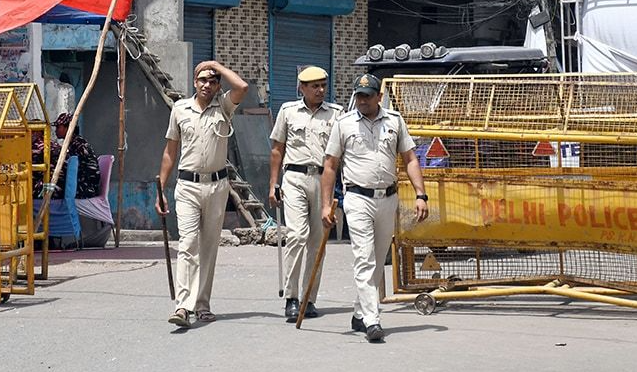
Kamal Singh allegedly killed his wife Komal in Delhi’s Jagatpuri after their children left home, withdrew Rs 7 lakh and tried to escape to Nepal, but was arrested after CCTV and technical surveillance traced his route.
Police recover the blood-stained pair of scissors from the centre table at the Jagatpuri crime scene in Delhi. Image Credit: NDTV
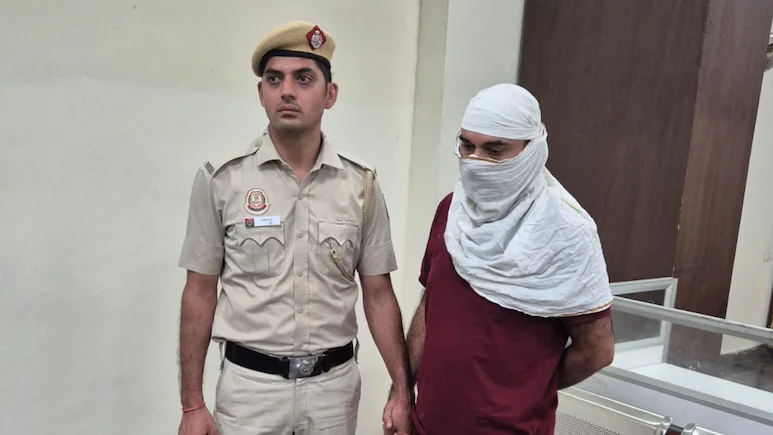
In a chilling case that has shocked Delhi’s Jagatpuri neighbourhood, a man has been arrested for murdering his wife by stabbing her multiple times with a pair of scissors, allegedly after ensuring their children were out of the house. The accused, 52-year-old Kamal Singh, was taken into custody near the Mathura railway station in Uttar Pradesh, five days after the killing, as he attempted to flee the city.
According to officials from the Shahdara District Police, a PCR call was received from the victim’s son, Gaurav, at the Shahdara Police Station, following which a team of cops reached the crime scene. The caller stated that his father had murdered his mother, Komal, while he and his sister were away. Police found the victim lying in a pool of blood near the sofa in the living room of the house, while the suspected murder weapon—a blood-stained pair of scissors—was recovered from the centre table.
Why and how the murder happened
During interrogation, Kamal Singh revealed that he was influenced by the Hollywood series The Staircase while committing the murder and trying not to get arrested. He confessed to premeditating the murder of his wife due to a property dispute, and he wanted to have all control over the property.
The police investigation pieced together the sequence of events on the day of the crime. According to the complainant, Gaurav, he had left for a library in Noida around 9:30 am, while his sister had left for work around 10:30 am. Before leaving, they had witnessed an argument between their parents. Throughout the day, the children called their mother several times but received no response. This story was also covered by NDTV.
Gaurav returned home around 9:15 pm. When he opened the flat with his key, he found his mother’s blood-soaked body near the sofa. He immediately informed the police, who launched a manhunt for Kamal Singh.
Officials at the Jagatpuri Police Station deployed 10 teams to trace the accused and pinpoint his likely escape routes. According to Joint CP (Eastern Range) Ajit Singla, police found in the CCTV footage that the children had left the house, and only Singh and his wife remained there. The footage also showed the accused leaving with something concealed in a bag.
During the investigation, the police discovered that the accused had withdrawn approximately Rs 7 lakh from his bank accounts before fleeing. Technical surveillance traced his location from Delhi towards Gorakhpur. Police say he initially planned to escape to Nepal but later changed his route to Mathura to mislead investigators.
Statements from police and accused
During interrogation, Kamal Singh told police that he had purchased the scissors used for the killing from Hari Nagar beforehand. After the incident, he attempted to hide and dispose of the weapon to destroy evidence. His admission that he was influenced by The Staircase suggests he had studied how criminals in fiction try to evade detection, though his actual execution was far from flawless.
Joint CP Ajit Singla emphasised that the swift use of CCTV analysis, technical surveillance and informant networks helped narrow down Singh’s movement and led to his arrest near Mathura. “He thought he could disappear, but modern policing does not allow such easy escape,” a senior officer said.
Yeh issue kaafi important hai because it shows how a premeditated crime, driven by property greed and pop-culture inspiration, can shatter a family in hours.
Background and context
Domestic violence and property-related murders are unfortunately not rare in India, but the specific details of this case—timing the crime when children are away, withdrawing large sums of money, and citing a TV series as inspiration—make it stand out.
The Staircase, a true-crime docuseries and dramatised adaptation, revolves around a man accused of killing his wife under suspicious circumstances. It has been widely watched in India and has sparked debates about how media portrayals of crime can influence real-life behaviour. While there is no evidence that Singh followed the series step-by-step, his confession indicates that he saw it as a guide for planning and evasion.
The Jagatpuri area, in eastern Delhi, is a mixed residential and industrial locality where property disputes often turn acrimonious. Police say that Singh and his wife had been in conflict over ownership and control of assets, which escalated into a fatal confrontation when the opportunity arose.
Timeline
Morning, July 31: Children leave home—son to Noida library at 9:30 am, daughter to work at 10:30 am; parents argue before they leave.
Daytime: Kamal Singh allegedly stabs wife Komal multiple times with scissors in the living room and withdraws around Rs 7 lakh from bank accounts.
Evening, 9:15 pm: Son returns, finds mother’s body, calls police; PCR call logged at Shahdara Police Station.
Next five days: Police deploy 10 teams, analyse CCTV, and trace technical signals; the accused moves from Delhi towards Gorakhpur, then changes route to Mathura.
Five days later: Kamal Singh was arrested near Mathura railway station in UP while trying to flee; scissors were recovered from the crime scene.
Also Read: Man Stabbed to Death, Woman Injured in Delhi Park Altercation; Minor Detained
Why This Matters
This matters because it highlights how property disputes within families can turn deadly when one party is determined to seize full control. It also shows the vulnerability of women in domestic settings, where arguments over assets can escalate into fatal violence.
It matters for policing too. The use of CCTV footage, bank transaction trails and technical surveillance to track the accused demonstrates how modern investigative tools can close cases faster, even when the suspect tries to mislead investigators.
For society, the case is a grim reminder that entertainment media can sometimes blur the line between fiction and reality. In simple Hinglish, jab koi insaan crime ko strategy samajhne lagta hai, toh natija aisa hi hota hai.
India angle
For Indian readers, this story is directly relevant because property-related family conflicts are common across the country. From Delhi to Uttar Pradesh to Bihar, disputes over land, houses and inheritance frequently lead to litigation and, in some cases, violence.
The India angle also includes the influence of global media. The Staircase is an international series, but its reach in India via streaming platforms means that its narratives can seep into local consciousness. While most viewers consume it as entertainment, a small subset may draw dangerous lessons.
There is also the legal dimension. India’s criminal justice system is already overburdened. High-profile cases like this put pressure on police to deliver swift arrests and on courts to ensure fair, speedy trials.
Analysis
My opinion is that while Singh’s claim of being inspired by The Staircase is attention-grabbing, the core motive remains property greed. The series may have given him a false sense of sophistication in planning, but basic investigative work still caught him.
I also think the timing of the crime—after children left—shows a cold calculation. It suggests that Singh knew the risk of witnesses and chose what he thought was the perfect window. That premeditation will likely be a key factor in how the case is prosecuted.
What Next
The immediate next step will be the filing of a chargesheet by the Delhi Police, outlining the evidence collected: CCTV footage, bank withdrawal records, witness statements from the children, recovery of the scissors and the accused’s confession. The case will then move to court, where Singh will face trial for murder, destruction of evidence and related offences.
The children of the victim will likely be involved as key witnesses, and their testimony will be crucial in establishing the timeline and the nature of the parental dispute. The property in question may also become part of civil litigation among family members.
Longer term, this case could be cited in discussions about media influence on crime, though it is unlikely to lead to any formal restrictions on streaming content. The focus will remain on ensuring that the legal process delivers justice for Komal and her family.
Conclusion
The arrest of Kamal Singh for the murder of his wife Komal in Delhi’s Jagatpuri area has exposed a dark intersection of property greed, domestic conflict and pop-culture influence. By allegedly timing the crime after their children left home, withdrawing Rs 7 lakh and attempting to flee, Singh thought he could escape justice, but CCTV, technical surveillance and informant tips led to his capture near Mathura.
His confession that he was inspired by The Staircase adds a disturbing layer to an already tragic case, but the core issue remains a family torn apart by a fight over assets. As the case moves to court, the focus will be on ensuring that the legal system holds the accused accountable and that the victim’s children receive justice and support.
Written By A. Jack