Shaheen Khan and Nafisa Khan of 4PM News Network allege brutal assault after questioning CM Rekha Gupta; Press bodies demand probe as cops cite VVIP security
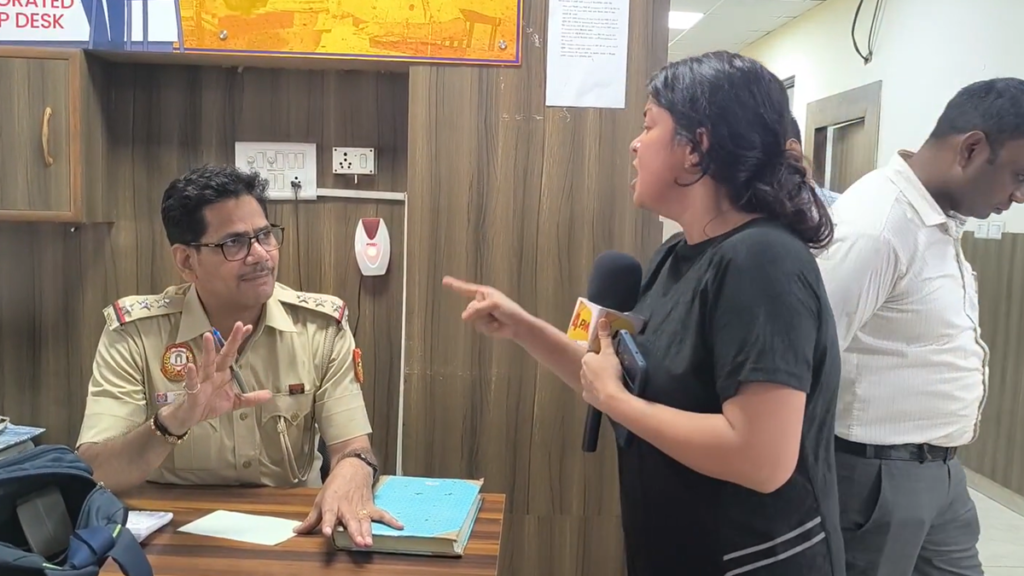
Journalist Shaheen Khan shows visible bruises on her arm while reporting from Saket Police Station in New Delhi on September 3, 2026. Image Credit: The Hindu
New Delhi, September 3, 2026—Two women journalists working for the digital news platform 4PM News Network have alleged they were detained, slapped, and beaten with sticks by Delhi Police personnel inside Saket Police Station after attempting to question Delhi Chief Minister Rekha Gupta about an alleged “cycle scam” at an event attended by Union Home Minister Amit Shah.
Shaheen Khan and Nafisa Khan, both freelance reporters, said they were covering the inauguration of a new wing at Max Hospital in Saket on Thursday when police forcibly removed them from the venue, took them to the police station, and assaulted them in a closed room. In a viral video posted by 4PM News Network, Shaheen Khan can be seen reporting from the police station with visible bruises on her arms, while Nafisa Khan showed injury marks on her leg and appeared semi-conscious with red bruises on her thigh.
The journalists alleged that the assault intensified after police personnel learned their surnames were “Khan” and realized they were Muslim. “Muslim hai? Do dande aur maro” (She’s Muslim? Hit her with two more sticks), a female police constable allegedly said before escalating the violence, according to the journalists’ account.
The Incident Unfolds
According to Shaheen Khan’s video statement, the incident began when she attempted to ask Chief Minister Rekha Gupta a question about an alleged “cycle scam” linked to the Delhi government during the hospital inauguration event. She said Delhi Police constables immediately “caught hold of her” and dragged her out of the venue while beating her, then took both her and Nafisa Khan to Saket Police Station.
Once inside the station, the journalists allege they were taken to a room where a female police constable wearing pink clothes assaulted them with sticks and slaps. Shaheen Khan claimed her phone was snatched, and when her brother called her, police saw “Khan” in his contact name and began assaulting them with “even greater force.” This story was also covered by TheHindu.
Sanjay Sharma, Editor-in-Chief of 4PM News Network, confirmed the allegations in an interview. “I have spoken to them and they have said that the police have brutally assaulted them with sticks and slaps, and the force used by the police intensified when they came to know Shaheen and Nafisa are Muslim,” he said. Sharma added that since their platform posted a video about the “cycle scam” and an interview with AAP leader Saurabh Bhardwaj, they had been facing “constant harassment from the government.”
Delhi Police Deny Assault Allegations
Delhi Police have categorically denied the allegations, calling them “factually incorrect, misleading and baseless.” In an official statement, Deputy Commissioner of Police (South) Anant Mittal said the two women had obstructed a designated VVIP route by parking their scooter near the venue and refused to move the vehicle despite repeated requests.
“In view of the security and safety protocol of the VVIP route, both women were taken to the local police station for further inquiry,” DCP Mittal said. He added, “Claims suggesting otherwise, including allegations of assault for asking questions to the Hon’ble Chief Minister, are totally false, misleading and baseless.”
However, the police statement did not address the specific allegations of physical assault, identity-based slurs, or the visible injuries shown by the journalists in their video. When asked by reporters whether illegal parking justified the level of force alleged, Sanjay Sharma responded, “Even if the issue were illegal parking, does that call for such brutal violence?”
The ‘Cycle Scam’ Controversy and Press Freedom Concerns
The “cycle scam” reference stems from an earlier video posted by 4PM News Network that allegedly exposed irregularities in a Delhi government scheme involving cycle distribution. According to Sharma, their platform has faced “suppression from the BJP governments earlier, where we had to take a legal course to save our organization.”
This incident comes amid growing concerns about press freedom in India. The Press Club of India, Indian Women’s Press Corps (IWPC), Delhi Union of Journalists (DUJ), Press Association, and Kerala Union of Working Journalists issued a joint statement condemning the alleged assault and calling for punitive action against Delhi Police officials posted at Saket Police Station, including the Station House Officer (SHO).
The statement alleged that upon reaching the police station, “the SHO allegedly instructed police officials to take the two journalists to a room, where women officers also joined, and started beating Shaheen and Nafisa.” It further claimed that police officials “determined their religious identity and escalated their attacks, reportedly hurling religion-specific abuses at the two.”
Key Events in the Saket Police Station Assault Case
September 3, 2026 (Morning): Shaheen Khan and Nafisa Khan arrive at Max Hospital, Saket, to cover the inauguration of a new wing by Union Home Minister Amit Shah and Delhi CM Rekha Gupta.
September 3 (During event): Shaheen Khan attempts to ask CM Gupta about an alleged “cycle scam”; police constables forcibly remove both journalists from the venue.
September 3 (Afternoon): Journalists taken to Saket Police Station; allege they were beaten with sticks and slaps in a closed room by female constables; assault reportedly intensified after police learned they were Muslim.
September 3 (Evening): 4PM News Network posts a video of Shaheen Khan reporting from a police station showing bruises; the video goes viral on social media.
September 3 (Night): The Press Club of India and other journalist bodies issue a joint statement condemning the assault and demanding a probe and action against the SHO.
September 4 (Morning): Delhi Police issue official denial, claim journalists obstructed VVIP route with illegally parked scooter; call assault allegations “false, misleading and baseless.”
September 4 (Ongoing): Both journalists are reportedly not in a condition to give formal statements; Editor-in-Chief Sanjay Sharma says the platform is planning legal action.
Why This Matters
Yeh issue kaafi important hai for three critical reasons. First, it strikes at the heart of press freedom—a journalist’s right to question public officials without fear of retribution. If asking a chief minister about an alleged scam can lead to detention and assault, what does that say about the state of democracy?
Second, the allegations of identity-based violence raise serious concerns about communal bias within law enforcement. If police personnel are indeed using religious identity as a trigger for escalated violence, this is not just a press freedom issue—it’s a fundamental rights crisis. The alleged remark “Muslim hai? Do dande aur maro” is deeply disturbing and demands immediate investigation.
Third, this incident highlights the vulnerability of digital journalists and freelance reporters who often lack institutional protection. Unlike mainstream media houses with legal teams and press accreditations, independent journalists working for YouTube channels or small digital platforms are easy targets for intimidation.
India Angle
For readers across India, yeh sirf Delhi ki problem nahi hai—yeh ek national pattern ban chuka hai. From Kashmir to Manipur, journalists face increasing pressure, harassment, and even violence for doing their jobs. The 2026 World Press Freedom Index ranked India 159th out of 180 countries, reflecting a steady decline in media independence over the past decade.
Agar aapko lagta hai ki yeh issue sirf opposition supporters ko affect karta hai, toh sochiye dobara. Press freedom is not about which party is in power—it’s about whether citizens can hold power accountable. When journalists are beaten for asking questions, every Indian loses the right to know what their leaders are doing.
The Saket incident also intersects with broader debates about minority rights and police reform. Multiple National Human Rights Commission reports have flagged concerns about custodial violence and communal bias in policing. Yet, accountability remains elusive, and impunity continues.
Analysis
The Delhi Police’s VVIP security argument doesn’t hold up under scrutiny. Even if the journalists did park illegally (which they dispute), the appropriate response is a fine or vehicle removal—not detention, and certainly not assault. The fact that police felt comfortable beating two women inside a police station, in a closed room, suggests a culture of impunity that goes beyond individual bad actors.
The religious identity angle is particularly alarming. If the allegations are true—and the visible injuries lend them credibility—this is not just police brutality; it’s hate-motivated violence by state actors. That should trigger not just a departmental inquiry but a criminal investigation under relevant sections of the IPC and SC/ST (Prevention of Atrocities) Act provisions that cover hate crimes.
From a journalistic standpoint, the video evidence posted by 4PM News Network is crucial. In an era of “fake news” accusations, having timestamped, geolocated video of injuries and first-person testimony makes denial harder. But it also puts the journalists at further risk—retaliation against whistleblowers is a well-documented phenomenon.
The involvement of multiple press bodies—Press Club of India, IWPC, and DUJ—shows this isn’t being treated as an isolated incident. When the entire journalistic fraternity unites around a case, it sends a signal that this is a red-line issue.
What Next
In the immediate term (next 7–14 days):
Medical documentation: Both journalists are expected to undergo formal medical examinations to document injuries, which will be critical for any legal case.
FIR filing: 4PM News Network has indicated plans to file an FIR against the involved police personnel; legal teams are preparing complaints under IPC sections for assault, wrongful confinement, and intimidation
Police inquiry: Delhi Police Commissioner Anurag Kumar faces pressure to order a “free and fair investigation” as demanded by press bodies; an internal inquiry may be announced within days.
Press Council intervention: The Press Council of India has been urged to take suo motu cognisance and conduct an independent probe; a notice may be issued to Delhi Police.
Longer-term (weeks to months):
Legal proceedings: If an FIR is registered, the case could move to court, where CCTV footage from Saket Police Station (if available) and witness testimonies will be scrutinized.
Policy debate: The incident may reignite parliamentary and civil society debates on press freedom protections, police reform, and anti-discrimination safeguards for journalists.
Platform vulnerability: Independent digital news outlets may push for collective security mechanisms, legal defense funds, and press accreditation reforms to protect freelance journalists.
Political fallout: Opposition parties, particularly AAP, may use this incident to question the BJP-led Delhi government’s commitment to press freedom and minority rights ahead of upcoming elections.
Final Thoughts
The alleged assault on Shaheen Khan and Nafisa Khan is more than a news story—it’s a stress test for Indian democracy. Can journalists question power without fear? Can minority citizens expect equal treatment from law enforcement? Can accountability mechanisms work when the accused are state actors?
The visible injuries, the viral video, and the unified condemnation from press bodies make this case harder to ignore than many before it. But the real question is whether this leads to meaningful change—or just another inquiry that gathers dust while the same patterns repeat.
For now, Shaheen Khan and Nafisa Khan’s bruises are a stark reminder of the cost of asking questions in today’s India. Whether those bruises become catalysts for reform or just fade with time depends on what happens next—and who is watching.
Written By A. Jack