Orange Alert issued for three districts; 12 dead in rain-related incidents as Nainital records 217 mm rainfall
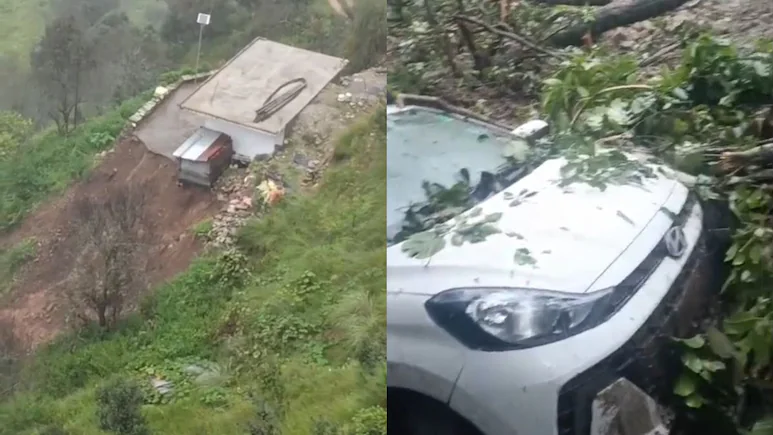
Fresh landslides triggered by relentless monsoon rains in Nainital’s Dhari tehsil have put multiple homes at risk in Pokhrad and Churigaad villages. Image Credit: NDTV
Nainital, September 3, 2026 — Heavy rainfall continues to batter Nainital and surrounding areas in Uttarakhand, triggering fresh landslides that have put homes at risk in the villages of Pokhrad and Churigaad in Dhari tehsil. In Pokhrad, the landslide has endangered three houses, while in Churigaad, debris piled up behind a home, sending water and mud into the house and an adjacent cowshed, damaging walls and allowing large amounts of water and debris to enter both structures.
District officials moved quickly upon learning of the damage, evacuating affected families to safer locations. No injuries to people or animals were reported in either incident, but authorities remain on high alert as the Meteorological Department has issued an Orange Alert for heavy to very heavy rain in three districts—Dehradun, Nainital, and Bageshwar—through Wednesday.
The Perfect Storm Behind the Landslides
The landslides in Pokhrad and Churigaad are a direct consequence of extremely heavy rainfall over the past 48 hours, with Nainital district recording some of the highest precipitation figures in the state. According to data from the State Emergency Operations Centre (SEOC), Nainital city received 217 mm of rain in 24 hours, while nearby areas like Bhimtal (161 mm), Mukteshwar (140 mm), Haldwani (122 mm), and Dhari itself (114 mm) also saw very heavy to extremely heavy rainfall. This story was also covered by NDTV.
When saturated soil meets steep Himalayan slopes, the risk of landslides increases dramatically. The geology of the Kumaon region—characterized by fragile sedimentary rocks, loose soil, and deforested patches—makes it particularly vulnerable during intense monsoon bursts. In Pokhrad and Churigaad, the combination of waterlogged ground and continuous rain likely destabilized hill slopes, causing debris to slide down and accumulate against residential structures.
The situation is compounded by the fact that this is not isolated rainfall but part of a broader weather system affecting the entire Himalayan region. On Tuesday alone, 12 people died in rain-related incidents across Uttarakhand, including house collapses in Almora’s Havalbagh block, where three family members were killed when walls gave way around 3 am.
Official Statements and Ground Reports
District administration officials in Nainital confirmed that teams from the State Disaster Response Force (SDRF) and the local revenue department reached Pokhrad and Churigaad immediately after receiving reports of landslides. “Our priority is the safety of residents,” a senior official told PTI. “Families have been shifted to relief camps, and we are monitoring the situation round the clock.”
The State Emergency Operations Centre (SEOC) in Dehradun said 12 people died in rain-related incidents across Uttarakhand since Tuesday, with landslides, house collapses, and flash-flood-like conditions disrupting life in multiple districts. The Dehradun-Mussoorie highway was blocked by falling boulders on Tuesday, cutting off traffic for several hours before crews could clear the debris.
In response to the Orange Alert, authorities in Nainital, Almora, and Bageshwar ordered schools from Classes 1 to 12 to remain closed on Wednesday as a precautionary measure. The Nainital district administration also opened additional channels to release excess water from Naini Lake, which had risen above 88 feet due to continuous inflow from rain-fed streams.
Uttarakhand’s Monsoon Woes and the Bigger Picture
This is not the first time Uttarakhand has faced deadly monsoon fury. The state has a long history of rain-triggered disasters, from the catastrophic 2013 Kedarnath floods that killed over 6,000 people to annual landslides that claim dozens of lives during peak monsoon months.
What’s particularly concerning this year is the timing and intensity. September is typically when the monsoon begins to withdraw from northern India, but climate patterns have shifted, bringing prolonged, high-intensity rainfall well into the post-monsoon window. The India Meteorological Department (IMD) has forecast light to moderate rainfall across Uttarakhand until September 7, with heavy rain expected at isolated locations on September 4 and 5 in districts including Nainital, Champawat, Dehradun, Haridwar, and Bageshwar.
The broader Himalayan region is also reeling from extreme weather. Just days ago, on August 26, Nepal was hit by a deadly flash flood when an ice-rock formation collapsed near the Nepal-Tibet border, killing more than 1,200 people and leaving hundreds of hydropower workers trapped in tunnels. The Trishuli river valley disaster underscores how climate-induced glacial instability is becoming a regional threat, with cascading impacts on downstream areas like Uttarakhand.
Key Events in Uttarakhand’s Rain Crisis
August 26, 2026: Deadly flash floods in Nepal’s Trishuli valley kill over 1,200; glacial collapse highlights regional climate risks.
August 31–September 1: Heavy rain begins across Uttarakhand; IMD issues a red alert for Nainital and Almora and an orange alert for other districts.
September 1: At least seven people killed in rain-related incidents; the Dehradun-Mussoorie highway blocked by landslides; schools closed in Nainital, Almora, and Bageshwar.
September 2: Death toll rises to 12; Nainital records 217 mm rain in 24 hours; Orange Alert extended through Wednesday for Dehradun, Nainital, and Bageshwar.
September 3: Landslides hit Pokhrad and Churigaad villages in Dhari tehsil; families evacuated; Naini Lake water level crosses 88 feet; 172 roads blocked across the state.
September 4–7: IMD forecasts continued light to moderate rain with isolated heavy spells; caution advised near rivers and streams as Alaknanda and Mandakini approach warning levels.
Also Read: Miracle Rescue: 2 Workers Pulled Alive From Nepal Hydropower Tunnel 9 Days After Devastating Floods
Why This Matters
Yeh issue kaafi important hai because it’s not just about one or two villages—this is a systemic problem that affects thousands of families living in hill districts every monsoon season. The landslides in Pokhrad and Churigaad are a microcosm of a larger crisis: unplanned construction on fragile slopes, inadequate drainage infrastructure, and insufficient early warning systems leave communities exposed year after year.
The human cost is staggering. Twelve deaths in 48 hours might seem like a statistic, but each number represents a family shattered, a livelihood lost, and a child without a parent. And beyond the fatalities, there’s the disruption—172 roads blocked across Uttarakhand, schools shut, markets closed, and entire villages cut off from essential supplies.
For a state that relies heavily on tourism and agriculture, repeated monsoon disasters have long-term economic consequences. Every landslide that blocks the Dehradun-Mussoorie highway or floods a village in Kumaon chips away at investor confidence and tourist footfall, creating a cycle of vulnerability that’s hard to break.
India Angle
For readers across India, yeh news sirf Uttarakhand ki problem nahi hai—yeh ek national security issue ban chuka hai. The Himalayan arc—from Jammu & Kashmir through Himachal, Uttarakhand, Sikkim, and the Northeast—is India’s most climate-vulnerable zone, yet disaster preparedness remains fragmented and reactive.
Central agencies like the National Disaster Response Force (NDRF) do excellent work, but they’re often called in after the damage is done. What’s needed is a proactive, region-wide strategy that includes:
Real-time monitoring: Deploying more weather radars and landslide sensors in high-risk zones.
Infrastructure hardening: Building retaining walls, proper drainage, and slope stabilization measures before monsoon hits.
Community training: Teaching villagers how to recognize early warning signs of landslides and evacuate quickly.
Inter-state coordination: Since rivers and weather systems don’t respect state boundaries, Uttarakhand, Himachal, and Nepal need joint flood forecasting and rescue protocols.
Agar aap Delhi, UP, or Bihar mein rehte hain, toh bhi yeh matter karta hai—because when Himalayan rivers swell, downstream flooding affects millions in the plains. The Ganga, Yamuna, Kosi, and Gandak all originate in these hills, and unchecked erosion and landslides increase sediment load, raising riverbeds and flood risks for states far away.
Analysis
The fact that Nainital recorded 217 mm in 24 hours is not an anomaly anymore; it’s the new normal. Climate models have been warning for years that the Himalayas will experience more intense, shorter-duration rainfall events as global temperatures rise. Yet, urban planning in hill stations like Nainital, Mussoorie, and Shimla continues to ignore these realities, with hotels and homes built on unstable slopes and natural drainage channels encroached upon.
The evacuation of families in Pokhrad and Churigaad was swift and effective—that’s a win for local administration. But the bigger question is, where will these families go after the rain stops? Will they return to the same vulnerable homes, or will there be a resettlement plan that moves them to safer ground? Without long-term solutions, we’re just delaying the next tragedy.
From a journalistic standpoint, this story also highlights the importance of hyperlocal reporting. National headlines focus on death tolls and highway blockages, but the real impact is in villages like Pokhrad and Churigaad, where a single landslide can wipe out a family’s entire livelihood. Local media and community correspondents play a critical role in bringing these stories to light and holding authorities accountable.
The Week Ahead and Beyond
In the immediate term (September 4–7):
Continued rainfall: IMD forecasts light to moderate rain across Uttarakhand, with isolated heavy spells in Nainital, Champawat, Dehradun, Haridwar, and Bageshwar on September 4 and 5.
River monitoring: The Alaknanda and Mandakini rivers in Rudraprayag are near warning levels; residents are advised to stay away from riverbanks and streams.
Road clearance: Teams are working to reopen 172 blocked roads, but landslides in steep areas may cause fresh disruptions if rain intensifies.
School closures: Schools in Nainital, Almora, and Bageshwar may remain closed depending on weather updates; parents are advised to check local notifications.
Longer-term (post-monsoon 2026):
Damage assessment: District administrations will conduct surveys to quantify losses to homes, roads, and agricultural land for relief packages.
Policy review: State government likely to convene a high-level meeting on landslide mitigation, possibly announcing new building codes for hill areas.
Infrastructure investment: Expect announcements for slope stabilization projects, drainage upgrades, and early warning system expansions ahead of the 2027 monsoon.
Regional cooperation: Uttarakhand may push for stronger coordination with Nepal and other Himalayan states on flood forecasting and joint rescue drills.
Final Thoughts
The landslides in Pokhrad and Churigaad are a stark reminder that living in the Himalayas comes with inherent risks—but those risks are magnified by human choices. Unplanned construction, ignored warning signs, and inadequate infrastructure turn natural weather events into human disasters.
The swift evacuation of affected families shows that authorities can act when lives are at stake. But the real test is what happens after the cameras leave and the headlines fade. Will there be meaningful investment in landslide mitigation? Will vulnerable communities be relocated to safer areas? Will building codes be enforced, or will business as usual resume until the next monsoon?
For now, the rain continues, the rivers swell, and families in villages across Uttarakhand watch the skies with a mixture of hope and dread. Their safety depends not just on the weather but on whether policymakers finally treat climate adaptation as an urgent priority—not a future possibility.
Written By A. Jack