Delhi will have an 8.1 km tunnel connecting Dwarka Motorway and South Delhi and Uttar Pradesh will have a 117.7 km access-controlled highway linking Kanpur and Kabrai. The projects are meant to ease congestion, facilitate logistics and open up fresh development corridors.
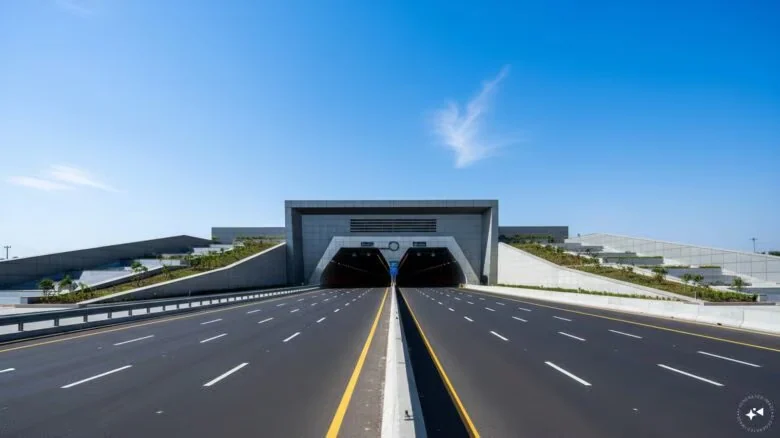
A large infrastructure push is set to reshape connectivity in Delhi-NCR and Uttar Pradesh. This image is only a concept. Image Credit: NDTV
The Union Cabinet has cleared two big-ticket road projects that could change how people and goods move across Delhi-NCR and Uttar Pradesh. The combined investment of nearly Rs 14,115 crore includes an 8.1-km six-lane tunnel connecting Dwarka Expressway with Nelson Mandela Marg in South Delhi and a 117.7-km access-controlled greenfield highway between Kanpur and Kabrai in Uttar Pradesh.
This is more than a transport update. It is a signal that the Centre is still betting heavily on roads as a growth engine for urban mobility, regional integration and logistics efficiency. For commuters, it could mean faster and less stressful journeys. For businesses, it could mean better freight movement and lower transport costs. And for real estate, it may open up a new wave of demand in connected corridors.
What the Projects Include
The Delhi tunnel is designed to strengthen connectivity between Dwarka Expressway, IGI Airport, Dwarka, Vasant Kunj and South Delhi. It will also connect with the upcoming AIIMS Mahipalpur elevated corridor, which should improve access toward Noida, Ghaziabad and East Delhi. The project has been approved at an estimated cost of Rs 6,969.67 crore under the Hybrid Annuity Model. This story was also covered by NDTV.
The tunnel is especially significant because Delhi’s road network is already under pressure from high traffic volumes and complex movement patterns between residential, airport and business zones. A tunnel of this kind is meant to reduce bottlenecks and create uninterrupted travel across key routes. In simple terms, it is meant to take pressure off some of the most frustrating stretches in the capital.
In Uttar Pradesh, the 117.7-km Kanpur-Kabrai greenfield highway has been cleared at an estimated cost of Rs 7,145.14 crore. The access-controlled corridor will be part of the Bhopal-Kanpur Economic Corridor and will link industrial centres in Uttar Pradesh with manufacturing, mining and agricultural regions of Madhya Pradesh. It will also connect with NH-34, NH-35, the Bundelkhand Expressway and the Kanpur Ring Road.
Why These Projects Matter
The biggest immediate impact will be on travel time. The Kanpur-Kabrai route, which currently takes around three and a half hours, is expected to come down to about 90 minutes once the highway is operational. That is a major shift for everyday commuters, freight operators and businesses moving goods across the region.
For Delhi, the tunnel is likely to make airport and South Delhi access far smoother. Anyone who has travelled between Dwarka, Gurugram, the airport and South Delhi knows how unpredictable that traffic can be. A tunnel that offers uninterrupted movement could save time, reduce stress and improve route reliability. Yeh kaafi important hai because in a city like Delhi, minutes saved on the road can matter a lot for work, travel and logistics.
For Uttar Pradesh and Bundelkhand, the Kanpur-Kabrai highway could become a catalyst for a more connected economic zone. Better road links often lead to more warehousing, logistics hubs, industrial activity and real estate interest. If raw material, finished goods and people can move faster, the local economy usually becomes more attractive to investment.
Jobs and Economic Impact
The Delhi tunnel is expected to generate around 7.54 lakh man-days of direct employment and nearly 9.8 lakh man-days of indirect employment during construction. That is an important point because infrastructure projects are not just about roads; they also create short-term economic activity through labour, materials, services and allied industries.
Such projects usually support a long chain of jobs. Construction workers, engineers, suppliers, transport operators and local vendors all benefit during execution. Once the project is complete, the economic impact shifts from construction to accessibility, land value and business potential. That is why these projects are often described as multipliers rather than just public works.
The Kanpur-Kabrai highway may also create a similar effect in Uttar Pradesh. Improved logistics and more predictable travel times can encourage industrial investment in regions that were previously underconnected. Bundelkhand, in particular, has often struggled with slower infrastructure development than the NCR. This highway could help reduce that gap.
Real Estate Watch
Developers are already watching the projects closely because infrastructure and property values often move together. Whenever a new expressway, metro line or airport link improves accessibility, nearby housing markets tend to respond. That does not mean prices rise automatically everywhere, but it usually means stronger long-term demand for well-connected locations.
Mohit Goel, Managing Director of Omaxe Ltd., said the approval of the Dwarka tunnel and the Kanpur-Kabrai highway reflects the government’s focus on high-impact infrastructure that strengthens regional connectivity and supports long-term economic growth. He described the projects as catalysts for urban expansion, investment and job creation.
According to him, better connectivity has historically been one of the strongest drivers of real estate value creation. He said the Delhi tunnel should improve housing demand, support property price appreciation and strengthen rental prospects across the corridor. He also noted that better access to employment hubs often attracts a wider mix of homebuyers, investors and commercial occupiers.
Pawan Sharma, Managing Director of TRG Group, made a similar point, saying such projects do more than cut travel time. He argued that they enable smooth movement of people, goods and services, which is a fundamental part of economic growth. He also said stronger road networks encourage industrialisation, warehousing, logistics, retail, hospitality and mixed-use developments.
Background and Context
India has been spending more on highways and expressways over the past decade as part of a larger effort to reduce logistics costs and improve freight movement. Roads remain one of the most visible ways to connect growth centres with markets, production zones and population hubs. That is especially important in a country where logistics can still be slowed by congestion, uneven road quality and long travel times.
The National Highways Authority of India has repeatedly emphasized that better road connectivity improves mobility, supply-chain efficiency and industrial cluster development while attracting private investment. These latest approvals fit neatly into that larger policy direction. In other words, they are not isolated projects; they are part of a wider national strategy.
For Delhi-NCR, the tunnel addresses a practical problem: too many important destinations are packed into a dense, traffic-heavy urban region. For Uttar Pradesh, the highway addresses a different but equally important challenge: how to link emerging industrial and mining belts with bigger markets efficiently. Both projects are examples of infrastructure being used as an economic lever.
Timeline
Recently: The Union Cabinet approves two road projects worth nearly Rs 14,115 crore.
Delhi project announced: An 8.1-km six-lane tunnel is cleared under the Hybrid Annuity Model.
Uttar Pradesh project announced: The 117.7-km Kanpur-Kabrai greenfield highway is approved.
During construction: The Delhi tunnel is expected to generate substantial direct and indirect employment.
After completion: Travel time on the Kanpur-Kabrai route is expected to fall from around 3.5 hours to about 90 minutes.
Also Read: Delhi Mayur Vihar Mob Attack After Eve-Teasing Objection Leaves Child Among 15 Injured
Why This Matters
This matters because road infrastructure is often the backbone of broader economic development. When travel time falls, logistics improve, businesses save money and new investment becomes easier to justify. Yeh issue kaafi important hai because roads connect not just places but also opportunities.
It also matters for daily life. A smoother route to IGI Airport or South Delhi can change the commute experience for thousands of people. A faster Kanpur-Kabrai corridor can help families, traders and transporters who rely on predictability. These are the kinds of improvements that people feel directly, even if they do not always make headlines.
There is also a macroeconomic angle. India’s growth story depends on more than big cities alone. It needs strong links between urban centres and emerging regions like Bundelkhand. If that connectivity improves, it can help spread economic activity more evenly.
India Angle
For Indian readers, this announcement is especially relevant because it touches both the capital region and a less-developed belt of Uttar Pradesh. In Hinglish, seedhi baat yeh hai: ek side Delhi ki traffic problem ko address karega, aur doosri side Bundelkhand aur Kanpur ko better market access dega. That combination makes the project important for both urban commuters and regional businesses.
The Delhi tunnel could become a major relief for residents who regularly travel between Dwarka, airport corridors and South Delhi. The Kanpur-Kabrai highway, meanwhile, could help industries and traders in UP move goods faster and more cheaply. For local communities, this kind of infrastructure often changes not just travel but also opportunity.
It also reflects a larger Indian development pattern: the government is trying to build corridors rather than only stand-alone roads. That means connecting cities, freight routes and economic nodes in a more integrated way. If executed well, that can have a lasting impact.
Analysis
My opinion is that the real value of these projects lies in their multiplier effect. A tunnel may look like just a faster route, but it can reshape traffic flows, business decisions and even property sentiment. A highway may look like a road, but it can pull entire districts into a new economic orbit. That is why such announcements often matter more after construction than on announcement day.
I also think the Delhi and UP projects complement each other well. Delhi gets relief from congestion in a high-pressure urban corridor, while UP gets a corridor that could support industrial movement and regional development. That balance between metro efficiency and regional expansion is a smart policy combination.
The one caution is execution. Large projects often attract optimism, but their impact depends on timely completion, proper design and good integration with existing roads. If delays or planning gaps emerge, the benefits can be reduced. So while the approval is significant, the real test will be in delivery.
What Next
The next step will be detailed planning, bidding, land preparation and execution for both projects. The Delhi tunnel will likely move under a construction model that allows private and public accountability through the Hybrid Annuity framework. The UP highway will need coordinated work because it connects several existing road networks and economic zones.
Over time, market watchers will likely track how land prices, commercial activity and housing demand respond around the project corridors. The Delhi tunnel could affect property sentiment in Dwarka, Vasant Kunj and surrounding zones. The UP highway could improve the investment case for areas along the Kanpur-Kabrai stretch and nearby industrial belts.
For the public, the most important next question is speed. If these projects move quickly and efficiently, their benefits will arrive sooner. If not, the economic promise will remain mostly on paper for a while. That is why execution will matter as much as approval.
Conclusion
The Union Cabinet’s approval of the Dwarka tunnel and Kanpur-Kabrai highway is a major infrastructure bet with wide implications for Delhi-NCR and Uttar Pradesh. Together, the projects aim to improve travel, strengthen logistics, support jobs and open up new growth corridors. Delhi’s tunnel could transform daily commuting, while the UP highway could redraw the economic map of Bundelkhand and surrounding industrial regions. If implemented well, this Rs 14,115-crore push could become one of those infrastructure moves that quietly but powerfully reshapes how a region grows.
Written By A. Jack