
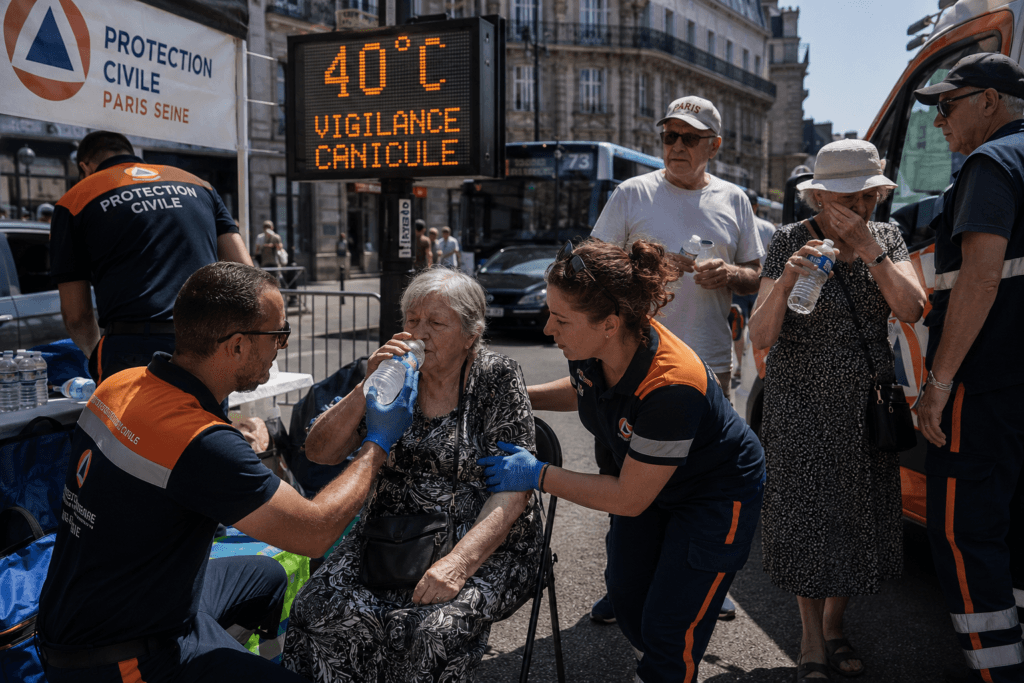
Europe heatwave: Europe is facing one of its most severe heatwaves in recent history, with France reporting nearly 1,000 excess deaths while Germany, Italy, the UK, and several other countries continue to battle dangerous temperatures exceeding 40°C, raising fresh concerns over climate change and public health.
This image is for illustration only | made by AI
A killer heat wave is sweeping across Europe, having already claimed hundreds of lives and disrupted daily life in several countries. Extreme temperatures affecting France have caused more than 1,000 excess deaths. Germany, Italy, the United Kingdom, Switzerland, Denmark, Slovakia and other neighboring countries continue to endure record-breaking heat. Many areas have seen temperatures soar above 40°C (104°F), leading governments to issue emergency alerts, suspend public activities and introduce water conservation measures.
Scientists say it’s not normal summer heat. Climate researchers say human-induced climate change has dramatically intensified the heatwave, helping to make such extreme weather events more frequent across Europe. The crisis has hit transportation, health systems, energy production, agriculture and public safety, and shows the growing threat of global warming.
Why and How the Heatwave Became So Severe
Meteorologists say the current heatwave in Europe has been caused by a high-pressure weather system that has been stationary and has trapped hot air over western and central Europe. This atmospheric “heat dome” has prevented the cooler air from reaching the affected regions, causing temperatures to continue to increase over several days.
Conditions were especially dangerous over the weekend in Germany and Italy, where meteorologists forecast temperatures above 40C in several areas. Germany’s national weather service warned of extreme heat across almost the whole country and urged residents to conserve water.
France has suffered some of the worst effects. Officials said there were about 1,000 more deaths than expected during the period of intense heat. Thousands of people have been treated in hospitals for heat exhaustion, dehydration and heatstroke, especially among elderly citizens and those with pre-existing medical conditions.
Meanwhile, Denmark saw its highest temperature since official record-keeping started in 1874, with 36.6°C recorded near Odense. Slovakia also recorded its hottest night on record, with temperatures failing to drop below 26°C overnight, leaving little chance for people or infrastructure to cool down.
The heatwave has also caused a number of tragic drownings in the UK as people sought to cool off by swimming in lakes, rivers and reservoirs. Six people drowned during the recent spell of hot weather, officials confirmed, after a number of similar incidents were reported during the May heatwave.
Scientists Link the Crisis to Climate Change
Climate scientists argue that the severity of this heat wave can’t be chalked up to random weather. Researchers have stressed that human-induced climate change has dramatically increased the likelihood and severity of such extreme temperatures.
Scientists from international climate research organizations explained that without the warming influence of greenhouse gas emissions, the nighttime temperatures observed during this event would have been nearly impossible. Warmer nights are particularly dangerous as the human body does not receive much relief from the daytime heat, increasing the risk of heat-related illness and death.
Meteorologist Karsten Brandt said parts of Germany could see temperatures well over 40°C, creating extremely dangerous conditions for vulnerable people. Public health officials have urged people to stay indoors at peak afternoon hours, stay hydrated and check regularly on elderly family members and neighbors.
Europe Faces Widespread Disruptions
Besides the tragic loss of life, the heatwave has caused huge disruption to everyday life across Europe.
Railway services in France have been delayed as extreme heat causes metal tracks to expand, increasing the risk to safety. Some schools suspended classes when the temperature inside the rooms became unsafe for students. In some public places, local authorities also placed restrictions on alcohol consumption to reduce health emergencies related to dehydration.
Power generation has also been problematic. High river temperatures have disrupted cooling systems at some power plants, reducing electricity production as air conditioning demand soars.
Agriculture has also suffered. Farmers in southern and central Europe are concerned about reduced crop yields as persistent drought conditions persist, while livestock producers are still struggling with heat stress on animals.
Tourism has also suffered. Popular outdoor attractions, sporting events, festivals and public gatherings have been postponed or cancelled for health reasons.
Expert opinions
Europe needs to prepare for more frequent episodes of extreme weather, climate scientists have been warning.
Researchers who study climate attribution say the ongoing heat wave illustrates how rising global temperatures are making weather events once considered rare more common. They say governments need better adaptation strategies as well as efforts to cut greenhouse gas emissions.
Public health experts have also noted that heatwaves have become one of Europe’s deadliest natural hazards, killing more people than floods, storms or wildfires—and often silently—due to dehydration, cardiovascular complications and respiratory illnesses.
Background and Historical Context
In the last two decades Europe has seen several very severe heat waves.
The deadly summer of 2003 is one of the continent’s worst climate disasters, killing an estimated 70,000 people across several countries. Scientists have warned time and time again that climate change would lead to more frequent, longer and more intense extreme heat events since then.
Recent summers have been breaking temperature records. Spain, Italy, France, Germany, Portugal and Greece have all experienced prolonged spells of intense heat, often coupled with drought and devastating wildfires.
The recent heatwave is the latest in this disturbing trend, implying record temperatures are becoming Europe’s new normal rather than historic events.
Also read: US Strikes 10 Targets Iran, Tehran Launches Attacks on Kuwait and Bahrain as West Asia war Escalate
Timeline of the Current Heatwave
In late June, Western Europe began to heat up, and the heatwave started to build and intensify rapidly in early July. Temperatures were much higher than normal in France, Switzerland and Germany, followed by Italy and the central European countries.
As the weather system moved east, Denmark had its hottest day since records began in 1874 and Slovakia its warmest night on record. Meteorologists expect the heatwave to continue in Poland and nearby regions before slowly easing off.
Throughout the event, governments have issued public health advisories, emergency weather warnings and water conservation measures as hospitals continue to monitor vulnerable populations.
Why This Matters
This heat wave is more than a passing weather event. It illustrates how climate change is affecting public health, infrastructure, food security and economic stability more severely.
Heatwaves are among the deadliest natural disasters, as they often affect millions of people simultaneously. The most serious risks are for vulnerable groups such as the elderly, children, outdoor workers and people with chronic illnesses.
The economic costs are equally important. Financial damage amounting to billions of euros is caused by transportation disruption, agricultural losses, higher healthcare spending, reduced productivity at work and higher demand for electricity.
Most importantly, this crisis is yet another wake-up call for countries around the world to invest in climate resilience, disaster preparedness and sustainable development.
India Angle
This is an important issue for Indian readers, as India has already seen several record-breaking heatwaves in recent years. Across cities like Delhi, Jaipur, Nagpur and parts of Uttar Pradesh, temperatures over 45°C have been recorded regularly in summers.
The European experience shows that even developed countries with sophisticated health care systems are not well equipped to cope with prolonged extreme heat. India, with its large population and growing urban centers, has even more problems.
Experts say Indian authorities could learn from Europe’s emergency response to build stronger heat action plans, better early warning systems, more urban green spaces and reliable access to drinking water in the peak summer months.
Climate change is clearly a challenge that is becoming a global one and not a regional one. What is happening in Europe can have an indirect impact on India through the changing weather patterns, agricultural uncertainty and global economic disruptions.
Analysis
From a digital journalism and SEO perspective, this story is of global relevance because it combines public health, climate science, environmental policy and international affairs into one ongoing crisis.
You can’t look at this as a one-off weather event, and readers should look at this as a piece of a larger climate trend that is supported by scientific research.” Governments can no longer dismiss extreme heat as a seasonal inconvenience. Heatwaves need to be prepared for in the same way we used to prepare for floods, hurricanes or earthquakes.
Media outlets also have a key role in offering practical safety advice along with the breaking news, helping readers to comprehend the immediate dangers and the long-term consequences. this story also covered by The times of india
What’s Next?
Meteorologists say the heatwave will continue its eastward march across Europe in the coming days, bringing record temperatures to more countries, possibly.
Officials are likely to maintain emergency measures until temperatures start to drop and health care systems prepare for more heat-related illnesses.
Climate scientists will continue to study the event to understand how it is related to global warming and will generate data that could be used in future climate policy discussions in Europe and elsewhere.
Governments are also expected to increase spending on heat-resilient infrastructure, urban cooling initiatives, renewable energy and climate adaptation programs in an effort to better prepare for future extreme weather events.
Conclusion
The ongoing European heatwave has become one of the most significant climate-related disasters of 2026, with France recording around 1,000 excess deaths and multiple countries enduring historic temperatures above 40°C. Beyond the tragic loss of life, the crisis has disrupted transportation, healthcare, agriculture, energy production, and everyday life across the continent.
Scientific evidence increasingly points toward climate change as a major factor amplifying the intensity and frequency of such extreme weather events. As Europe continues responding to the immediate emergency, the broader message is unmistakable: adapting to a warming planet is no longer optional—it is an urgent necessity.
For countries around the world, including India, this heatwave serves as a powerful reminder that climate resilience, public awareness, and long-term environmental policies will play a crucial role in protecting lives during future extreme weather events.