
The US Strikes on 10 Iranian military sites after an alleged drone attack on a commercial oil tanker in the Strait of Hormuz. Iran retaliated by launching missile and drone strikes on US military facilities in Kuwait and Bahrain, raising fears of a wider conflict across West Asia.
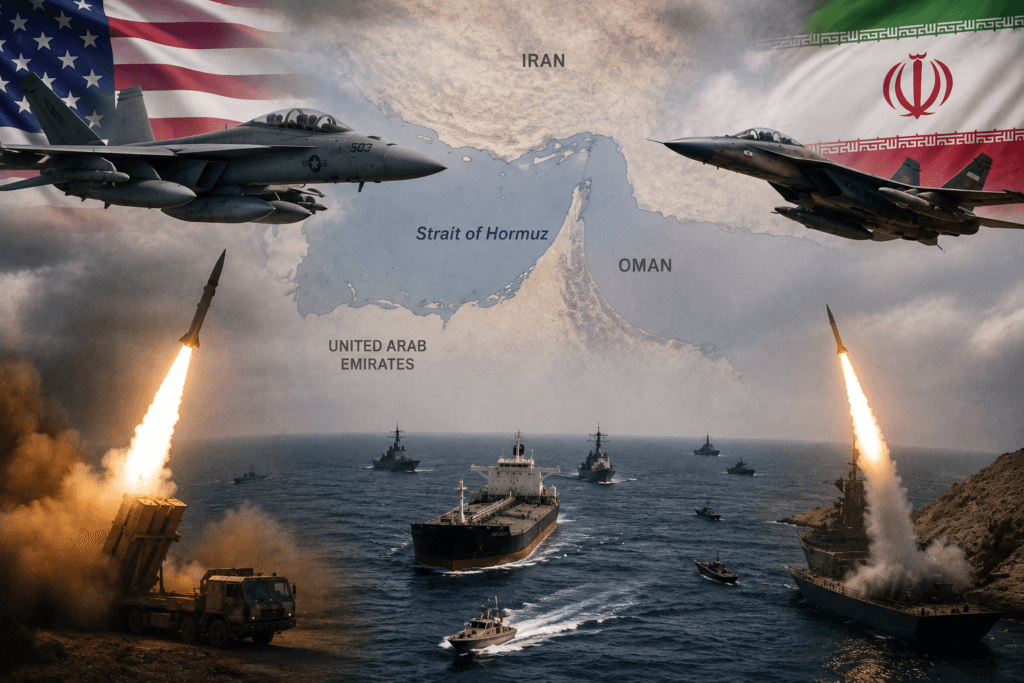
A representative image showing military aircraft, missile launches, and the Strait of Hormuz amid renewed military tensions between the United States and Iran. | This image is for illustration only | Made by AI
The US-Iran conflict has entered a new dangerous phase after the two countries traded fresh military strikes over the weekend. US Central Command (CENTCOM) said American forces conducted coordinated airstrikes against 10 Iranian military targets, accusing Tehran of attacking a commercial oil tanker in the Strait of Hormuz with a one-way drone. Iran responded hours later with missile and drone attacks on U.S. military installations in Kuwait and Bahrain, escalating tensions in the Gulf region.
The latest exchange took place despite an understanding of an interim ceasefire between Washington and Tehran, which was expected to create room for diplomatic negotiations. Instead, the resumption of military action has once again pushed West Asia to the brink of a wider regional conflict.
US officials said the operation targeted Iranian surveillance infrastructure, communications systems, air-defense sites, drone storage facilities and naval mine-laying capability around the Strait of Hormuz. The oil tanker Kiku, carrying more than two million barrels of crude oil, was attacked as it was passing through one of the world’s busiest maritime routes, CENTCOM said in a statement, adding that strikes were carried out after the attack.
In a statement, the US military said Iran was given the opportunity to abide by the ceasefire agreement but chose to violate it by attacking commercial shipping. ‘Commercial vessel transits through the Strait of Hormuz remain ongoing. US forces are alert, lethal and prepared,” the statement said, reiterating America’s commitment to protect international shipping lanes.
US President Donald Trump also reacted strongly to developments. He accused Iran of repeatedly breaking the ceasefire on Truth Social, and said there would be “severe consequences” if the attacks continued.
“United States aircraft just struck Iranian missile and drone storage sites and coastal radar sites for violating the Ceasefire Agreement, AGAIN!” Trump wrote. He also warned that if the US were forced to resume large-scale military operations, “the Islamic Republic of Iran will no longer exist.”
Within hours, Iran responded. The Islamic Revolutionary Guard Corps (IRGC) said it conducted a joint missile and drone operation against US military facilities at Ali Al-Salem Air Base in Kuwait and the headquarters of the US Fifth Fleet in Bahrain. Iranian officials said the attack was in response to the American strikes and warned that any future military action against Iran would be met with what they called a “crushing response.”
“If any violation of the ceasefire occurs, there will be an increase in retaliation,” military spokesman Ibrahim al-Fiqar said, warning Iran would tighten its grip on maritime traffic passing through the Strait of Hormuz if tensions continued to escalate.
Also read: US Partially Lifts Iran Oil Sanctions Amid Encouraging Nuclear and Peace Talks
The Strait of Hormuz is one of the world’s most strategically important waterways. Every day, almost 20 percent of the world’s crude oil passes through this narrow shipping lane. Any disruption in the region immediately raises concerns about global oil supplies, international trade and shipping security. The strategic location of the area means that even a limited military incident is likely to have worldwide economic consequences.
The United States and Iran have had a hostile relationship for decades. Differences over Iran’s nuclear program, its regional influence, economic sanctions and military activities have repeatedly brought the two countries close to confrontation. Diplomatic efforts have at times eased tensions, but mistrust between the two governments remains high.
Background and Timeline
The Gulf has already seen rising tensions following a series of security incidents involving commercial ships. The Kiku, a tanker, was allegedly attacked by a drone, prompting the latest American military retaliation. The US struck 10 Iranian military targets with airstrikes and Iran quickly retaliated by hitting US bases in Kuwait and Bahrain. The swift exchange has demonstrated once again how fragile the security situation in West Asia remains.
Why This Matters
“This current escalation is not a regional problem. A long-running confrontation between the US and Iran could upset global energy supplies, push up prices for crude oil, impact international shipping and create uncertainty in financial markets. Many countries across Asia, Europe and further afield closely monitor events in the Gulf because they rely on energy imports from the region.
India Angle
This is quite an important development for India. India imports much of its crude oil from West Asia and any disruption in the Strait of Hormuz could lead to higher fuel prices and transportation costs. Higher crude oil prices could also lead to higher inflation, which would affect both consumers and businesses.
It is also equally important to the millions of Indians who live and work in the Gulf countries, including Kuwait and Bahrain. Any additional military escalation may call for increased diplomatic efforts to guarantee the safety and security of Indian citizens in the region.
Analysis
The latest exchange demonstrates that the ceasefire between Washington and Tehran is still very fragile. Both countries say their actions are defensive, but each military reaction raises the chance of another round of retaliation. The military posturing is getting more aggressive and the diplomatic negotiations seem to be losing momentum.
Neither side may want a full-scale war in a global sense, but repeated strikes raise the risk of miscalculation. A miscalculation involving civilian shipping or military personnel could easily take the conflict beyond the Gulf. The story was also covered by Hindustan time
What Next?
The next few days will be decisive. Diplomatic talks are expected to be renewed by international leaders to prevent an escalation. Meanwhile, the US is expected to raise its naval presence in the Strait of Hormuz, while Iran may continue its military preparations and make more warnings on maritime activity.
Every development will be followed very closely by global oil markets, shipping companies and investors. There’s restraint on both sides, and maybe diplomacy can still work. But continued retribution could pull West Asia into another long and dangerous conflict.
Conclusion
The latest military clash between the US and Iran has once again brought to the fore the fragile security situation in West Asia. US strikes on 10 Iranian military sites and Tehran’s retaliatory strikes on American bases in Kuwait and Bahrain have stirred new fears about regional stability, global energy security and international trade.
Both governments continue to justify their actions. But the international community now faces the urgent task of preventing further escalation. For countries like India that are highly dependent on energy supplies from the Gulf and have millions of citizens living in the region, the developments are of economic and strategic importance. In the next few days we will see whether diplomacy can restore calm or whether the region is heading towards a wider conflict.