In another development, Rajasthan Police arrested a teenager days ahead of the NEET 2026 re-examination for allegedly running a Telegram-based scam to sell fake question papers to anxious students seeking an edge in the highly competitive medical entrance test.
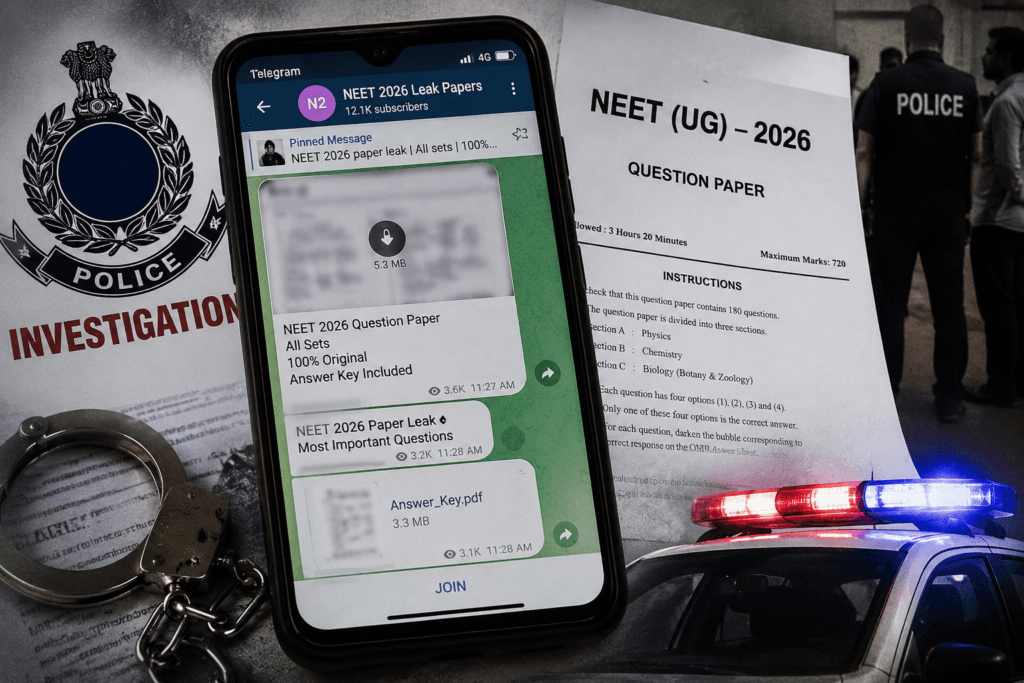
This image is only for illustrations. |Created by AI
Rajasthan Police has arrested a 19-year-old youth in Rajasthan in a major crackdown against examination-related cyber fraud for allegedly selling fake question papers of the NEET re-examination through Telegram in the run-up to the NEET 2026 re-exam on June 21. Pratapnagar Police in Bhilwara arrested the accused, identified as Akash Chaudhary of the Churu district of Rajasthan, after police received input about suspicious online activities regarding an alleged paper leak racket.
The arrest comes at a time when concerns on examination integrity are high across India after several controversies involving competitive examinations. The accused created a Telegram channel named “Paper Mafia” and used it to distribute and sell fake NEET question papers to students for Rs 4,000 each, the investigators said. His cell phone and educational materials have also been seized as police expand their net to his financial transactions and possible links.
The case underscores the growing use of encrypted messaging apps and social media platforms to prey on students preparing for high-stakes tests.
How the Alleged Scam Operated
Preliminary investigation has revealed that Akash Chaudhary allegedly created and operated a Telegram channel called “Paper Mafia” to lure students looking for leaked exam papers. Authorities believe he used a United States-based Virtual Private Network (VPN) to disguise his online identity and to avoid detection while operating the channel.
Investigators at the time of the arrest found that there were about 52 persons connected to the Telegram channel. Police believe many of those involved joined the platform hoping to get genuine examination material ahead of the re-examination.
The accused is said to have advertised fake Re-NEET question papers and charged Rs 4,000 from interested students to access them. He is also reported to have attached the QR code of his bank account to the Telegram channel so students could pay him directly.
Police suspect the operation was created to leverage the anxiety and uncertainty associated with the NEET re-exam. Students who are preparing for competitive exams are generally under tremendous pressure and thus a soft target for fraudsters who promise early access to examination papers.
The police are now looking at banking records and digital evidence to see how many students might have been tricked and if others are part of the scam.
Police Investigation and Official Action
The probe was ordered on a tip-off received through the S-Mek portal of the Government of India by the office of the Superintendent of Police, Special Branch, on suspicious social media activities that could be related to a leak of the examination paper.
Based on the intelligence input, Pratapnagar Police started a technical investigation and kept a tab on the activities related to the Telegram channel. Eventually, the investigation pointed to Akash Chaudhary, who was arrested.
During the operation police recovered a mobile phone, a NEET study guide and some documents, said Pratapnagar Station House Officer Sunil Tada. Digital forensic experts are expected to examine the seized devices to identify communication records, transaction histories and possible accomplices.
Authorities have booked the accused under charges of fraud, selling fake question papers, violations of the Information Technology Act and provisions of the Public Examination Act.
Investigators are also trying to determine whether any students actually bought the fake papers and whether similar activity took place on other social media platforms.
Statements and Reactions
As the probe continues, the officials have said no evidence has surfaced so far that points to the existence of an actual NEET paper leak related to the case. However, early findings suggest the suspects could have been exploiting public anxiety about the security of examinations.
“The main objective now is to unravel the entire network and find out whether the accused acted alone or had assistance of others,” a senior police official associated with the investigation was quoted as saying.
The authorities’ swift action was welcomed by education experts. According to several examination analysts, cases of fake paper leak scams are likely to rise whenever major competitive examinations are under controversy or rescheduling.
Students need to be on alert and not believe social media channels claiming to have leaked examination papers, one education consultant said. Such claims are often made to make money out of desperate candidates, creating confusion and panic.
NEET and Growing Examination Security Concerns
The National Eligibility cum Entrance Test (NEET) is the largest medical entrance examination in India and is the gateway to the undergraduate medical courses across the country. Every year millions of students compete for limited seats in government and private medical colleges.
In recent years, examination security has become a hotly debated topic in the public eye. There have been allegations of paper leaks, cheating networks, impersonation and organised fraud and authorities have cracked down on monitoring systems and brought in tougher regulations.
The Public Examination Act was promulgated to combat the scourge of organized examination malpractices and to impose severe penalties on those who attempt to undermine the sanctity of public examinations.blic examinations.
There were already serious doubts about the NEET 2026 re-examination because of misinformation, rumours and speculation on social media. The authorities have been monitoring the digital platforms to avoid the spread of false information that could impact the candidates and the process of examination.
The Rajasthan arrest is an example of law enforcement agencies using technology to gather surveillance and intelligence to track down online threats before they spiral out of control.
Timeline of Events
Following reports of suspicious online activity related to examination materials, authorities have increased their surveillance of social media platforms in the weeks leading up to the NEET 2026 re-examination.
The Government was informed about a Telegram channel, which was allegedly promoting the leaked question papers, through its S-Mek monitoring system. The Special Branch started an investigation and passed information to local police units.
The Pratapnagar Police carried out a technical investigation, monitored digital activity linked to the channel, and found that the alleged operator was Akash Chaudhary.
The 19-year-old suspect was arrested by police on Friday, electronic devices were seized, and a case was lodged under multiple provisions of the law.
Investigators are now going through financial records, digital correspondence, and channel membership information to assess the scale of the operation.
Why This Matters
The case is important as it underscores the increasing convergence of technology, education, and cybercrime in India. Competitive exams like NEET are important for students as they decide their academic and professional careers. “Any attempt to manipulate, exploit, or create misinformation around these examinations can have serious consequences.”
Even if the question papers are fake, the damage can be huge. Students may lose money, be emotionally stressed, and be distracted from legitimate preparation. False allegations of leaks can also erode public confidence in the examination system and create unnecessary panic among the candidates and the parents.
The incident also highlights how encrypted messaging apps can be exploited for scams. While platforms such as Telegram provide useful communication tools, they can also be conduits for scams when there are inadequate monitoring and enforcement mechanisms in place.
Rajasthan Police’s quick response is a strong signal that the authorities are monitoring digital platforms and are prepared to take action against those attempting to prey on the students.
The India Angle
For Indian students and parents, this incident is a strong reminder that there is no substitute for hard work in competitive examinations. Every year lakhs of students prepare for NEET and the competition is very tough. In such an atmosphere, rumors of leaked papers can quickly spread and affect decisions.
This is a very important issue because it has an impact on the faith people have in the education system of India. Families spend huge amounts of time, money, and emotional energy in preparing children for exams like NEET. When fraudsters try to take advantage of students’ stress, the impact is more than financial loss.
The case also underscores India’s increasing efforts to tighten digital governance and examination security. Now, authorities are deploying new monitoring tools, cyber intelligence systems, and inter-agency cooperation to detect threats before they affect examination processes.
The bottom line for students is simple: go with the official word from examination authorities and avoid social media channels where leaked papers or guaranteed success are promised.
Analysis
This story isn’t just about a single teen’s arrest in terms of digital journalism and SEO. This is part of a broader pattern of increasing sophistication and targeting in cyber-enabled fraud.
The use of Telegram, VPN services, and digital payment systems illustrates how modern scammers leverage technology to reach susceptible audiences. This case is particularly interesting because the alleged operation targeted a very sensitive area, education.
“I think the authorities should get credit for nabbing the activity before it could cause widespread confusion among candidates.” Proactive measures are often more effective than reactive investigations after damage has been done.
At the same time, educational institutions and examination agencies have to continue to invest in awareness campaigns. Students need to be reminded often that claims of leaked papers are often scams designed to make money and not to provide real exam materials.
The larger lesson is that cybersecurity and exam security are now intertwined. Physical safeguards and strong digital monitoring are necessary to protect the integrity of exams.
What Next?
The police will also be looking into the accused’s bank transactions, digital communication, and online activities in the coming weeks, and the investigation is expected to continue. Authorities are expected to try to trace people who may have bought the fake documents and investigate whether there were other suspects.
Digital forensic analysis could show whether there were other similar channels with different names or if the accused had collaborated with people from other states.
The case may also lead to more vigorous enforcement efforts prior to future competitive examinations. Law enforcement agencies are expected to watch social media platforms and messaging apps closely in an attempt to prevent misinformation and fraud.
NEET candidates are now preparing for the re-examination, which is just around the corner. Officials have repeatedly told students to disregard rumors and only trust official announcements and verified sources. this story also covered by The Indian news
Conclusion
The arrest of Rajasthan’s 19-year-old Akash Chaudhary is a sign of the increasing challenge of tackling examination-related cyber fraud in India. The accused allegedly ran a Telegram channel that sold fake NEET question papers. It is believed that the accused leveraged the fear and anxiety among students preparing for one of the most competitive exams in the country.
The case is a reminder that misinformation can be as damaging as actual examination leaks. The Rajasthan Police have prevented a possible big scam by timely intervention and brought to the fore the need for vigilance in the digital era.
The incident underscores a need for greater awareness, responsible use of technology, and sustained efforts to protect the integrity of India’s examination system as investigators continue to probe the full extent of the operation. The message to students and parents is clear: rely on reputable sources, exercise caution online, and remember that true success is about preparation, not shortcuts.