Thursday’s gritty 0-0 draw with Paraguay ensured Australia a place in the knockout rounds of the World Cup. It wasn’t a classic, but enough for the Socceroos to advance while Paraguay now have to wait and see if their third-place finish is enough to keep their tournament alive.
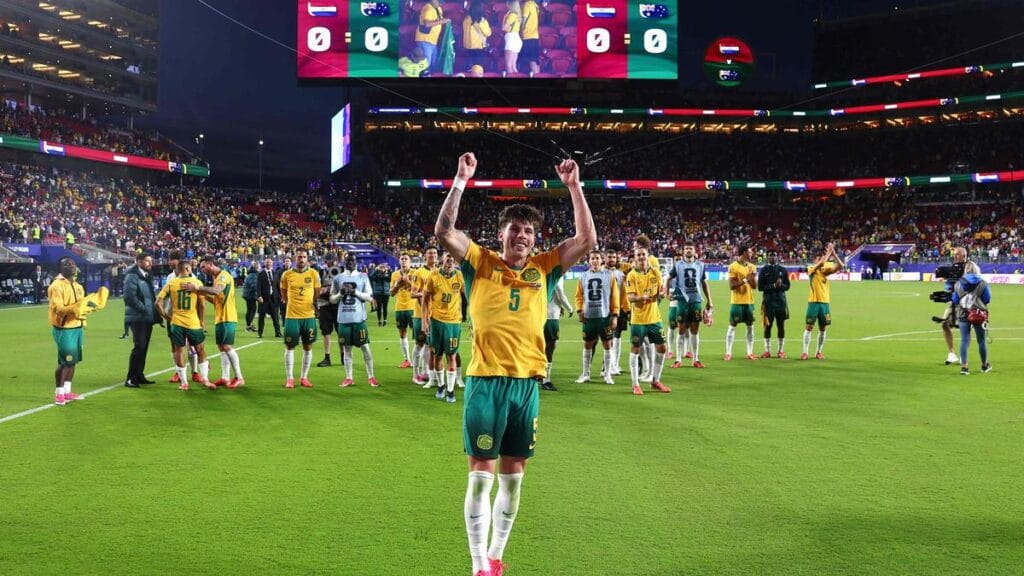
Australia players celebrate reaching the World Cup knockout rounds after a tense 0-0 draw with Paraguay in a cagey Group stage contest. Image Credit: The Hindu
FIFA World Cup 2026: Australia reached the World Cup knockout stage on Thursday after playing out a goalless draw with Paraguay in a match that was defined more by tension than fluency. The result at the end of a stop-start, physical contest was enough to send Australia through, while Paraguay now faces an anxious wait to discover whether their third-place finish will be enough to extend their campaign.
This was not a match packed with flowing football or high-scoring drama. Instead, it was one of those tournament games where discipline, shape and patience mattered more than spectacle. Australia handled that challenge slightly better, creating the more dangerous chances and doing enough to earn the result they needed. In World Cup football, sometimes a point is priceless, and yeh match usi category mein aata hai.
How the Match Unfolded
The contest was cagey from the start. Both sides were physical, tackles were often late or wayward, and the rhythm of the game kept breaking down. That made it difficult for either team to build sustained attacking pressure. Still, Australia found the sharper moments in front of goal and arguably had the better of the chances. The Hindu has covered the full story.
Cristian Volpato forced a save from the Paraguay goalkeeper, showing good composure in a match where clean openings were rare. Jackson Irvine also tested the keeper, underlining Australia’s ability to create danger even in a compressed and scrappy game. Late on, Jordan Bos went painfully close twice, and those moments could easily have turned the draw into a victory.
Paraguay had their own spells, but they struggled to turn physical intensity into clear chances. Their finishing was poor, and the final ball repeatedly let them down. In a match like this, that kind of inefficiency is costly. When a game is tight and there are few openings, one sharp finish can decide everything — and neither side found it.
Why Australia Advanced
Australia advanced because they managed the match better under pressure. They did not panic when the game became messy, and they kept creating enough danger to stay ahead of Paraguay in overall threat. That does not mean they were dominant, but they were effective in the right moments.
Tournament football rewards teams that can survive ugly games. Australia showed patience and structure, which is often more important than style in the group stage. They were not forced into mistakes, and they did not allow the game to become completely chaotic. That is a big positive for a team moving into the knockout rounds.
Another factor is mental resilience. Many teams struggle when a match is physical and stop-start because it becomes harder to find rhythm. Australia stayed focused, kept their shape and never looked as though they were chasing a result in panic mode. That steadiness matters.
Paraguay’s Waiting Game
For Paraguay, this draw leaves them in an uncomfortable position. They finished third in the group and now have to wait to learn whether that will be enough to progress. That is always a nerve-racking place to be because qualification is no longer fully in their hands.
From a footballing perspective, Paraguay will likely look back at this match with frustration. They had chances to do more, but poor finishing and a lack of precision in the final third hurt them. In a World Cup where every point matters, missed chances can come back to haunt you.
Still, Paraguay were competitive and physical, and that kind of edge can be useful in tournament football. Whether it is enough to survive depends on results elsewhere. That uncertainty is what makes third-place finishes so tense.
Background and Context
Australia has developed a reputation for being difficult to beat in tournament football. They do not always play the most expansive style, but they often bring discipline, a strong work rate, and a willingness to battle for every ball. This result fits that identity perfectly.
Paraguay, meanwhile, are a side that often rely on structure and toughness, but they did not get the clean finishing required in this match. The result shows how tight World Cup group-stage football can become when both teams are under pressure and neither wants to overcommit.
Matches like this are not always remembered for beauty, but they are remembered for consequence. A 0-0 draw can feel dull in real time and still become one of the most important results of a team’s tournament. That is exactly what happened for Australia.
Timeline
Opening phase: The game begins as a physical, stop-start contest.
First half: Australia creates the better chances but cannot convert.
Cristian Volpato chance: The goalkeeper makes a key save.
Jackson Irvine chance: Australia comes close again.
Late second half: Jordan Bos twice goes narrowly close.
Full time: The match ends 0-0.
After the whistle: Australia qualifies for the knockout rounds, while Paraguay must wait on third-place calculations.
Also Read: Turkiye Beat USA 3-2 in FIFA World Cup 2026 Thriller to Deny Co-Hosts a Historic Moment
Reported Match Feel
A football analyst would probably describe this as a classic “survive and advance” performance from Australia. They did not overwhelm Paraguay, but they found enough attacking moments to justify their progression.
Another fair summary would be that Paraguay was made to pay for poor finishing in a game where openings were already limited. When chances are scarce, the team that handles them better usually gets rewarded, and that did not happen here.
The match also showed the value of calm decision-making. Australia did not try to force the game into something it was not. They accepted the physical battle, stayed organized and made sure they did not lose the kind of point that can take a team into the next round.
Why This Matters
This matters because the World Cup knockout stage is where tournament identity becomes real. For Australia, reaching the last rounds confirms that they can handle pressure and survive a difficult group game. Yeh issue kaafi important hai because progress in a World Cup is often built on moments when a team refuses to lose.
It also matters because Paraguay is now in a waiting position that can be emotionally draining. Their fate depends on what happens in other groups, and that uncertainty can be hard to manage after a physically demanding match. A team would always prefer to qualify outright rather than depend on calculations and tiebreakers.
For fans, especially those following underdog narratives, this kind of result shows why group-stage football is so compelling. Not every qualification story is built on goals. Some are built on grit, organisation and one hard-earned point.
India Angle
For Indian football fans, Australia’s result is easy to understand because it is the sort of tournament football that many viewers connect with emotionally. It was not flashy, but it was practical. In Hinglish, seedhi baat yeh hai: kabhi-kabhi Cup jeetne ke liye pehle match nahi, result jeetna hota hai.
Indian fans often appreciate teams that fight hard and stay disciplined, especially in knockout-style settings. Australia fit that image well. Their style may not always be exciting, but it is effective, and that is something Indian viewers generally respect.
This also offers a lesson for Indian football development. Teams that want to go deep in tournaments must be comfortable in scrappy matches, not just open, attacking games. Australia’s qualification shows the value of resilience when the football itself is messy.
Analysis
My view is that Australia earned this result through maturity more than dominance. They did not need to win stylishly. They needed to stay alive, avoid mistakes and create enough moments to be dangerous. That is precisely what they did.
Paraguay’s problem was not effort but efficiency. In tight World Cup games, the side that converts one big chance usually takes control of the storyline. Paraguay never found that one clean moment, and the draw leaves them with a lot of waiting and not much comfort.
What stands out most is how much tournament football rewards calmness. Australia never looked rushed, and that may end up being the reason they continue to the next stage. In knockout football, staying composed under pressure is often the biggest edge.
What Next
Australia now turns their attention to the knockout rounds, where the pace, pressure and consequences will be even higher. Their next challenge will likely require more attacking sharpness, but they will be comforted by the fact that they have already shown they can survive a difficult, physical game.
Paraguay must wait for results elsewhere to know whether they are through as one of the third-place teams. Until that is confirmed, their tournament remains hanging in the balance.
For both teams, the next step is clear: recover physically, review the match, and prepare for whatever comes next. In a World Cup, there is almost no time to linger on one result.
Conclusion
Australia’s goalless draw with Paraguay was not a match full of goals, but it was a result full of significance. The Socceroos did enough to advance to the knockout rounds, thanks to a disciplined, physical and patient performance that produced the better chances without ever turning into a classic. Paraguay, meanwhile, must wait nervously to see if their third-place finish is enough. In the end, this was a reminder that in tournament football, survival often matters more than style.
Written By A. Jack