Eight people have been arrested in a probe by a Special Investigation Team (SIT) into the alleged misappropriation of donations received at the Ram Ayodhya Temple. The case has ignited a national debate about transparency and accountability in the treatment of religious donations.
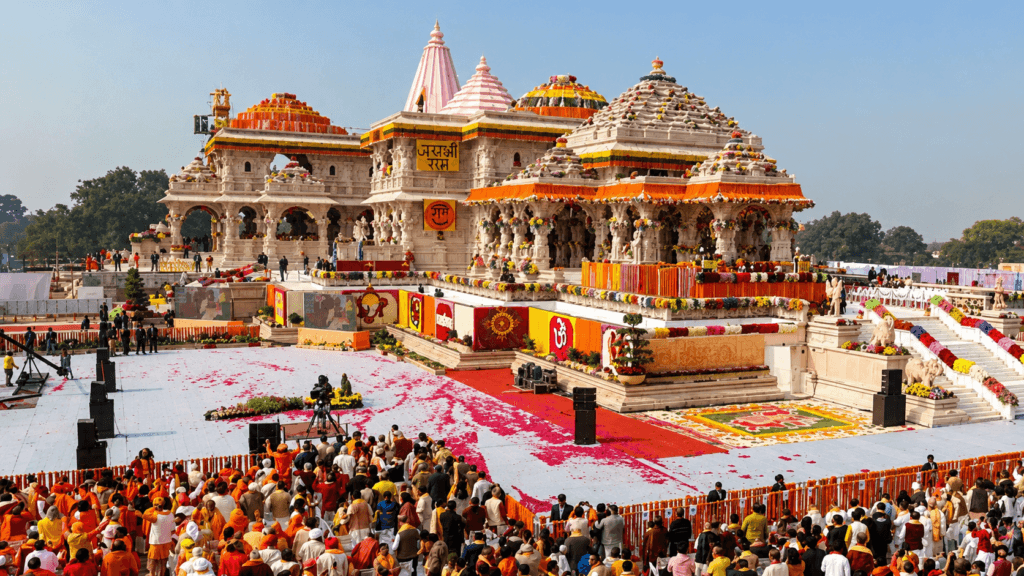
Ayodhya Temple| The image is used for illustration only
The Uttar Pradesh Police have taken the matter to a crucial stage in the alleged Ram Temple donation embezzlement case in Ayodhya by arresting eight people named in an FIR in connection with the suspected siphoning off of temple donations. The arrests have been made barely two days after the Special Investigation Team (SIT) submitted its preliminary findings to the Uttar Pradesh government indicating that the probe has moved from initial allegations to active legal action.
The case centers on the management of cash and valuables donated by millions of devotees at Shri Ram Janmabhoomi Temple, one of the most important religious sites in India. The entire findings of the SIT report are yet to be made public but the arrests indicate that the investigators found enough grounds to move against the accused.
How the controversy played out
The row erupted earlier this month when it was alleged that funds donated by devotees at the Ram Temple were being siphoned off during the counting and deposit process. At first, the political leaders and the temple authorities dismissed the allegations as baseless attempts to tarnish the reputation of the temple administration.
Those arrested include Avinash Shukla, Anukalp Mishra, Lavkush Mishra, Manish Kumar Yadav, Karunesh Pandey, Ramashankar Mishra, Subhash Srivastava and Ramshankar Yadav alias Tinnu. All of them were involved in counting cash and valuables acquired through donation boxes inside the temple complex, officials said.
The investigators are examining possible irregularities in the handling and accounting of donations before they were officially deposited into designated bank accounts. Authorities are examining financial records, surveillance footage, paperwork and the positions of everyone involved in the counting process.
The exact sum of money that was supposedly embezzled has not yet been officially announced, but investigators are still checking financial records to establish the full scope of the alleged embezzlement.
Government and Trust Response
Uttar Pradesh Deputy Chief Minister Brajesh Pathak outrightly rejected the charges when the allegations first came out in the public.
Some people are trying to spread rumors about the Shri Ram Temple and create a false narrative to mislead the public, he said. “The people of Uttar Pradesh know such political gimmicks and they will not be fooled by disinformation,” he said.
Similarly, the Shri Ram Janmabhoomi Teerth Kshetra Trust denied any financial irregularities.
Donations to the temple are regularly audited and representatives of the Trust and the State Bank of India are involved in the verification process,” said Trust General Secretary Champat Rai. He said that audits had been done and found no discrepancies.
However, despite these assurances, the seriousness of the allegations prompted the Trust itself to request an independent investigation.
The Uttar Pradesh government formed a Special Investigation Team (SIT) on June 13 in response to that demand.
SIT investigation.
SIT was charged with looking into each phase of the donation management system, from the opening of donation boxes to the counting, documentation, transportation and depositing of monies.
Employees were allegedly interrogated and CCTV footage, attendance records, cash registers and bank deposit slips were reportedly checked to see if any financial misconduct had taken place.
SIT member Vijay Vishwas Pant on June 23 confirmed that the preliminary investigation report has been submitted to the Additional Chief Secretary (Home).
“The report is confidential and I don’t want to release the contents to the public, although I said all the findings have been handed over to the state government for further review,” he said.
Just two days later, police arrested all eight accused named in the FIR, suggesting that investigators had collected enough preliminary evidence to take immediate legal action.
Officials said the investigation is continuing and more arrests are possible if additional evidence comes to light.
How the donation system works
Huge donations are received every day at the Shri Ram Temple from devotees coming to Ayodhya from across India and abroad.
Contributions come in the form of cash, gold, silver ornaments, jewellery and other valuables.
Donation boxes are normally opened in the presence of witnesses. Only authorized personnel are allowed to count, document, verify and deposit the money collected into the appropriate bank accounts. The process involves multiple officials to ensure transparency.
The temple receives donations worth several crores every year and it is extremely important to keep the public confidence in this system.
Any suggestion that this process was manipulated raises serious questions about accountability and financial governance.
Background and Context
The Ram Temple holds great religious, cultural and political significance in India.
The Supreme Court’s historic judgment in November 2019, after decades of litigation over the Ayodhya land dispute, cleared the decks for the construction of the temple.
Work soon began, and the grand consecration ceremony in January 2024 received national and international attention.
Since then, millions of pilgrims have come to visit the temple, making it a major source of daily donations.
The shrine has an emotional attachment with millions of devotees and any allegation involving temple funds quickly becomes a matter of national interest.
That is why this investigation has generated huge public interest even though official assurances have been given that auditing systems are already in place.
Sequence of Events
The controversy broke in early June when allegations of financial irregularities over the donations received at the Ram Temple were made.
Uttar Pradesh Deputy Chief Minister Brajesh Pathak on June 8 denied the allegations, saying they were a false narrative.
In the same period, General Secretary of Shri Ram Janmabhoomi Teerth Kshetra Trust Champat Rai also denied any irregularities, saying periodic audits had not revealed any irregularities.
Increased public attention and at the request of the Trust, the Uttar Pradesh government formed a Special Investigation Team on June 13.
The SIT carried out its preliminary inquiry in the days that followed.
On June 23, investigators submitted their confidential interim report to the state government.
The police arrested all the eight persons named in the FIR in connection with the alleged embezzlement case two days later.
Why It Matters
This is bigger than a routine financial investigation.
The Shri Ram Temple is a symbol of faith, devotion and national heritage for millions of Indians. Devotees’ donations of even a single rupee are always considered to have emotional and religious significance.
To the extent that there has been a breach of the donation management system, it is a serious issue that calls into question financial transparency, institutional oversight and public trust.
On the other hand, if the investigation ultimately finds that there had been no large-scale embezzlement, the results would be important in restoring the confidence of the devotees.
Either way, the outcome is likely to have an impact on how major religious institutions across India handle donations in future.
Also read: Lucknow Coaching Institute Fire: 16 students dead, many jump out as blaze engulfs educational hub
India View
This is a pretty kaafi important issue for the citizens of India, especially for devotees who come to Ayodhya from all corners of the country, because the issue is directly related to the faith attached to one of the holiest temples in India.
Every year families contribute according to their means, hoping that their contributions will help in religious activities and the development of the temple.
Any allegation concerning these donations is bound to cause concern among devotees.
The probe could lead to even more rigorous digital accounting systems, CCTV surveillance, independent audits and transparency in the management of donations by religious institutions in India.
In the end, public confidence is as important as compliance with legal requirements.
Analysis
From a journalistic perspective, the handling of this case underscores the importance of allowing investigative authorities to do their work before jumping to final conclusions.
Both political leaders and temple authorities first denied the allegations. However, the making of the SIT and the subsequent arrests show that the authorities regarded the matter as serious enough to be investigated as a criminal case.
It is equally important to remember that an arrest is not an admission of guilt.
It will now be up to the courts to decide if the evidence collected by investigators is enough to prove the allegations in a court of law.
The case also points to a wider problem of governance. And as more and more donations pour into religious institutions across India every year, strong financial controls, independent audits, digital tracking of transactions and transparent reporting become all the more necessary.
These measures not only stop financial misconduct, but they also help build public confidence in religious organizations. The story is also coverd by NDTV
Upcoming
The investigation is expected to continue over the coming weeks.
The authorities could conduct further financial audits, review digital records, interview more witnesses and analyze banking transactions tied to the accused individuals.
A forensic audit of financial records would also show whether this was a systematic diversion of funds or isolated irregularities as alleged.
If sufficient evidence is available, the police will file a detailed chargesheet in the appropriate court.
Alternatively, if investigators find no criminal conspiracy, the accused could receive legal relief through the judicial process.
The recommendations of the SIT are also likely to be considered by the state government, which could include stricter safeguards for managing temple donations in the future.
Conclusion
The arrest of eight individuals in connection with the alleged Ram Temple donation embezzlement case marks a significant development in one of India’s most closely watched financial investigations involving a religious institution.
While the Shri Ram Janmabhoomi Teerth Kshetra Trust has consistently maintained that regular audits found no irregularities, the SIT investigation and subsequent arrests indicate that authorities are pursuing every lead to establish the facts.
Millions of devotees place immense trust in the temple administration, making transparency and accountability essential. As the legal process moves forward, the focus will remain on ensuring a fair, impartial, and evidence-based investigation.
Regardless of the final outcome, this case is likely to shape future standards for financial governance and donation management at major religious institutions across India.