Egypt got the point they required to go through, Iran’s wait for qualification continues. The draw had big ramifications with group standings still playing into the final Round of 32 picture.
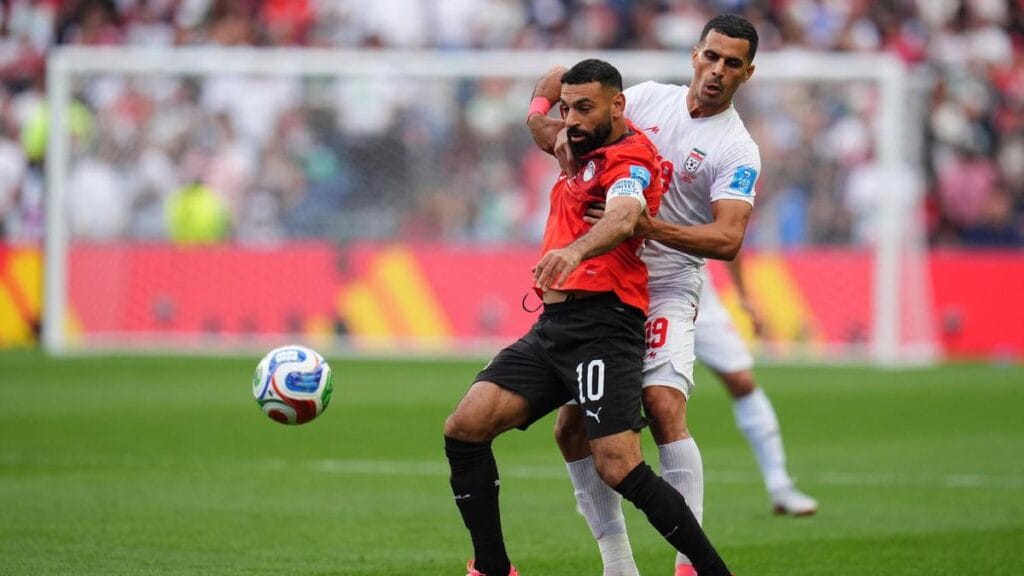
Egypt and Iran players battle for the ball during a nervous 1-1 Group G draw that sent Egypt into the World Cup knockout round. Image Credit: The Hindu
FIFA World Cup 2026: Egypt and Iran played out a nervy 1-1 draw in their final FIFA World Cup 2026 Group G clash on Friday, a result that sent Egypt through to the knockouts and left Iran’s fate dependent on the wider group picture. Mahmoud Saber gave Egypt an early lead, but Iran responded almost immediately through Ramin Rezaeian in a match that carried both sporting and political tension. With Egypt needing only a point to progress and Iran requiring a win to guarantee qualification, the stakes were high from the opening whistle.
This was not a game that flowed easily. It was tense, cautious and shaped by the pressure of qualification. Egypt got the outcome they needed, while Iran showed the kind of stubbornness that has defined their tournament so far. In a World Cup, sometimes the biggest results are not the most glamorous ones—and this was one of those nights.
How the Match Unfolded
Egypt started strongly and was rewarded early when Mahmoud Saber found the net. That goal gave them the kind of platform teams dream of in a must-not-lose match. It allowed Egypt to settle, control nerves and force Iran to chase the game sooner than expected. The Hindu has covered the full story.
But Iran responded quickly, which prevented Egypt from fully settling into a defensive rhythm. Ramin Rezaeian equalized just minutes later, and that changed the mood of the match almost instantly. Instead of one side protecting a lead and the other panicking, the game became a tactical battle again, with both teams knowing that one more mistake could decide their World Cup fate.
After that, the match became increasingly cautious. Egypt knew a draw was enough to secure qualification, while Iran remained in the mix but needed more than just resilience if they wanted to top the group outright. The result was a nervous contest in which neither team could fully take control, but Egypt were ultimately the happier side because the point was enough.
Egypt’s Qualification Path
For Egypt, this draw is meaningful because it took them into the knockout stage of the FIFA World Cup 2026. The seven-time African champions have a deep footballing history, but a first World Cup win in this modern context, coming 92 years after their debut, has put them in charge of their group destiny and lifted expectations around the team.
The big takeaway is that Egypt handled the pressure well enough to get what they needed. They did not need to overcommit after taking the lead. Once Iran equalized, Egypt shifted from attack mode to control mode, and that is often the right instinct in a tournament setting. A point in a final group game can be worth as much as a victory if it secures progression.
That kind of game management is not always flashy, but it is often what separates experienced sides from those that get carried away by the moment. Egypt may not have produced a spectacular win, but they achieved the far more important result: advancement.
Iran’s Strong But Frustrating Campaign
Iran’s campaign has been impressive in terms of resilience but frustrating in terms of final reward. They drew with Belgium and New Zealand before facing Egypt, showing they can compete with strong opposition. That is a major positive. However, in a tightly packed group, draws alone are often not enough if you want to control your own destiny.
Coach Amir Ghalenoei’s description of Iran as the tournament’s “most oppressed team” reflected the off-field difficulties the squad has had to deal with, especially around travel restrictions. That context matters because it has shaped the team’s experience heading into the match. Even so, Iran still had the chance to settle qualification on the pitch, and they fell just short.
Iran will now have to wait on the remaining group outcomes. A win would have guaranteed passage into the Round of 32, but the draw leaves them in a dependent position. Depending on the Belgium-New Zealand result, they could still progress, but it is no longer fully in their hands.
Background and Context
This match carried more than footballing tension. There were geopolitical undercurrents surrounding Iran’s participation, with travel restrictions and diplomatic issues forming part of the wider story. The United States said earlier in the week that Iran would be allowed to travel two days before the game instead of one, which eased one practical concern, but the wider pressure remained.
That context added another layer to a group game that already mattered for qualification. For Iran, simply arriving and competing has involved extra complication. For Egypt, the focus was more straightforward: get the result and move on. That difference in circumstances was part of what made the match feel so charged.
Both teams also came into the fixture with enough points and performances to believe qualification was possible. Egypt had momentum from earlier results, while Iran’s disciplined draws kept them alive. When two teams enter a final group game with so much on the line, the result often depends on who handles the emotional pressure better. In this case, Egypt was steadier at the right moment.
Timeline
Early phase: Egypt score first through Mahmoud Saber.
Minutes later: Iran responds quickly with Ramin Rezaeian’s equalizer.
First half onward: The game becomes increasingly tense and tactical.
Second half: Egypt prioritizes control, knowing a draw is enough to advance.
Full time: The match ends 1-1.
After the whistle: Egypt qualifies for the knockout rounds, while Iran must wait for other results.
Also Read: FIFA World Cup 2026: Belgium Rout New Zealand 5-1 to Top Group G and Reach World Cup 2026 Knockouts
Why This Matters
This matters because final group-stage matches often decide not just who advances but also how the rest of the tournament shapes up. Egypt reaching the knockout rounds is significant for African football and for the team’s own World Cup story. Yeh issue kaafi important hai because qualification on the biggest stage is never just about one game—it affects confidence, support and future expectations.
It also matters because Iran’s position shows how thin the margins are at this level. A draw can be valuable, but when another team also needs only a point, the pressure becomes even more intense. Iran has performed well enough to stay in the race, but football often rewards decisive moments more than consistency alone.
For neutral fans, the draw is another reminder that the World Cup is as much about nerve as skill. A goal in the first few minutes can lift a team, but an immediate response can strip that advantage away. That emotional swing is part of what makes tournament football so compelling.
India Angle
For Indian football fans, this match offers a useful lesson in tournament mentality. Egypt did not try to win the game in a reckless way once the stakes were clear. They understood the situation and adjusted accordingly. In Hinglish, seedhi baat yeh hai: kabhi-kabhi smart football hi best football hota hai.
Indian fans also tend to follow African and Asian teams closely during the World Cup because the underdog and regional rivalry storylines are easy to connect with. Iran’s resilience, Egypt’s pressure handling and the off-field challenges around travel all make this a more layered story than a simple 1-1 draw.
There is also something instructive for Indian football development here. The teams that go further in tournaments usually understand how to manage a point, not just chase one. That kind of maturity is what India will need if it wants to compete at this level in future editions.
Analysis
My view is that Egypt deserves credit for handling the pressure more cleanly. They got the early lead, then accepted the tempo of the game instead of forcing it. That is often the smarter move when one point is enough. Iran, meanwhile, will probably feel they had enough quality to do more but not enough sharpness in the decisive moments.
The broader point is that this kind of match shows why group stages remain fascinating. No one needs a six-goal thriller for a game to matter. A 1-1 draw can still carry huge consequences, especially when both teams are competing for knockout spots and the standings remain unsettled.
The political backdrop also adds to the story’s reach. It makes the game bigger than the pitch, while not overshadowing the football itself. That balance is important in coverage because readers want both the sporting detail and the context.
What Next
Egypt moves into the knockout rounds and will now prepare for a tougher, more direct phase of the tournament. Their next challenge will be about converting group-stage stability into knockout-stage sharpness.
Iran’s next step depends on how the rest of Group G finishes, including the Belgium-New Zealand result. If the numbers go their way, they may still survive. If not, this will become a frustrating near-miss after a campaign that showed plenty of fight.
For both teams, the immediate focus is recovery and preparation. But only one of them can move forward with certainty, and that is Egypt.
Conclusion
Egypt’s 1-1 draw with Iran was tense, tactical and ultimately decisive. Mahmoud Saber’s early goal and Ramin Rezaeian’s quick reply set the tone for a match in which neither side could fully dominate, but Egypt did enough to secure their place in the knockout rounds. Iran remain alive only through the standings, and their fate now depends on other results. In a World Cup group finale, that is often the difference between relief and regret.
Written By A. Jack