Yassine scored his second in the 89th minute, after a deflection off Rahimi gave Morocco a lead they would not relinquish in the 78th minute. Haiti, in football’s biggest showpiece for the first time in 52 years, again showed fight but were undone by Morocco’s bench strength.
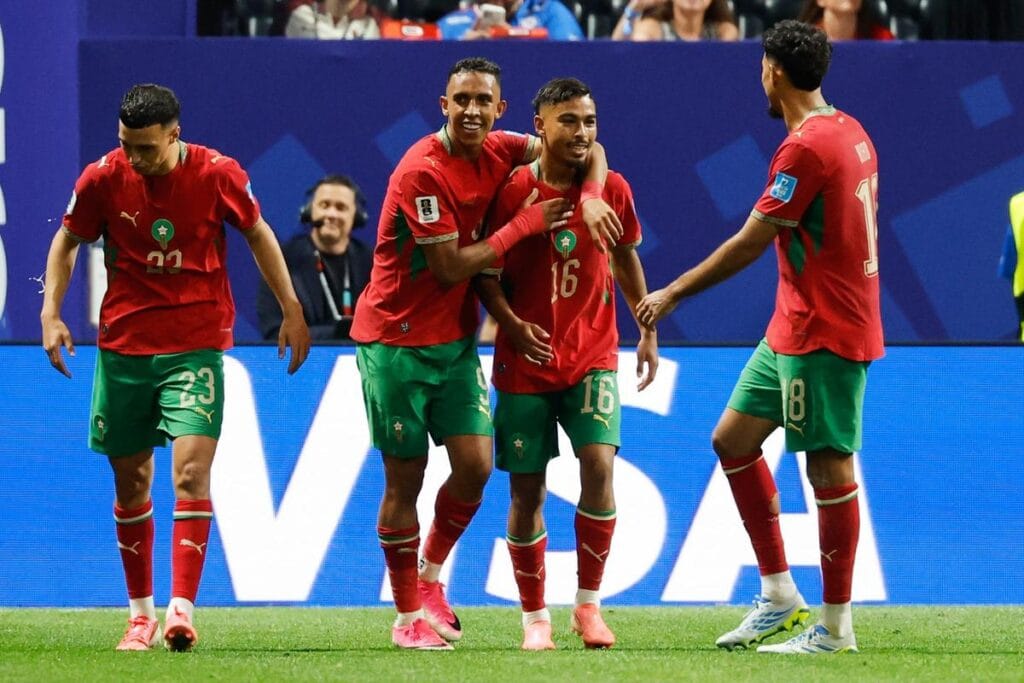
Moroccan players celebrate a dramatic comeback over Haiti in Group C of the FIFA World Cup 2026. Image Credit: The Hindu
FIFA World Cup 2026: Morocco produced a spirited second-half comeback to defeat Haiti 4-2 in a FIFA World Cup Group C match on Wednesday, June 24, 2026. The North African side had to come from behind twice before substitute Soufiane Rahimi and Gessime Yassine delivered the decisive late goals. The victory not only confirmed Morocco’s place in the Round of 32, but also ended Haiti’s dream of collecting a first-ever World Cup point in a tournament appearance that has already carried huge emotional significance for the Caribbean nation.
Why and How Morocco Won
Morocco did not win this match by starting fast or controlling every phase from the opening whistle. Instead, they won because they stayed calm, used their depth intelligently and kept pressing until the game tilted in their favor. That is often what separates good teams from tournament-ready teams. When the scoreline turns messy, the side with more composure usually finds a way back. The Hindu has covered the full story.
Haiti made the game uncomfortable by scoring twice and forcing Morocco into recovery mode on more than one occasion. That kind of resilience is important because it shows Haiti was not overwhelmed by the occasion. But Morocco’s bench changed the story. Soufiane Rahimi, coming off the bench, struck a deflected shot in the 78th minute to make it 3-2, and Gessime Yassine wrapped things up in the 89th minute to remove any remaining doubt.
The timing of the goals is what made the result feel inevitable once the momentum shifted. A late lead in a World Cup group match often feels heavier than it does in ordinary football because the trailing team runs out of both time and emotional energy. Morocco managed that stage of the game very well.
Haiti’s Brave Effort
Even in defeat, Haiti can take some pride from the performance. This was a team playing on football’s biggest stage for the first time in 52 years, and they twice found a way to respond to Morocco’s pressure. That tells you they came in with belief and were not simply there to make up the numbers.
The downside, of course, is that they could not hold the match when it mattered most. Against a more experienced side, every late defensive lapse becomes expensive. Haiti’s hopes of earning a first-ever World Cup point now disappear with the loss, which makes the result emotionally difficult even if the performance had moments of promise.
Still, this is the kind of match that can help shape a nation’s football identity. If the lessons are absorbed properly, Haiti’s World Cup return may prove valuable beyond the final scoreline. In simple terms, yeh match unke liye sirf defeat nahi, ek learning experience bhi hai.
Morocco’s Tournament Maturity
Morocco’s performance was impressive because it reflected maturity rather than panic. Teams with deep tournament ambitions do not always need to dominate every moment; they just need to survive the difficult ones and capitalize late. Morocco did exactly that here.
Finishing second in Group C behind Brazil is a strong outcome. Brazil, the five-time champions, beat Scotland 3-0 in the other group game, so Morocco’s position was secure but still meaningful. Advancing to the Round of 32 with momentum matters because it gives the team a more positive emotional footing before the knockout stage.
This is also a useful reminder of how important squad depth is in modern tournament football. The match was changed not by the starting XI alone, but by the substitutes who arrived with fresh energy and a clear impact. That is a huge advantage in a World Cup, where matches can change in a matter of minutes.
Reported Match Reaction
A football analyst would likely call this a “classic bench-driven comeback.” That phrase fits because Rahimi and Yassine did not just add numbers to the score; they changed the match’s direction.
Another fair description would be that Morocco showed “the calm of a team that expects to progress.” That is what elite tournament teams often look like when they are not at their best early on but still manage to win.
For Haiti, a broadcast observer might say they “played with spirit but were punished by inexperience at the highest level.” That does not reduce the value of their effort; it simply reflects the unforgiving nature of World Cup football.
Background and Context
This World Cup appearance matters to Haiti because it has been 52 years since they last played on football’s biggest stage. That long gap gives every match extra weight, every goal extra meaning and every mistake extra pain. Simply reaching the tournament already marks a major step.
Morocco, meanwhile, has developed a reputation in recent years as one of Africa’s most organized and tactically mature national teams. Their ability to manage tight games has become one of their defining strengths. That is why a comeback like this fits the broader story of their development: they are no longer just competing; they are expecting to win.
Group C also added context. Brazil’s 3-0 win over Scotland meant Morocco could focus on their own match without needing a miracle elsewhere. Once the result turned their way, their progression became a matter of control rather than desperation.
Timeline
Opening stages: Morocco and Haiti begin a tense Group C match with both sides looking for control.
First half / early phases: Haiti stays competitive and keeps the match alive.
Second half: Morocco twice comes from behind as the score swings back and forth.
78th minute: Soufiane Rahimi’s deflected shot gives Morocco a 3-2 lead.
89th minute: Gessime Yassine scores to seal the 4-2 win.
Full time: Morocco advanced to the Round of 32 in second place behind Brazil.
After the match: Haiti are eliminated and remain without a World Cup point.
Why This Matters
This matters because World Cup tournament football is often decided by resilience more than brilliance. Morocco’s win shows how a team can stay alive even when the game is not going smoothly. That is a valuable quality in knockout competitions, where one bad spell can end a campaign.
It also matters because Haiti’s return to the World Cup is bigger than the result itself. A team coming back after 52 years brings enormous symbolism for players, supporters and the country’s football structure. Yeh issue kaafi important hai because these appearances can inspire the next generation even when the scoreboard is painful.
For fans, matches like this are part of what makes the World Cup special. The underdog’s courage, the favorite’s recovery and the late goals all create a story that goes beyond points. That is why this result will be remembered not just as a 4-2 win, but as a game of character.
India Angle
For Indian football fans, Morocco’s win is especially relatable because it shows the value of structure, patience and strong bench depth. India may not yet have a regular World Cup presence, but stories like this show what it takes to succeed on the global stage. In Hinglish, seedhi baat yeh hai: match chhota ho ya bada, late goals aur calm mindset bahut kaam aate hain.
Indian viewers often enjoy underdog stories, and Haiti’s return after 52 years is exactly that kind of emotional arc. At the same time, Morocco’s comeback offers a tactical lesson: strong teams do not panic when the score is against them. They wait for the right moment and use their substitutes well.
That is useful for Indian football conversations too, especially when discussing how to build a deeper, more competitive squad. Bench strength matters. Game management matters. Aur sabse important, belief matters.
Analysis
My opinion is that Morocco’s most valuable trait here was composure. A lot of teams can look good when leading. Fewer can recover twice and still finish strongly. That is what makes their performance more meaningful than the scoreline alone.
Haiti’s side of the story is equally important because football is not only about winners. Their participation after 52 years gives the tournament emotional depth. Even in defeat, they contributed to one of the more dramatic group-stage narratives. From a writing perspective, that balance of result and meaning makes the story strong.
What Next
Morocco now moves into the Round of 32 in second place behind Brazil, and the focus will shift toward knockout preparation. They will need to tighten their defensive moments because the next stage will punish slower starts more harshly.
Haiti exited the tournament, but the experience should still feed into long-term football development. Their return after such a long absence means the country now has a fresh reference point for future growth and investment.
For Morocco, the next step is simple: carry this momentum forward. If they can combine their resilience with a cleaner start to matches, they could become a difficult opponent in the knockout rounds.
Conclusion
Morocco’s 4-2 comeback over Haiti was one of the more entertaining and meaningful matches of the World Cup group stage. Soufiane Rahimi and Gessime Yassine made the difference off the bench, turning a tense contest into a decisive win and sending Morocco through to the Round of 32 behind Brazil. Haiti’s return after 52 years ended without a point, but their presence still added emotional weight to a memorable Group C battle.
Written By A. Jack