Bosnia-Herzegovina’s victory keeps the possibility of a first-ever World Cup knockout stage appearance alive. The result ended Qatar’s tournament, with youth, experience and efficiency proving crucial for Bosnia.
Bosnia-Herzegovina players celebrate after a 3-1 win over Qatar in Group B. Image Credit: The Hindu
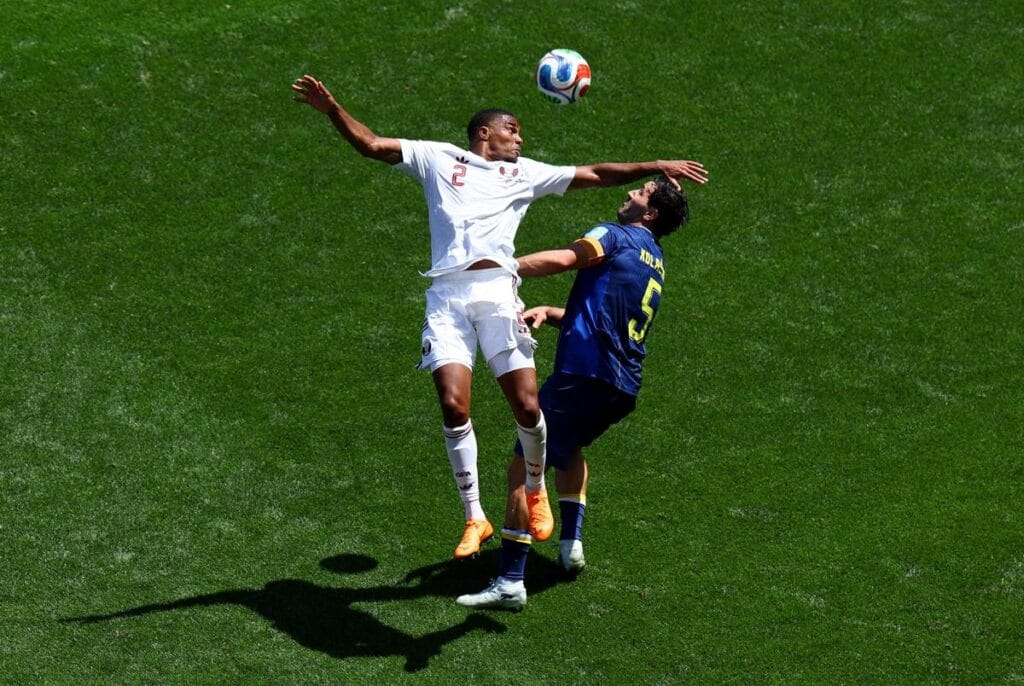
FIFA World Cup 2026: Bosnia-Herzegovina boosted its chances of advancing to the World Cup knockout rounds with a 3-1 win over Qatar on Wednesday, June 24, 2026, in a Group B match that also eliminated Qatar from the tournament. The victory leaves Bosnia-Herzegovina in third place, but in the expanded World Cup format that still may be enough to progress, as the eight best third-place teams across the 12 groups move on to the Round of 32. For Bosnia-Herzegovina, the result carries historic weight because the team has never reached the knockout stage at a World Cup before.
How Bosnia-Herzegovina Took Control
Bosnia-Herzegovina did the important work early and never really let go of the match. Kerim Alajbegovic opened the scoring in the 29th minute with a powerful near-post strike from around 20 yards out, giving Bosnia a lead that it would not surrender. At just 18 years old, Alajbegovic became the eighth-youngest scorer in World Cup history, which is a remarkable achievement in a tournament that usually rewards maturity and composure. The Hindu has covered the full story.
The second goal came five minutes later, in the 34th minute, and it was the kind of goal that often defines a group-stage match. Sead Kolasinac delivered a cross to the back post, Edin Dzeko volleyed the ball back into the middle, and Qatar’s Sultan Al-Brake ended up deflecting it into his own net. It was not the cleanest goal Bosnia will score, but it showed pressure, movement and presence in the box.
Qatar briefly gave itself hope before halftime through Hassan Al Haydos, whose 42nd-minute goal kept the game alive. But Bosnia-Herzegovina responded after the break and restored control in the 80th minute when Ermin Mahmic scored again, adding the third goal and sealing the result. That late strike was crucial because it removed any real chance of a comeback and confirmed Bosnia’s superiority on the night.
Why the Win Matters So Much
This result matters because Bosnia-Herzegovina is now more than likely to advance to the Round of 32 through the third-place route. In the new World Cup format, even a third-place finish can be enough to progress if a team ranks among the best eight third-place sides across the 12 groups. That means Bosnia’s three points, goal difference and overall performance all matter now.
For a nation that has only appeared in one previous World Cup, back in 2014 in Brazil, this could become a landmark moment. If Bosnia-Herzegovina does advance, it would mark the first time in its national team history that the side reaches the knockout stage at a World Cup. That is a huge milestone, not just for the squad but for football in the country more broadly.
Qatar’s elimination, meanwhile, underlines how difficult it can be to turn World Cup participation into sustained success. The team did not win a game in the tournament, and while they showed moments of competitiveness, they lacked the consistency and sharpness needed to survive the group stage. In a tournament this demanding, small lapses quickly become decisive.
Bosnia’s Blend of Youth and Experience
One of the most interesting parts of Bosnia-Herzegovina’s performance was the balance between a young scorer and veteran leaders. Kerim Alajbegovic, at 18, provided the spark, while Edin Dzeko and Sead Kolasinac added experience and composure. That combination is often the difference between a team that competes and a team that progresses.
Young players can bring fearlessness, and Alajbegovic clearly did that here. His goal was not a tap-in or a lucky deflection—it was a confident finish from distance under World Cup pressure. That kind of moment can change a player’s career and also give a team belief that it can do something special.
The older players, particularly Dzeko, bring structure to the attack. Even when they are not directly scoring, they help create the space and timing that younger teammates need. Bosnia-Herzegovina’s performance was a strong reminder that tournament football often rewards teams with a good mix of energy and experience.
Qatar’s Exit and the Lessons Behind It
Qatar’s elimination is disappointing, but it is not without lessons. They stayed competitive at times, and Hassan Al Haydos’s goal showed that they could still trouble opponents. But they were not able to sustain pressure for enough of the match, and the defensive errors around Bosnia’s second and third goals proved costly.
When a team does not win any matches in the group stage, the conversation usually turns to development. That is especially true for a side like Qatar, which has invested heavily in football infrastructure and international exposure. Results at this level are the real test, and this tournament has shown that there is still work to do in terms of finishing, defensive stability and game management.
The gap between competitiveness and qualification is often very small. Qatar had enough moments to make the game interesting, but Bosnia-Herzegovina had the sharper overall execution. That difference is why the South Americans? No—rather, the Balkans? More accurately, the Europeans emerged with a very valuable three points.
Reported Reaction and Expert View
A football analyst would likely describe Bosnia-Herzegovina’s performance as “efficient and mature.” That is the best way to frame it because the team did not need to overwhelm Qatar with possession or create a huge number of chances. It simply made key moments count.
Another observer might say the 18-year-old Alajbegovic “announced himself on the biggest stage possible.” That sounds dramatic, but World Cup history supports the point. Big tournaments are where unknown players become famous, and this goal could be the start of a much larger story for him.
For Qatar, a fair assessment would be that they showed spirit but not enough structural control to survive the full match. They scored, stayed in the contest for a while, but could not hold back Bosnia’s momentum. That is the difference between promising spells and tournament survival.
Background and Context
Bosnia-Herzegovina’s only previous World Cup appearance came in 2014, which means this tournament has carried unusual weight for the national team. For many supporters, the chance to get beyond the group stage is not just about progression—it is about rewriting the country’s football history.
The expanded World Cup format has made third-place qualification a real pathway, and Bosnia-Herzegovina has used that system well so far. Instead of needing only first or second place, teams now have an additional route to the knockouts. That has made the competition more open and more unforgiving at the same time, because goal difference and small margins now matter more than ever.
Qatar’s broader World Cup story has been about ambition versus consistency. They have invested heavily in football development, but tournament results remain the clearest benchmark. This exit will likely lead to more reflection on how to turn long-term investment into stronger on-field outcomes.
Timeline
29th minute: Kerim Alajbegovic scores to give Bosnia-Herzegovina the lead.
34th minute: Bosnia adds a second through an own goal after pressure from Dzeko and Kolasinac.
42nd minute: Hassan Al Haydos pulls one back for Qatar.
80th minute: Ermin Mahmic scores Bosnia’s third goal.
Full time: Bosnia-Herzegovina wins 3-1.
After the match: Qatar is eliminated; Bosnia-Herzegovina moves closer to the Round of 32.
Why This Matters
This matters because World Cup progress can reshape a nation’s football identity. For Bosnia-Herzegovina, reaching the knockout stage would be a major historic first and a moment of pride for the team and its fans. It can also increase attention on the country’s players, coaching setup and long-term football development.
It also matters because the match shows how the expanded format changes strategy. Third-place teams now have a real chance to advance, so every goal and every late goal matters. Yeh issue kaafi important hai because teams cannot afford to relax even after losing one or two games—goal difference can decide everything.
For Qatar, the result matters because it points to the next phase of evaluation. When a heavily invested football program exits without a win, the pressure shifts to planning, coaching and youth development. The lessons from this tournament will likely be studied closely.
India Angle
For Indian football fans, Bosnia-Herzegovina’s story is easy to relate to because it shows how a smaller football nation can still build a genuine World Cup moment. India has long been working toward more regular success in international football, and Bosnia’s mix of patience, youth and experience offers a useful reference point.
In Hinglish, seedhi baat yeh hai: Bosnia ne chance pakad liya aur Qatar ko out kar diya. That kind of clinical finishing is exactly what Indian fans often want to see from developing national teams. When chances come at the World Cup, you have to convert them.
It also matters for Indian viewers because the World Cup is full of teams trying to make history. Bosnia-Herzegovina is now one result away from the knockout stage, and that underdog-to-breakthrough narrative is something Indian football audiences usually enjoy following closely.
Analysis
My view is that Bosnia-Herzegovina’s win is more impressive than a simple 3-1 scoreline suggests. The team had to absorb Qatar’s brief response and then close the game out without any panic. That is the mark of a side that understands tournament football.
Alajbegovic’s goal also gives the story a long-tail narrative advantage because fans love records and emerging talent. An 18-year-old becoming one of the youngest scorers in World Cup history creates a headline that is both emotional and factual. It makes the match memorable beyond the standings.
What Next
Bosnia-Herzegovina now waits to see whether its three points and overall record are enough to place it among the eight best third-place teams. If the numbers hold, the country could celebrate a historic first knockout-stage appearance.
Qatar’s campaign is over, and the focus will likely shift to evaluation and rebuilding. The team will need to assess what worked, what failed, and how to improve for future international tournaments.
For Bosnia-Herzegovina, the immediate goal is simple: stay alive in the knockout race and prepare for the next step if qualification is confirmed. If they do advance, the tournament suddenly becomes much bigger for them.
Conclusion
Bosnia-Herzegovina’s 3-1 victory over Qatar was both a practical and historic result, boosting its chances of reaching the Round of 32 while eliminating Qatar from the World Cup. Kerim Alajbegovic’s record-breaking strike, combined with goals from Dzeko’s involvement, an own goal and Mahmic’s late finish, gave Bosnia the points it needed to stay in the race for a first-ever knockout-stage berth. For a team that has only played one other World Cup, this could be the beginning of a very special chapter.
Written By A. Jack