The African side broke the deadlock in the 50th minute and pulled away late to seal a clinical victory over the World Cup co-hosts. It will be Morocco’s second consecutive quarterfinal appearance after its historic run in 2022.
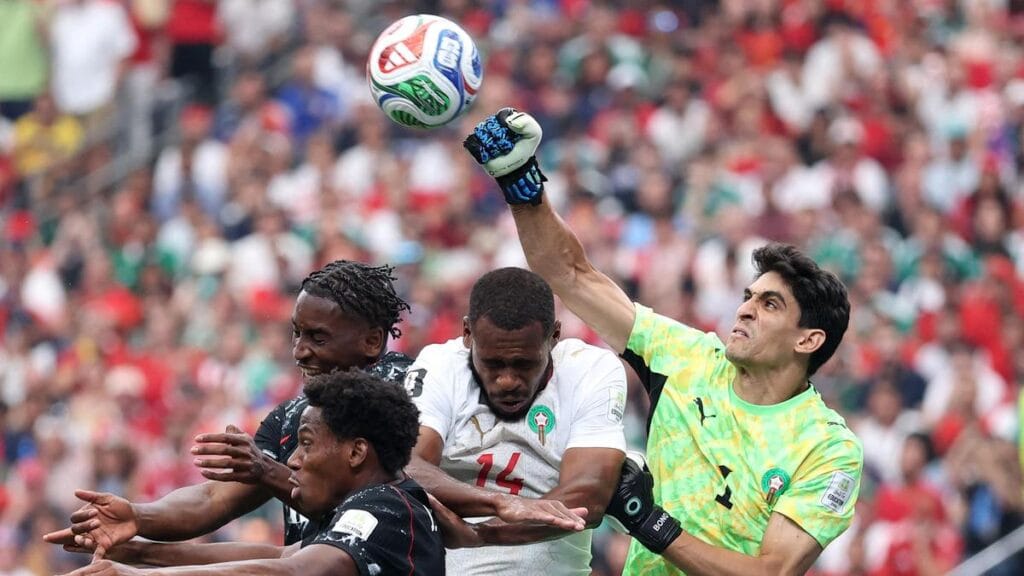
Moroccan players, after Azzedine Ounahi’s goals, powered a 3-0 win over Canada and sent them into the World Cup quarterfinals. Image Credit: The Hindu
Morocco produced another memorable World Cup performance on Saturday, beating co-host Canada 3-0 in the Round of 16 to move into the quarterfinals. Azzedine Ounahi scored twice in a composed and efficient display, and Morocco became the first African nation to reach the World Cup quarterfinals more than once. The win also continued their remarkable tournament journey after becoming the first African team to reach the semifinals in 2022.
This was not a match decided by frantic tempo or constant end-to-end attacking. Instead, Morocco waited patiently, defended smartly and struck at the right moments. Canada competed hard, but Morocco’s quality in key areas made the difference once the game opened up after halftime. Yeh win kaafi special hai because it confirms that Morocco’s previous success was not a one-time story.
How Morocco Won the Match
For much of the first half, neither side managed to break through. The match stayed tight, with both teams looking cautious and organized. That kind of game often depends on one moment of quality, and Morocco found theirs through Azzedine Ounahi in the 50th minute. The Hindu has covered the full story.
The first goal came after a free kick from Achraf Hakimi. Ounahi took the ball from outside the box and fired a right-footed shot through traffic into the bottom right corner. That strike changed the rhythm of the match immediately. Canada, who had kept things level up to that point, now had to chase the game.
Once Morocco had the lead, their confidence grew. They were already comfortable defending compactly and waiting for opportunities in transition. With Canada now needing to push higher, Morocco gained more space to attack. Ounahi capitalized again in the 82nd minute, this time finishing a right-footed shot from the middle of the box after a pass from Brahim Díaz to make it 2-0.
The third goal completed the job and removed any late tension. Morocco’s ability to strike at both the start of the second half and the closing stages showed a team that understands timing. They did not waste energy trying to dominate every minute. They chose the right moments, and that was enough.
Ounahi’s Big Moment
Azzedine Ounahi was the standout performer because he delivered exactly when Morocco needed it most. Tournament football often creates heroes in short, sharp moments rather than in long statistical domination. Ounahi’s two goals were a perfect example of that.
His first goal mattered because it broke a stubborn deadlock. Canada had held Morocco through the first half, so the opening goal was not just a scoreline change — it was a psychological shift. Once Morocco led, they could play with more control and less urgency.
The second goal was equally important because it ensured Canada could not build any serious late momentum. In knockout football, a 1-0 lead can still leave a match open. A second goal usually ends that uncertainty. Ounahi provided that insurance, and it reflected both composure and finishing quality.
Morocco’s Continued Rise
This victory is part of a bigger arc for Moroccan football. In 2022, Morocco became the first African team to reach the World Cup semifinals, which was already a historic achievement. Now they have followed that by reaching the quarterfinals again, making them the first African nation to do so more than once.
That consistency matters. One breakthrough run can be called a surprise. Two strong runs in back-to-back World Cups suggest structure, planning and a national football culture that has found real momentum. Morocco is no longer simply an inspiring outsider story. They are becoming a tournament regular with genuine ambition.
The win over Canada also reinforces Morocco’s reputation as a side that knows how to handle pressure. They do not need chaos to win. They can stay disciplined, absorb pressure and hit opponents when the game becomes stretched. That is a valuable quality in a World Cup where margins are often tiny.
Canada’s Effort and Frustration
Canada entered the game as co-hosts and would have hoped to make life difficult for Morocco, especially in the opening half. They did keep the match close for a long period, but they could not turn that resistance into a breakthrough. Once Morocco scored, Canada were forced to take more risks, and that opened space for the African side to exploit.
This was not a poor effort, but it was a painful result. Against a side like Morocco, mistakes are often punished quickly. Canada simply could not find the decisive attacking move that would have changed the story.
For a co-host nation, getting knocked out in the Round of 16 is always a disappointment, especially after the energy and attention that comes with staging the tournament. Still, Canada showed enough resilience in parts of the match to suggest they can build on this experience in future cycles.
Background and Context
Morocco’s current success should be viewed in the context of their rapid rise on the world stage. Their run in 2022 changed the perception of African teams in knockout football. They proved that an African side could not only compete at the highest level but also sustain a deep tournament run with tactical maturity and mental strength.
This latest result strengthens that legacy. Reaching the quarterfinals twice in a row is rare and meaningful, especially for a team from outside Europe and South America. It also adds to the growing belief that Morocco’s football system has become one of the most efficient in international football.
Canada, meanwhile, has been part of a World Cup that offered them exposure and development, even if the final result here was disappointing. Playing as co-hosts gave them a huge platform, but Morocco’s level on the day was simply higher.
Timeline
First half: The match remains goalless as both teams stay organized.
50th minute: Azzedine Ounahi scores from outside the box after a free kick from Achraf Hakimi.
Second half: Morocco controls the game more confidently after taking the lead.
82nd minute: Ounahi scores again from open play after a pass from Brahim Díaz.
Late stage: Morocco adds a third goal to seal the 3-0 win.
After full time, Morocco advance to the quarterfinals and continue their historic run.
Also Read: Colombia Overcome Ghana 1-0 to Reach FIFA World Cup Last 16
Why This Matters
This matters because Morocco is changing what is possible for African football on the world stage. Reaching the quarterfinals once was historic. Doing it again turns that success into a pattern. That is a huge signal for players, federations and fans across the continent. Yeh issue kaafi important hai because representation at the top level can change beliefs everywhere.
It also matters for the World Cup itself because tournaments are richer when more regions produce genuine contenders. Morocco’s progress gives the competition more variety and more storylines. It shows that modern football is not just about the traditional powerhouses anymore.
For Canada, the match is important for a different reason. It highlights the gap between effort and final quality. That gap is where future development must focus. Competing hard is necessary, but converting key chances is what takes a team deeper into knockout football.
India Angle
For Indian football fans, this result has a lot of relevance because Morocco’s rise offers a practical example of how a nation can build a stronger football identity over time. In Hinglish, seedhi baat yeh hai: talent important hai, lekin system aur discipline usse bhi zyada important hota hai. Morocco has shown how coaching, structure and confidence can produce repeat success.
Indian readers also tend to connect with underdog stories, and Morocco has become more than just an underdog now. They are a team that has earned respect. That makes them a useful reference point for Indian football development, where the long-term goal is not just to participate but to compete deeply.
There is also an emotional angle. Fans in India often enjoy teams that play with heart, tactical clarity and visible team spirit. Morocco’s style fits that description well. Their rise feels inspiring because it is built on collective strength rather than individual hype alone.
Analysis
My opinion is that Morocco is now beyond the stage of being seen as a one-off success story. Reaching the semifinals in 2022 was already incredible, but following it up with another quarterfinal berth changes the narrative completely. It suggests a football structure that is now repeatable, not accidental.
The match itself also shows the importance of patience in knockout football. Morocco did not rush. They stayed in the game, trusted their structure and waited for the right openings. That kind of control is often what decides high-level matches, even when the scoreline seems straightforward.
Canada will likely learn from the experience, but the headline belongs to Morocco. They were more polished, more efficient and more decisive when the opportunities came. That is what top tournament sides do.
What Next
Morocco now moves into the quarterfinals, where the pressure will rise even higher. Their next opponent will likely test their defensive structure and transition play even more severely. But after this performance, they will have confidence that they can handle whatever comes next.
Canada will leave the tournament with valuable experience, but also with a reminder of how hard knockout football can be against an elite side. The challenge for them now is to turn this exposure into a stronger next cycle.
For African football, Morocco’s progress is a continued source of pride and hope. If they keep this run alive, they will carry not just their own ambition but the expectations of a whole continent.
Conclusion
Morocco’s 3-0 win over Canada was more than just a Round of 16 victory. It was a statement that their 2022 run was the beginning of a new standard, not a one-time miracle. Azzedine Ounahi’s two goals powered a composed, clinical display that made Morocco the first African nation to reach the World Cup quarterfinals more than once. With another historic barrier broken, Morocco now enters the final eight as one of the tournament’s most compelling teams.
Written By A. Jack