Norway secured a dramatic place in the FIFA World Cup 2026 Round of 16 with a late 2-1 victory over Ivory Coast in Arlington. Erling Haaland’s tap-in in the 86th minute finally broke the deadlock and sent Norway into a marquee clash with Brazil.
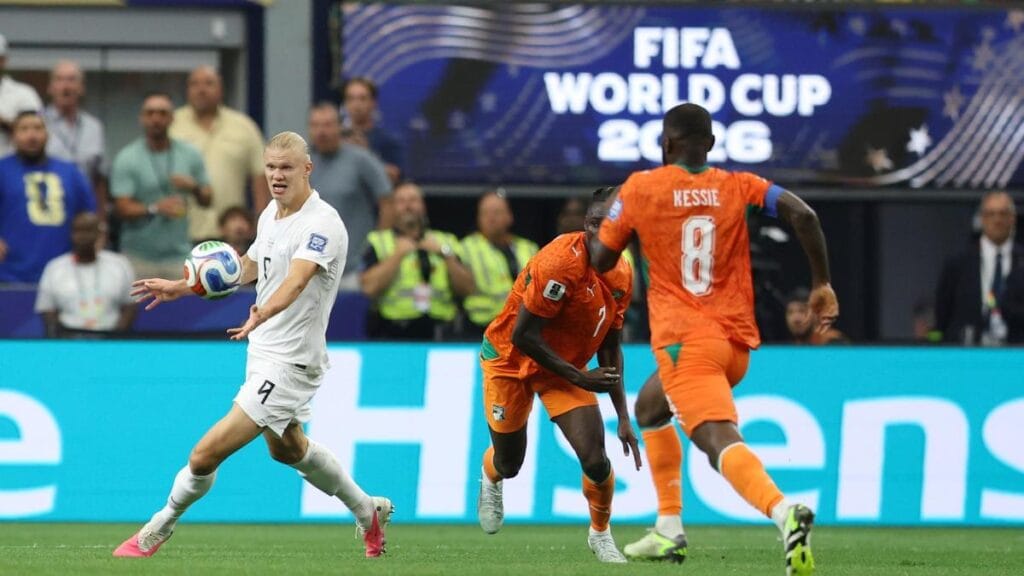
Norway players celebrate their late 2-1 World Cup win over Ivory Coast in Arlington, with Erling Haaland scoring the decisive goal in the 86th minute. Image Credit: The Hindu
Norway advanced to the FIFA World Cup 2026 Round of 16 with a hard-fought 2-1 victory over Ivory Coast in Arlington, sealing the result through Erling Haaland’s late goal in the 86th minute. The striker, who had been largely quiet for most of the match, arrived in the right place at the right time to turn in Patrick Berg’s cross and end Ivory Coast’s resistance. The win sends Norway into a highly anticipated last-16 meeting with Brazil.
This was a match defined by patience, discipline and collective effort rather than constant attacking fireworks. Norway absorbed Ivory Coast’s physical challenge, defended without panic and waited for the moment that would open the game. When it arrived, Haaland delivered. Yeh victory kaafi important hai because it shows how tournament football is often won not by domination, but by timing, composure and unity.
How Norway Won
Norway’s victory was built on a simple but effective principle: stay together, stay calm and do not lose shape under pressure. Ivory Coast brought intensity and physicality, trying to unsettle the Norwegian side with direct play and aggressive battles across the pitch. Norway, however, refused to react emotionally or get dragged into chaos. The Hindu has covered the full story.
The key moment came in the 86th minute, when Patrick Berg delivered a cross into the box and Haaland finished with a simple tap-in. The striker had been relatively uninvolved until that point, which made the goal even more telling. Top forwards do not always need 20 touches to decide a game. Sometimes they need one. That was the story here.
Norway’s defending also deserves credit. The team did not panic even when Ivory Coast applied pressure and tried to turn the match into a physical contest. Instead of breaking apart, Norway held its structure and kept the match within reach. That discipline allowed them to remain dangerous late in the game, when fatigue and concentration become decisive.
The celebration after the final whistle captured the spirit of the performance. Norway’s fans had already turned their support into a kind of rowing ritual in the stands, and the players joined in after the match, sitting down together and rowing in unison with the crowd. It was symbolic but also accurate: this was a team victory, not just a star player moment.
Haaland’s Role
Erling Haaland once again proved why he remains one of the most important attacking players in world football. He did not dominate the match statistically, but he dominated the most important moment. In knockout football, that is often enough.
What makes Haaland special is not only his power and finishing but also his ability to appear at exactly the right time. That trait matters even more in a World Cup, where matches are often tight, cautious and decided by small margins. Against Ivory Coast, he waited, stayed focused and then punished a defensive lapse.
His 86th-minute tap-in was also a reminder that elite strikers do not need spectacular chances to make history. They need concentration, positioning and instinct. Norway got all three. Ivory Coast did not.
Ivory Coast’s Missed Opportunity
Ivory Coast will feel this was a missed opportunity because they were in the game for long stretches and brought enough physical intensity to trouble Norway. But pressure without an end product rarely wins knockout matches. That was the challenge they could not solve.
The flat-footed defensive reaction to the decisive goal will hurt most. Patrick Berg’s cross found Haaland with too much space and too little urgency from the back line. At that level, one lapse can end a tournament run. Ivory Coast’s players will know that the margin for error at the World Cup is tiny.
That said, the match was not lost because of a single moment alone. Ivory Coast had chances to control the rhythm and convert their pressure into a clearer attacking threat. They did not do enough in the final third, and Norway’s compact shape made it difficult to break through.
In knockout football, that combination is dangerous. If you cannot convert pressure into goals, the more clinical team usually wins. That is exactly what happened here.
Background and Context
This result adds another chapter to Norway’s growing World Cup story. The players and fans have developed a visible identity around unity and shared effort, and that collective spirit has become part of the team’s image. The rowing celebration is more than a gimmick; it reflects how the group sees itself, with everyone contributing to the same destination.
For Ivory Coast, the defeat is painful because it ends a match they could have used to establish momentum on the world stage. African teams have often built tournament runs on energy, speed and physical strength, but those qualities must be combined with game control and finishing in the final third. On this night, Norway was the more composed team.
The wider context matters too. Norway’s win sets up a date with Brazil, which will instantly become one of the marquee matchups of the next round. That alone increases the significance of the result. It is not just about who Norway beats, but who they get to face next. Brazil versus Norway will attract global attention, and this victory makes that clash possible.
Timeline
First half: Norway and Ivory Coast battle in a tense, physical encounter.
Middle stages: The Ivory Coast presses hard, but Norway maintains their shape and composure.
86th minute: Patrick Berg delivers a cross and Erling Haaland scores the winner.
Final whistle: Norway celebrates a 2-1 victory and advances to the Round of 16.
Next round: Norway will face Brazil in one of the most anticipated fixtures of the knockout stage.
Also Read: FIFA World Cup 2026: Paraguay Stun Germany on Penalties to Reach World Cup Round of 16
Why This Matters
This matters because it shows how knockout football rewards discipline and timing as much as talent. Norway did not need to dominate every phase of the match. They needed to survive, stay organised and take one key chance. Yeh issue kaafi important hai because it teaches that tournaments are not won by style alone.
It also matters because Norway’s progression adds another layer of intrigue to the World Cup bracket. A Brazil-Norway clash is the kind of fixture that lifts interest across continents. Fans want drama, and this win delivers it.
For Ivory Coast, the result is a reminder that physicality and intensity are not enough if the finishing edge is missing. In modern football, especially at the World Cup, teams must balance energy with precision. Otherwise, one late mistake can undo 90 hard minutes.
India Angle
For Indian football fans, Norway’s win will be interesting because it highlights the value of structure and team discipline. In Hinglish, seedhi baat yeh hai: sirf attacking star hone se match nahi jeeta jata, team ko saath khelna padta hai. Norway showed that even when Haaland was quiet for long stretches, the side stayed united and ready for the big moment.
Indian viewers also tend to enjoy underdog stories and late winners, especially when they come against a physically strong opponent. This match has both. It is the kind of game that reminds fans why tournament football remains so exciting.
There is also a broader lesson for Indian football development. A clear system, collective movement and mental toughness can keep a team alive in big matches. Norway’s victory is a good example of how tactical discipline can support individual brilliance rather than depend on it alone.
Analysis
My view is that Norway deserved the win because they handled the pressure better. Ivory Coast brought the physical battle, but Norway stayed emotionally balanced and did not allow the game to spiral. That calmness is often the difference in knockout football.
Haaland’s winning goal will naturally get the headlines, but the bigger story is Norway’s collective identity. Teams that develop a clear and repeatable way of playing are often the ones that survive the World Cup’s chaos. Norway’s rowing celebration may look playful, but it perfectly reflects a serious football truth: everyone must pull together.
The Brazil matchup now becomes the next big storyline. From an SEO perspective, that adds even more value to this result because the next fixture has global appeal. Norway has done the hard part by getting there.
What Next
Norway now prepares for a major last-16 meeting with Brazil, which will be one of the standout fixtures of the knockout round. That match will test whether their discipline can hold up against one of the world’s most gifted teams.
For Ivory Coast, the tournament ends with frustration and lessons to take forward. They will review how they handled the final third, how they defended the decisive move and how they can be more clinical in future tournaments.
For the World Cup overall, Norway’s win adds to the sense that knockout football remains unpredictable. The bracket is now more exciting, and the Brazil-Norway clash will be one of the biggest talking points going into the next round.
Conclusion
Norway’s 2-1 victory over Ivory Coast was a classic knockout performance built on patience, defensive discipline and one late moment of quality from Erling Haaland. The 86th-minute tap-in was the difference, but the win belonged to the whole team and the spirit they brought to the pitch. Norway now moves on to a blockbuster Round of 16 match against Brazil, while Ivory Coast is left to regret a missed opportunity. In a tournament full of pressure and surprise, Norway showed the value of rowing together until the very end.
Written By A. Jack