Switzerland sealed their spot in the FIFA World Cup last 16 with a disciplined, tactically astute 2-0 win over Algeria on Thursday, July 2, 2026. Breel Embolo opened the scoring early and Dan Ndoye added the second as Murat Yakin’s side dominated a close-fought, tactical encounter to set up a meeting with either Ghana or Colombia in Vancouver.
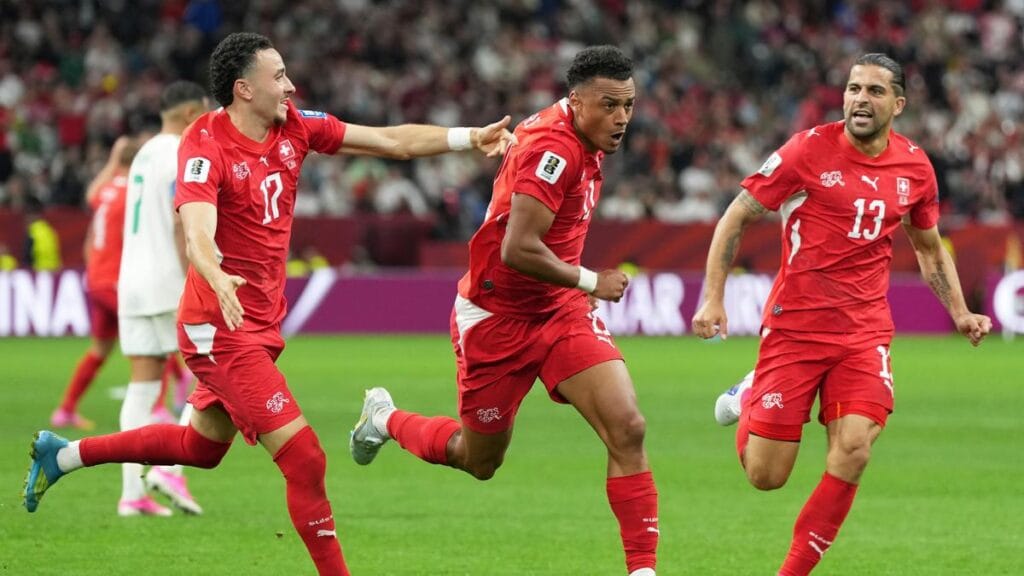
Switzerland players celebrate after Breel Embolo and Dan Ndoye scored in a 2-0 win over Algeria that sent them into the World Cup’s last 16. Image Credit: The Hindu
Switzerland advanced to the FIFA World Cup 2026 last 16 with a polished 2-0 victory over Algeria in Vancouver on Thursday, July 2, 2026. Breel Embolo struck early to give the Swiss the lead, and Dan Ndoye later added the second to put the match beyond Algeria’s reach. The result was a strong statement from Murat Yakin’s side, who managed the game with tactical intelligence and calm under pressure.
The match may not have been full of end-to-end drama, but it had layers of strategy, defensive planning and decisive finishing. Switzerland did not need to dominate every phase in a flashy way. Instead, they waited, adapted and punished Algeria at the right moments. That is often what separates good knockout teams from great ones. Yeh win kaafi important hai because it shows Switzerland can win with control, not just talent.
How Switzerland Won the Match
Switzerland’s victory was built on discipline rather than noise. Murat Yakin’s team shifted formations, changed rhythms and set traps for Algeria before striking with two well-timed goals. That kind of game management is valuable in knockout football, where one mistake or one lapse can end a tournament run. The Hindu has covered the full story.
Breel Embolo’s early goal gave Switzerland exactly what they needed: an opening that forced Algeria to chase the match. Once that happened, the tactical balance tilted in Switzerland’s favour. Algeria had to take more risks, and that created space for the Swiss to work into more dangerous areas.
Dan Ndoye’s second goal was the insurance strike that settled the contest. In knockout matches, that second goal often matters as much as the first because it changes the emotional tempo of the game. Algeria could still hope after 1-0, but 2-0 makes the challenge much harder.
The real story, though, was how Switzerland controlled the shape of the match. The phrase “tactical masterclass” fits because they did not simply wait for Algeria to make a mistake. They actively created confusion through movement, structure and traps. That is smart football, and it is exactly what a well-coached side should do in a World Cup knockout game.
Why Algeria Struggled
Algeria were not completely outplayed in every moment, but they were outmanoeuvred in the areas that mattered most. In a game described as short on excitement but rich in nuance, Algeria likely found that Switzerland’s organisation left fewer clean routes to goal. When a defence is compact and a midfield is reading the game well, chances become harder to create.
This was especially difficult after the early Swiss goal. Teams trailing in knockout football often have to force the pace, and that can lead to rushed decisions or poor spacing. Algeria probably had periods of possession and pressure, but the Swiss plan appears to have absorbed that pressure effectively.
The key problem for Algeria was not effort. It was timing and precision. They needed a moment to swing the game back in their direction, but Switzerland kept shutting those doors. That makes the defeat frustrating, because it feels less like a collapse and more like being outsmarted.
Murat Yakin’s Tactical Edge
Murat Yakin deserves a lot of credit for this result. Tournament football is often decided not just by the players on the pitch but by the coach’s ability to adapt during the game. Switzerland reportedly shifted formations and laid traps for Algeria, which suggests a detailed and flexible plan.
That matters because a lot of international sides can defend well or attack well, but only a few can do both while changing shape mid-match. Switzerland’s ability to adapt is a major tournament strength. It means they are not dependent on one fixed style.
Yakin’s approach also signals confidence in the team’s football intelligence. If players can move between shapes and roles without losing structure, then they are more likely to survive against different opponents in later rounds. This is where knockout football becomes a chess match, not just a sprint.
Background and Context
Switzerland’s progress into the last 16 adds to their reputation as one of Europe’s most dependable tournament sides. They are not always the loudest team in the competition, but they are often among the most organised. That consistency is valuable in World Cups, where many teams start brightly but fade under pressure.
Algeria, meanwhile, came into the match knowing that a knockout appearance carries weight and expectation. For many fans, an African side making progress on the world stage is important not just for the country involved but for the broader football conversation. Algeria’s exit will be disappointing, especially because the margin was controlled rather than chaotic.
The next round will keep Switzerland on the move, with a matchup against Ghana or Colombia waiting in Vancouver. That means the Swiss journey is not just continuing; it is likely to face an even sharper test. But after a composed 2-0 win, they have every right to feel confident.
Timeline
Early phase: Switzerland start with tactical control and begin shaping the rhythm of the game.
Opening goal: Breel Embolo scores to put Switzerland ahead.
Middle period: Algeria try to respond, but Switzerland keep their structure.
Second goal: Dan Ndoye scores to strengthen the Swiss lead.
Final stretch: Switzerland manage the match calmly and see out the 2-0 win.
After full-time: Switzerland advance to the last 16 and prepare for Ghana or Colombia.
Also Read: Ramos Stoppage-Time Winner and Ronaldo Penalty Seal Dramatic Comeback Into FIFA World Cup Last 16
Why This Matters
This matters because knockout football rewards teams that can adapt under pressure. Switzerland showed that they can win without needing a chaotic, high-scoring display. That is a very useful quality in a World Cup, where margins are thin and composure often decides everything. Yeh issue kaafi important hai because tactical maturity can carry a team further than raw excitement.
It also matters because Switzerland’s progress keeps the tournament balanced and competitive. A side that can manage different game states, absorb pressure and strike efficiently becomes a genuine threat in later rounds. That creates more interesting matchups ahead.
For Algeria, the result is painful but informative. It shows how quickly a clever, disciplined opponent can turn a tight game into a controlled win. In tournaments, that lesson is often as valuable as the result itself.
India Angle
For Indian football fans, this match is a good example of how tactics can matter more than entertainment alone. In Hinglish, seedhi baat yeh hai: kabhi-kabhi flashy football se zyada kaam disciplined football karta hai. Switzerland did exactly that, and it is a useful lesson for viewers who enjoy understanding the strategic side of the game.
Indian fans who follow World Cup football often appreciate underdog stories and smart tactical performances. This one fits that mould. It was not about a superstar scoring a hat-trick; it was about a team doing the basics better than the opponent and winning through organisation.
There is also a broader point for Indian football development. As Indian clubs and youth systems try to improve, matches like this show the importance of structure, spacing and team shape. Talent matters, but without tactical discipline, tournament football becomes much harder.
Analysis
My opinion is that Switzerland are being quietly built into one of the more dangerous teams in the tournament. They may not attract the same hype as larger football nations, but tactical flexibility is exactly what can take a team deep into a knockout bracket. When a team can change shape and still stay stable, it becomes much harder to beat.
Algeria’s loss also underlines a common World Cup truth: you can play reasonably well and still lose if the opponent is sharper in the decisive moments. That is why coaches value control so much. It is not always about possession or volume of chances; it is about who manages the game better when it matters.
The most notable thing here is Switzerland’s efficiency. Early goal, second goal, no panic, no chaos. That is tournament football done right.
What Next
Switzerland now moves into the last 16, where they will face either Ghana or Colombia in Vancouver next week. That promises a tougher and more open battle, especially if the opponent has greater attacking speed or individual flair.
The Swiss will likely stick with the same core idea: stay organised, rotate shapes and wait for the right moments to strike. If they keep playing with this level of control, they will be a serious problem for whoever comes next.
Algeria will head out of the tournament with disappointment but also with lessons about how elite knockout games are managed. The team’s next phase will likely involve reflection on how to turn competitive performances into winning performances.
Conclusion
Switzerland’s 2-0 win over Algeria was not the most dramatic match of the World Cup, but it was one of the smartest. Breel Embolo and Dan Ndoye provided the goals, while Murat Yakin’s tactical approach gave the Swiss a clear edge in a game full of strategy and subtlety. With a place in the last 16 secured and Ghana or Colombia next, Switzerland have sent a strong message: they may not always be the loudest team, but they are shaping up to be one of the most effective.
Written By A. Jack