
The Hinjawadi-Shivajinagar corridor on Pune’s Line 3 has completed trial runs and has now entered the last phase before commercial launch, bringing the city’s first third-rail-powered metro line on the cusp of completion. The 23-km “Puneri Metro” will change the daily ride from the city’s IT hub to the central business districts, and will also feature a cleaner and more compact traction setup than Pune’s existing overhead-wire lines.
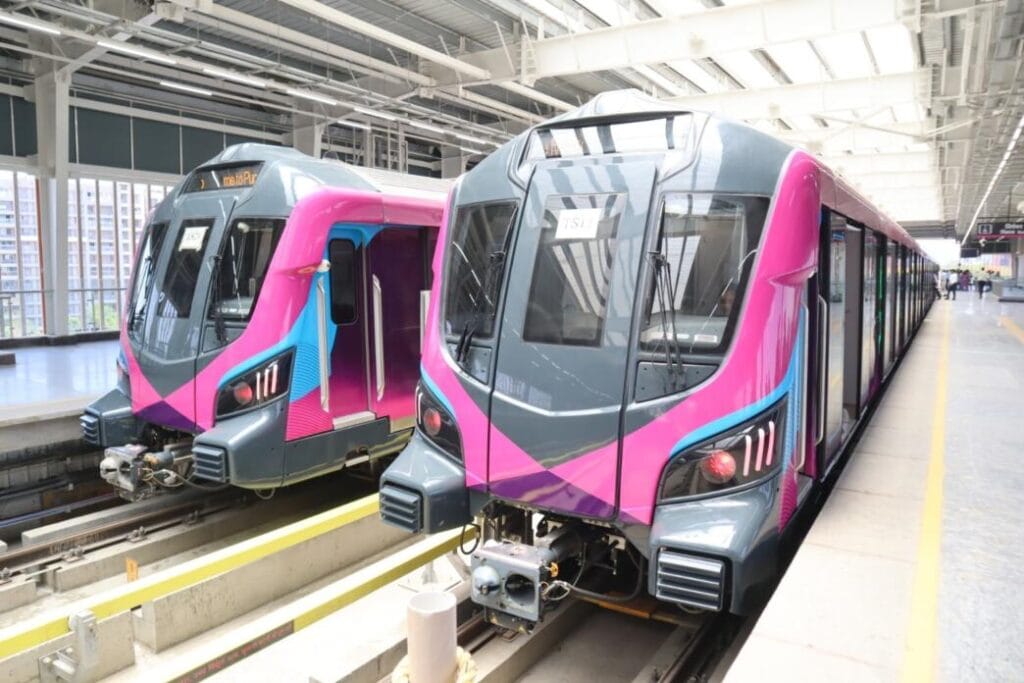
Pune Metro Line 3 trains undergo final trial runs on the Hinjawadi–Shivajinagar corridor. Image Credit: Pune Times Mirror
Pune is on the verge of a major transit milestone as Metro Line 3, the Hinjawadi–Shivajinagar corridor, moves closer to launch after completing full trial runs. The 23-kilometre route will be the city’s first metro line to use a 750V DC third-rail system instead of overhead wires, marking a significant shift in how urban rail power is delivered in Pune. Once it opens, the line is expected to cut travel time sharply between Pune’s high-traffic IT corridor and its older commercial core.
The project is important not just because it adds another metro line, but because it introduces a different technical model for the city. Pune’s current metro network relies on conventional overhead traction, while Line 3 will use collector shoes beneath the train to draw power from a rail laid alongside the track. That may sound technical, but the impact is simple: smoother, cleaner and potentially more efficient metro operations. Yeh upgrade kaafi important hai because it affects daily travel, city design and long-term urban planning all at once.
How the Third-Rail System Works
A third-rail metro is powered differently from a conventional overhead-wire metro. Instead of pantographs reaching up to overhead cables, the train uses collector shoes mounted underneath the coach to pick up electricity from a conductor rail running beside the track. In Pune’s Line 3, the system is based on 750V DC power, which is commonly used in many urban metro environments. NDTV has covered the full story.
This setup has several practical advantages. First, it reduces visual clutter because the corridor does not need masts and overhead wires across the line. That matters in a city like Pune, where the metro route passes through busy built-up areas and major road corridors. Second, the system is considered sturdier in dense urban settings and potentially cheaper to maintain than conventional overhead traction. Third, it is well suited for frequent train operations where short intervals and quick acceleration matter.
The other major technology on Line 3 is CBTC, or Communication-Based Train Control. This is a modern digital signalling system that continuously communicates a train’s exact position and speed. Instead of relying on fixed blocks of track space like older systems, CBTC allows trains to run closer together safely. In practical terms, that means shorter waiting times and more efficient service. It also leaves room for more automation in the future, which is a sign of where modern metro systems are headed.
Why This Corridor Matters
The Hinjawadi–Shivajinagar corridor is not a random route. It connects the Rajiv Gandhi Infotech Park in Hinjawadi with Wakad, Baner, Balewadi, University Circle and Shivajinagar. That is one of the most important commuter stretches in Pune because it links the IT employment zone with the city’s commercial and educational core.
Anyone who has travelled this route during peak hours knows the problem: traffic gets heavy, and what should be a manageable commute turns into a long, tiring journey. The metro is expected to ease that pressure by offering a faster and more predictable option. Officials say the journey between Shivajinagar and Hinjawadi, which can take around 90 minutes now, may be reduced to roughly 45 minutes once the line is operational. That is not a small improvement; it is a life-changing cut in commute time for thousands of daily riders.
For Pune, this is also about the city’s growth pattern. The IT sector continues to expand westward, while housing and business clusters have multiplied around the corridor. If transit does not keep up, congestion only gets worse. Line 3 is Pune’s attempt to stay ahead of that curve rather than simply react to it.
Trial Runs and Launch Readiness
The corridor has reportedly completed full trial runs and is now in the final stretch before commercial launch. That means the infrastructure is largely in place, but the project is still waiting on final statutory and regulatory approvals. This is the stage where safety checks, operating clearances and official sign-offs matter most.
Rollout will happen in phases. The opening phase covers 13.3 kilometres between Maan and the R.K. Laxman Museum, with 12 stations. A second phase will extend the line to District Court station, where it will connect into the wider Maha Metro network. That phased approach is common in large metro projects because it allows the system to start serving passengers before every last segment is fully active.
From a commuter’s perspective, that is good news. Even partial opening can ease congestion on the most heavily used stretch and give people a faster option early on. For a city like Pune, where road traffic has become a major daily headache, even a phase-wise launch can make a noticeable difference.
Background and Context
Pune’s metro story has been evolving over time, but Line 3 is particularly significant because it brings in a new type of power and signalling system. Third-rail power is already used in parts of the Kolkata Metro and Bengaluru’s Namma Metro, along with a handful of newer rail systems. Pune now joins that list, making it part of a smaller but growing group of Indian metro networks using this setup.
The shift also reflects a broader trend in Indian urban transport. Cities are moving toward more compact, technology-driven metro systems that can handle tighter schedules and denser passenger flows. Overhead wires still work well in many contexts, but in tightly developed corridors, third-rail systems can sometimes offer cleaner integration with the urban landscape.
Line 3 is also notable because it is one of the city’s most strategically placed routes. By connecting the IT belt and key city zones, it is designed not just as a transport line but as a mobility solution for Pune’s economic geography. That gives it importance beyond the metro map.
Timeline
Planning phase: Pune finalises the Hinjawadi–Shivajinagar corridor as Line 3.
Construction stage: The 23-km route is built with third-rail traction and CBTC signalling.
Trial runs: Full trial runs are completed on the corridor.
Final approvals: The project enters the last stage, awaiting statutory and regulatory clearances.
Opening phase: 13.3 km between Maan and R.K. Laxman Museum is set to open first.
Expansion phase: The line will later extend to District Court and connect with the broader Maha Metro system.
Also Read: Pune Metro Coach Leakage During Heavy Rain Sparks Commuter Concerns
Why This Matters
This matters because transport shapes how a city lives and works. If a metro line reduces commute time from 90 minutes to around 45, that changes productivity, family time and even stress levels. For office workers, students and daily commuters, that extra hour saved each day is huge. Yeh matter isliye important hai because time saved on the road becomes time gained in real life.
It also matters because the line is introducing a more advanced operational model to Pune. Third-rail power and CBTC signalling represent a more modern metro design, which can support higher frequency and possibly better reliability. In a growing urban centre, that is not just a tech upgrade; it is a city planning step.
There is also an environmental angle. More efficient mass transit can reduce dependence on private vehicles and lower congestion. That means less idling traffic, less fuel wasted and a cleaner commuting experience for the city.
India Angle
For Indian readers, this story is important because Pune is a good example of how fast-growing cities are trying to modernise transport without waiting for traffic to solve itself. In Hinglish, seedhi baat yeh hai: jab road pe load zyada ho jata hai, tab metro hi long-term solution ban sakti hai. Pune’s Line 3 is a strong case study for that.
It also speaks to the larger Indian metro boom. Cities across the country are choosing different technologies depending on geography, density and commuter patterns. Pune adopting third-rail power shows that Indian cities are not all building identical systems; they are trying to match technology to local needs.
For working professionals in India, especially in IT hubs, this matters a lot. Commutes in Indian metros are often the biggest source of daily frustration. If a line like this works well, it becomes a model for other corridors in cities such as Bengaluru, Hyderabad, Ahmedabad and beyond.
Analysis
My opinion is that the third-rail detail gives this story extra SEO value because it is technical, unusual and highly specific. Many readers may not know the difference between third-rail and overhead power, so the explanation makes the article both useful and discoverable. At the same time, the real story is not just the technology; it is the commute relief.
The phased rollout also makes sense from a practical standpoint. Opening in stages allows the city to start delivering benefits without waiting for every final link to be complete. That is often the smartest way to handle a project of this scale.
The key challenge now is regulatory clearance. Infrastructure projects often look finished before they are fully ready for passengers, and the final approval stage is where delays can still happen. Still, the fact that trial runs are complete is a strong signal that the launch is near.
What Next
The next step is the final statutory and regulatory sign-offs. Once those are completed, commercial operations can begin on the first phase between Maan and the R.K. Laxman Museum. After that, attention will shift to the extension toward District Court and the full integration with the Maha Metro network.
After launch, the real test will be reliability. Commuters will want punctual service, smooth frequency and easy interchange with other travel modes. If the line performs well, it could quickly become one of Pune’s most important transport links.
For the city, the long-term next step is corridor-level traffic relief. If Line 3 works as planned, it may encourage more people to shift from private vehicles to public transport, which would be a major win for Pune’s mobility future.
Conclusion
Pune Metro Line 3 is almost ready to become the city’s first third-rail metro, and that makes it a major milestone for urban transport in Maharashtra. With trial runs completed and final approvals pending, the Hinjawadi–Shivajinagar corridor is set to bring faster travel, cleaner station design and more modern signalling to one of the city’s busiest commuter stretches. If the line opens as expected, it could cut journey times sharply and reshape how Pune moves every day. This is not just a metro launch; it is a sign of how Indian cities are adapting to the demands of faster, denser urban life.
Written By A. Jack