A Gujarat-based startup is using IoT-powered hydroponics and climate-controlled farming systems to help farmers grow more crops with much lesser water. Brio Hydroponics claims its model can deliver up to 5X higher yields while cutting water usage by up to 90% and promises a more predictable and profitable future for Indian agriculture.
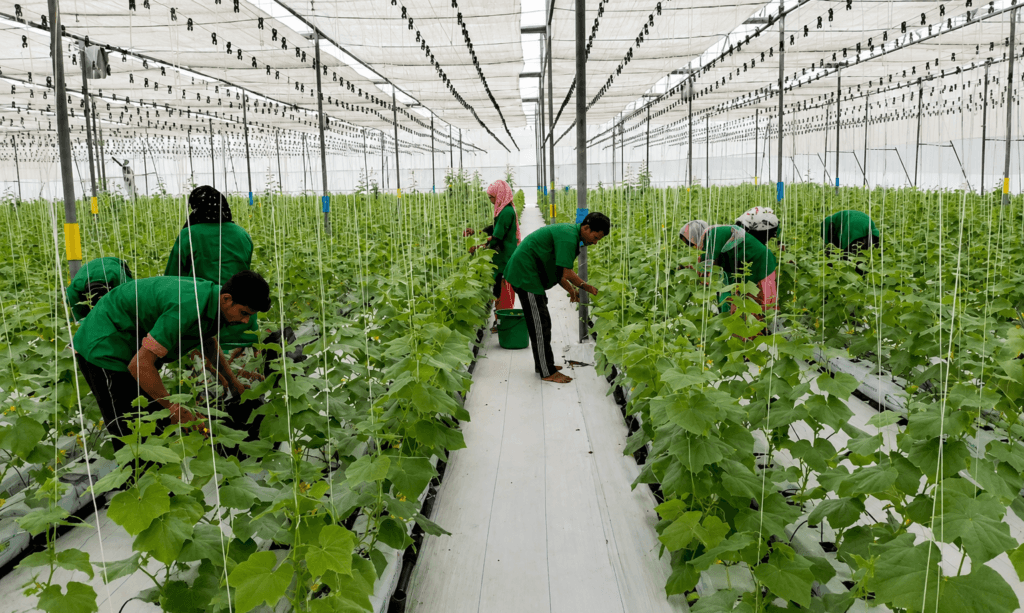
A view of a greenhouse farm where rural youth are growing high-quality vegetables through hydroponics. Image Credit: The Better India
In Gujarat, a new model of farming is changing the way some Indian farmers think about agriculture. Pravin Patel’s startup Brio Hydroponics is developing IoT-enabled hydroponic farming systems that grow crops without soil, using a fraction of the water and producing more consistent yields.
Farmers across India are already using the model, including Gujarat’s Yash Vora, who says hydroponics has given him a more efficient and commercially viable way to grow vine crops such as cucumbers, tomatoes and capsicums. This is a very important development as it tackles three of the biggest problems of Indian agriculture at one go: water scarcity, weather uncertainty and unstable income.
What Hydroponics Is
Hydroponics is a soil-less farming method in which plants receive water and nutrients directly through controlled systems. Instead of relying on open fields and natural rainfall, the crops are grown inside protected structures where temperature, humidity, irrigation, and nutrient delivery are carefully managed.
Brio Hydroponics is a combination of Controlled Environment Agriculture and IoT-based technology to control the health of the crop. This means that sensors, fogging systems, fertigation tools and irrigation controls all work together in unison to create a farming environment that is much more predictable than conventional agriculture.
This is part of why the model is getting noticed. In India, traditional farming is often heavily dependent on rainfall and other natural conditions. Hydroponics attempts to reduce that uncertainty through technology. In summary, the farm is not a gamble on the weather but a managed production system.
Why Farmers Are Turning To It
The biggest draw of hydroponics is its water efficiency. Farmers using the startup’s system can reportedly save up to 90% more water than with traditional farming while producing five to 10 times more per acre.
For farmers dealing with shrinking water supplies, that is a major advantage. Gujarat is a water-stressed state in many regions, and that makes technologies like hydroponics especially appealing. Yash Vora says water scarcity was a major reason he turned to hydroponics, calling it the right solution for the future.
He says the system allows him to grow vine crops in a way that is efficient, consistent, and commercially viable. The real benefit, he adds, is not only higher-quality crops but also much lower losses, which improves returns and reduces risk.
How The Startup Began
Pravin Patel founded Brio Hydroponics in 2014, having grown up in a farming family and seen firsthand the problems of agriculture. Patel, a commerce graduate and son of a farmer, says he realised that soil-less farming would address some of the biggest challenges facing Indian farmers.
He pointed to unpredictability in traditional farming as the core issue. According to Patel, conventional agriculture often gives farmers little forecastability, while hydroponics allows them to plan production much better according to demand and supply.
That is a big shift in mindset. Instead of waiting for the season to decide what the harvest will look like, farmers can now manage production through a system. Patel says the bigger goal was never just to introduce a new technology but to create a system-driven way of farming that supports economic stability.
What Makes The System Different
Brio’s hydroponic model provides multiple layers of protection to protect crops from insects, rain and temperature variations. Fogging systems help control humidity and heat. Rainwater harvesting helps conserve water. The Better India has covered this story.
Sensor-based fertigation enables accurate delivery of nutrients to the farms. “Crops are irrigated several times a day based on precise requirements, so the system controls pH, nutrient levels and water delivery,” says Patel. That cuts down on human error and makes farming more scientific.
The startup says cucumber yields can reach 500 to 600 tonnes per hectare annually under its system. For farmers, that means not just more output, but better consistency. That consistency is crucial because market planning becomes easier when farmers know what to expect from each season.
Why This Matters
This is important because Indian agriculture is under great stress. Farmers are facing challenges such as irregular rainfall, rising temperatures, pest attacks, shrinking arable land and water shortages. A system that can generate more food with less water is obviously of value.
It matters, too, because hydroponics can help make farming a more structured business. The traditional model leaves farmers open to risks they cannot control. Hydroponics does not remove all the risks, but it does get rid of enough of the uncertainty to make planning possible.
For farmers, that can change everything. Predictable production means better income planning, better market timing, and lower losses. That is not just a technical upgrade; it is a livelihood upgrade. Yeh point kaafi strong hai because it shows technology can improve both sustainability and dignity in farming.
India’s Role in Hydroponic Farming Innovation
The point is clear to India. Water stress is already a huge problem for many states and climate change is making it difficult to farm in rural and semi-urban areas. Hydroponics and the like may not replace all farming but can provide a useful parallel system for high-value crops.
The model will be particularly useful for farmers looking to grow crops such as cucumbers, cherry tomatoes and capsicums in a more controlled environment. Hydroponics can help with these crops, which are often highly demanded by the market.
It also aligns with India’s broader push for agritech and precision farming. Water-saving systems are likely to become more important as more farmers seek to cut losses and improve profitability. In that sense, Gujarat’s startup story is not just a local innovation — it’s a national shift in how farming could be done in the future.
From Technology To Agripreneurship
One of the most interesting parts of Brio’s story is how it has tried to build confidence in a new kind of farming. When the startup began, many people did not believe crops could grow without soil. Patel says convincing people that hydroponics was possible was one of the biggest early challenges.
The company has focused on demonstrations, training and field support to build trust over time. That effort has been rewarded. “The conversation has gone from ‘what is hydroponics?’ to ‘how do you make this a business?’” says Patel.
That shift matters because it has spawned a new class of agripreneurs. It is now being joined by people from IT backgrounds, students and traditional farming families. That is to say, the view of farming as a family occupation is no longer the only perception, and it is more and more an enterprise.
Experiences From Farmers
Yash Vora says that hydroponics has made farming feel more planned and commercially viable. “The model gives better returns as the crop quality is good and losses are minimal, so the business is more sustainable in the long run,” he says.
Mehul Shah of Assam has a similar experience. “In my state, traditional farming was living with too much rain and too little control,” he says. “Hydroponics gave me predictability. He can now grow cherry tomatoes, coloured capsicums and cucumbers with more confidence in the timing of the harvest and the market value.
“I wanted to grow high-value, reliable crops rather than depend on weather every year,” says Gaurang Parikh from Maharashtra. The system, he says, has helped him think like an agripreneur and not just a farmer.
These statements show a recurring theme: hydroponics is changing not only crops but also confidence. That is a major shift in a sector where uncertainty has traditionally been accepted as normal. Go check out here for the latest news from all over india.
Background And Timeline
2014: Brio Hydroponics set up by Pravin Patel in Gujarat.
The startup develops demonstrations, training programs and practical support for farmers.
Last decade: Trained over 16,000 participants through online, offline and internship-based programs.
Recent years: Brio has been supporting more than 150 hydroponic projects in India and abroad.
Now: The company is working on 100 acres hydroponic project in Talod, Gujarat.
The timeline below illustrates the startup’s journey from early experimentation to large-scale implementation. It also signifies that hydroponics is evolving from a niche innovation to broader agricultural relevance.
How Hydroponics Is Reshaping Indian Farming
The biggest takeaway is that hydroponics is solving a real Indian problem and is not just a futuristic-sounding thing. Here, water savings, climate control and predictable yields are not marketing claims. They are direct answers to the problems farmers already have.
The economics also seem interesting, although the startup’s numbers show that this remains a high-investment model. A pilot hydroponic farm can cost Rs 50–90 lakh per acre, though costs can drop to Rs 25–40 lakh per acre as projects scale. Farms at optimal scale can generate Rs 60-80 lakh per acre per year in revenue.
That may be OK for high-value crops, but it also means hydroponics is not yet an easy fix for every farmer. It requires capital, technical support, and proper management. So while the model is powerful, it is best seen as a scalable tool for targeted farming, not a universal replacement for open-field agriculture.
What’s Next for Hydroponic Farming in India
The next step for Brio Hydroponics seems to be cluster expansion and growth. The company is setting up a 100-acre project in Talod, Gujarat, that could be one of the largest hydroponic installations in the country.
If the project is a success, it could help prove that hydroponics can work on a much larger scale in India. This would probably bring in more farmers, investors and policymakers to the model.
Same goes for high-value crops — in time, more water-stressed states may look to similar systems. The big question is whether the technology can become affordable and accessible enough for wider adoption. If that happens, the future of farming could look very different from today.
Conclusion
Brio Hydroponics is proving that Indian agriculture need not be dependent on rainfall, the quality of soil and the perennial uncertainty. The startup is helping farmers produce more with less water and less risk using IoT, precision irrigation and climate-controlled hydroponics.
The model is still evolving and it’s not cheap to set up, but it offers a compelling path for farmers who want stability, sustainability and better returns. And in a country where farming is often a gamble, that sort of predictability might be one of the most valuable innovations of all.
–Written by A. Aisha–