A tragic kolkata warehouse collapse in Kolkata’s Taratala area claimed five lives and left several workers trapped under debris, prompting the West Bengal government to suspend construction work at projects approved under the previous administration pending a structural safety audit.
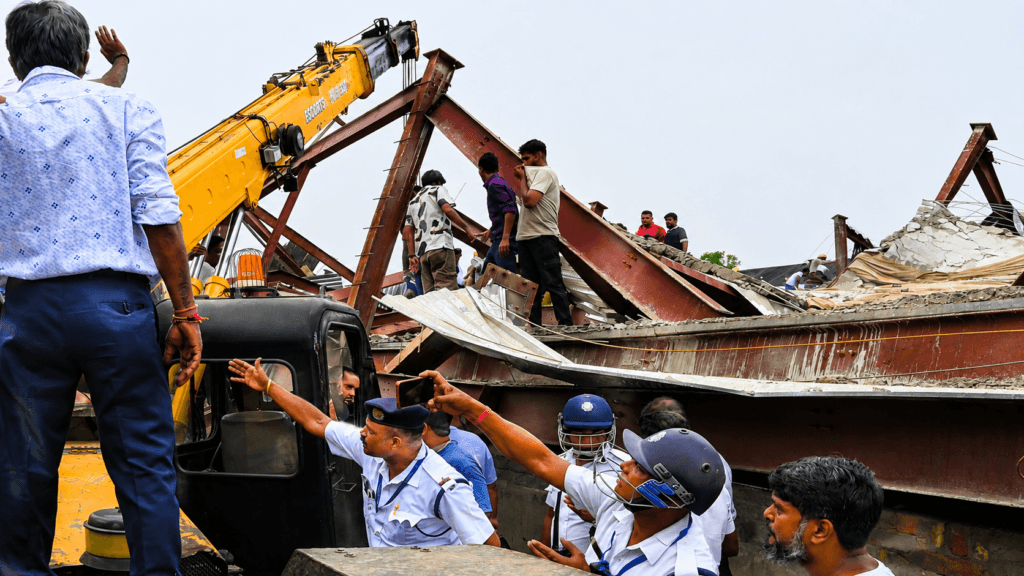
Rescue personnel from the Indian Army, disaster response teams, and Kolkata Police conduct operations at the collapsed warehouse construction site in Taratala. | Credit to PTI
A major construction tragedy has unfolded in Kolkata as a part of a warehouse under construction collapsed in the Taratala area on Wednesday, killing at least five workers and injuring dozens more. The incident saw the Indian Army, disaster response agencies, police personnel and emergency medical teams carry out a large-scale rescue operation.
Officials said the collapse occurred during working hours when a large number of laborers were present on the site. Rescue teams sifted through tons of fallen concrete, steel rods and debris after receiving distress calls, hoping to find workers trapped beneath the rubble.
In the early stages of the rescue operation, at least 20 workers were rescued and taken to hospitals, while several others remained trapped under the rubble, authorities said. “Several injured workers were in critical condition undergoing intensive treatment,” medical officials at Kolkata’s state-run SSKM Hospital said.
The disaster has raised serious concerns over the safety standards of construction, the approvals of projects, and the practices of structural engineering in one of the biggest metropolitan cities of India.
What Happened at the Taratala Construction Site?
Early indications are that the warehouse was an active construction site when much of the structure suddenly collapsed. Witnesses said they heard an explosive cracking sound seconds before the building’s framework collapsed.
Many laborers were engaged in routine construction work when the structure suddenly collapsed, surviving workers said. When the collapse occurred, panic broke out in the area with clouds of dust enveloping the site and emergency services were immediately alerted.
Heavy machinery, cranes and specialist rescue equipment were used to carefully remove debris without risking further danger to survivors trapped underneath. Rescue workers toiled through the evening and well into the night, challenged by the presence of large concrete slabs covering portions of the site.
The officials said some of the trapped workers had been communicated with during the operation, raising hopes that more lives could be saved despite the difficult conditions.
Chief Minister Orders Immediate Action
West Bengal Chief Minister Suvendu Adhikari arrived at the accident site soon after the incident and took stock of the ongoing rescue work.
The Chief Minister told reporters that preliminary observations indicated that the collapse was linked to structural deficiencies rather than weather-related factors. He said the iron framework that supports the warehouse may not have been able to support the weight of the concrete building being built.
Adhikari also announced an immediate halt on all commercial projects under construction that were approved by the previous Trinamool Congress government in the Kolkata Municipal Corporation area till July 31.
The government has also ordered a comprehensive structural audit of the ongoing construction projects to identify any potential safety risks before work resumes.
The Chief Minister said the audit would be carried out by a multi-agency task force comprising officials from the Public Works Department, Fire Services, Civil Defense, Kolkata Police and municipal authorities.
Arrests Made as Investigation Intensifies
Police have already arrested three people, including the project’s supervisor, in connection with the collapse.
Investigators are examining if the disaster was caused by negligence, safety violations, shoddy construction materials or design flaws.
Officials are examining construction plans, approval documents, engineering certifications and inspection reports related to the project. The investigators are also talking to contractors, engineers, project managers and labor supervisors involved with the warehouse development.
Police said more criminal charges could be filed if evidence indicates deliberate negligence or violations of building laws.
Rescue Operations Continue Amid Difficult Conditions
Perhaps one of the most remarkable things about the tragedy has been the size of the rescue effort.
Personnel from disaster management agencies and local emergency services joined hands with teams from the Indian Army’s Eastern Command. Rescue teams used sophisticated equipment to find survivors trapped under the rubble.
The operation was complicated by the unstable debris and the danger of secondary collapses, officials said. The large concrete blocks had to be carefully removed so as not to injure more trapped people.
Medical teams waited nearby so they could treat rescued workers immediately and move them to hospitals.
The operation highlighted the importance of coordination between civilian authorities, military units, and emergency response agencies in major urban disasters.
Background
India has seen a number of building collapses over the years, most of them exposing the loopholes in construction monitoring and regulatory enforcement.
Rapid urbanization has increased the need for commercial and residential infrastructure in the large cities. Development has helped boost economic growth, but experts have repeatedly cautioned that lax oversight can present serious safety risks.
There have been a number of incidences in Mumbai, Delhi, Chennai, Kolkata and other urban centers leading to casualties from structural failures, illegal modifications, poor quality of materials, or violations of approved building plans.
Tragedies keep happening, urban planning specialists say, and stronger inspections and accountability are needed to prevent them.
The Taratala collapse is likely to spark fresh debate on the approval, supervision and auditing of construction projects across India.
Timeline of Events
A part of the building suddenly collapsed at the warehouse project in Taratala on Wednesday afternoon when construction work was on.
Emergency services received information shortly afterward and deployed rescue teams to the site.
Initial rescue efforts saw several workers pulled from the rubble and rushed to nearby hospitals.
Authorities continued to pull more victims out from under the rubble, pushing the death toll higher.
The Chief Minister made a visit to the site, announced an audit of construction projects and ordered a temporary suspension of work at projects approved under the previous administration.
As the investigations were intensified, the police arrested three persons connected with the project.
Rescue operations continued through the night amid fears more workers were still trapped.
Why This Matters
It’s not just a construction accident, the collapse of the warehouse. It poses critical questions about urban development, worker safety, and regulatory oversight.
Thousands of workers are engaged daily in construction projects across India. Safety is based on engineering integrity, proper supervision and regulatory compliance. When these safeguards fail, the results can be catastrophic.
This is a big problem because it is directly connected with public safety and trust in infrastructure development. People want their houses, their warehouses, their bridges and their stores built to a certain standard.
Such incidents serve as reminders to policymakers and industry leaders that growth cannot be achieved at the expense of safety.
Also read: Kannada actor Krishi Thapanda’s Bengaluru home: Businessman found dead, police probe circumstances
A Wake-Up Call for Urban Infrastructure
The tragedy of Taratala has a significance that goes far beyond the boundaries of Kolkata.
Indian cities are growing rapidly to accommodate their growing populations and economic activity. Warehouses, commercial centers, residential complexes and industrial projects are being built at a record pace.
In general, experts believe that regulatory systems must progress in tandem with infrastructure development that is essential for economic development.
The collapse is a reminder that even approved projects are subject to constant scrutiny. Citizens of every major Indian city have a stake in ensuring that construction standards are adhered to rigorously.
The incident also underscores the need for better workplace protections, insurance coverage and emergency preparedness measures for workers and their families.
Analysis
The collapse of the Kolkata warehouse is a human tragedy as well as a governance challenge from a journalistic and public policy point of view.
The emphasis must be on rescue operations and support to the families affected. But the larger conversation must address systemic issues that allow structural vulnerabilities to remain unaddressed.
The government’s decision to stop work on ongoing projects and to carry out audits indicates that it is aware of a potentially more widespread problem. But the real test of the legacy of this tragedy will be if the audits produce real reforms.
Accountability will be important. If investigations show negligence, strong legal action could send a strong message to developers and contractors across the country.
The incident also serves as a reminder that disaster preparedness and swift emergency response can save lives. The involvement of the Army and specialist rescue teams would surely have prevented an even greater loss of life. |This story also covered by The times of india
What Next?
The days ahead will be critical as rescue crews search for any trapped workers and investigators gather evidence.
Authorities are expected to release detailed findings on the structural integrity of the warehouse and identify specific factors that led to the collapse.
The government audit of construction projects across Kolkata could reveal more safety issues and, perhaps, tighter building regulations.
Depending on the outcome of the investigation, legal proceedings against those responsible could also be extended.
Victims’ families likely will be paid compensation packages, and lawmakers may feel compelled to pass tougher construction safety regulations.
Conclusion
Five workers died and dozens were injured when a warehouse under construction collapsed in Kolkata’s Taratala area, raising serious questions on construction safety standards. The tragedy has already prompted significant government action: the project has been suspended, structural audits and criminal investigations are underway, and the rescue efforts continue as investigators try to determine the exact cause.
Besides the immediate loss of life, the incident has also raised wider questions around urban development, accountability and the protection of workers. It serves as a stark reminder that any growth in infrastructure must be accompanied by strict safety measures and effective oversight.
The ongoing investigation will not only determine who is behind the collapse; its findings may also affect future construction policies in West Bengal and elsewhere. Meanwhile, the main thing now is to keep rescuing those trapped and support the families involved and make sure this kind of tragedy never happens again.