For the first time in nearly 14 years, the Ministry of External Affairs (MEA) has made a major revision in passport fees in all key categories. The new fees will take effect on July 1, 2026, and will apply to new applications, renewals and a variety of passport services.
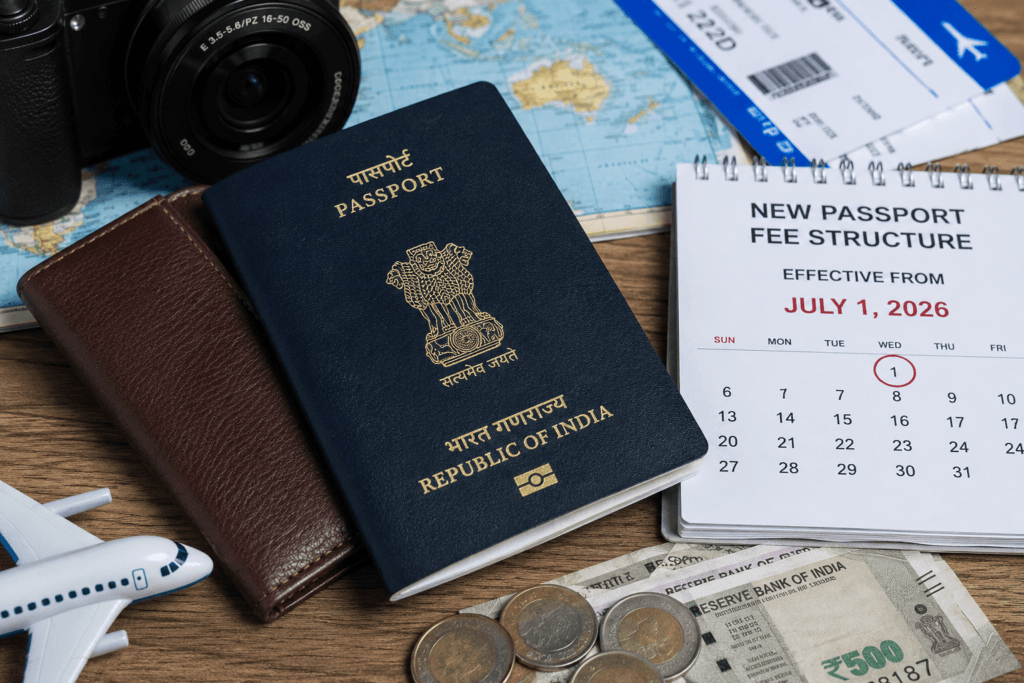
An Indian passport placed alongside travel essentials, symbolizing the revised passport fee structure that will take effect from July 1, 2026.
If you were considering applying for a new passport or renewing an old one, now is the time to pay attention. The Government of India has increased the fees for passports significantly and the revised fees will come into effect from July 1, 2026. The Ministry of External Affairs (MEA) said the new fee structure will apply to almost all the major passport categories and is the first comprehensive revision of passport fees in nearly 14 years.
This comes at a time when Indian households are already facing a surge in expenses on many fronts. Inflation has slowly pushed up the cost of things families need and want, such as food, fuel, overseas travel, airline tickets, electronic gadgets and education costs. Now getting or renewing one of the country’s most important travel documents is also getting more expensive.
The revised passport fees are likely to have a direct financial impact on millions of Indians who travel abroad for work, higher education, tourism, business or family visits. Applicants submitting their applications before June 30, 2026, will still pay the current fees, while applications submitted after July 1 will be subject to the new fee schedule.
Why is the government raising passport fees?
The Ministry of External Affairs has not stated any reason for the revision of fees, but experts say the decision is in line with the rising administrative and operational costs involved in the issuance of passports.
The Passport Seva Programme has seen a great expansion in the last ten years. The use of digital verification systems, biometric technologies, online appointment scheduling, cybersecurity infrastructure and advanced passport printing technologies has increased operational costs.
Besides the cost of running Passport Seva Kendras, regional passport offices, secure document production and police verification systems also increased over the years.
The government believes that after nearly 14 years, the adjustment of passport fees is a step towards aligning government service charges with current operational realities and maintaining ongoing quality improvements in service.
The revision also comes against the backdrop of rising demand for passports in India. This has led to record numbers of passport applications in recent years, with more Indians studying, working and travelling abroad than ever before.
What Will Change From July 1?
The revised fee structure will be applicable for most of the passport-related services, including fresh passport applications, renewal of passports, replacement of damaged/lost passports, additional booklets and Tatkaal services.
Applications submitted on or after 1st July, 2026 will be automatically charged as per the revised fee schedule announced by the Ministry of External Affairs.
If they book their appointment shortly after but submit their online application and payment by the deadline, they will still be entitled to the current pricing, provided they adhere to the official rules.
Travel experts are urging citizens whose passports are due for renewal within the next few months to get the process done before the revised charges come into effect.
How will the fee increase affect applicants?
Many families, especially those applying for several passports at the same time, could face a significantly higher total cost under the new fee structure.”
Students who are contemplating studying abroad, professionals who are taking jobs abroad, senior citizens who are planning trips abroad, and families who are applying for their children’s passports may see the financial difference.
For one applicant, the increase may seem small, but if you are applying for multiple passport services, the combined effect is more substantial.
Many applicants have already begun to move forward with their renewal plans to avoid paying the higher charges after July 1, travel consultants say.
With the new fees expected to be rolled out, several Passport Seva Kendras are gearing up for a rush of appointment demand in the last week of June as citizens rush to file applications before the hike.
Government’s Perspective
The Ministry of External Affairs has not provided an elaborate public explanation on the hike, but government officials have repeatedly stressed the need to modernize passport services. The system for issuing passports in India has changed remarkably over the last ten years.
“Applications previously requiring multiple physical visits can now be done on digital platforms.
Online appointments, electronic verification of documents, SMS updates, tracking police verification and faster processing timelines have made it very convenient for the citizens.
Officials say continued investments are needed to keep pace with technological advances.
Experts also say that even after the hike, India’s passport fees are still competitive when compared to many countries offering similar biometric passport services.
Background
The last major change in the cost of passports was almost 14 years ago.
Since then, India has changed tremendously in technology, inflation and international travel patterns. With growing opportunities for overseas employment, international education, global tourism and business expansion, the number of holders of Indian passports has grown significantly.
The introduction of initiatives such as Passport Seva Kendras, Post Office Passport Seva Kendras, online application and digital appointment facilities has made passport issuance one of the most efficient citizen services in the country. Hence, the present revision is not only a fee increase but also the next step in the continuous modernization of India’s passport infrastructure.
Timeline
For almost 14 years, passport fees stayed the same as administrative costs increased and demand rose.
During this period, India extended its digital passport ecosystem through Passport Seva Kendras and online citizen services.
The Ministry of External Affairs announced a comprehensive revision of passport fees in June 2026.
The new charges will come into effect from July 1, 2026.
Applications received before the deadline will continue to be processed under the current fee structure, and all new applications filed after this date will be subject to the revised charges.
Why This Matters
This announcement affects millions of Indian citizens, not just the frequent international travelers.
These days passports are not just for overseas vacations. Students need passports to study in universities abroad. Professionals need them for job opportunities. Business owners depend on travel abroad to forge partnerships around the world.
Medical tourists are people who travel to another country for medical care. Families use passports to go on holidays, on religious pilgrimages, or to visit relatives overseas. This is a very important issue, as a passport has become an essential identity and travel document for an increasing number of Indians. Any variation in government fees therefore has a direct impact on household financial planning. also covered by News 18
India View
India is one of the world’s fastest-growing sources of international travelers. Every year, millions of Indians go abroad to work in the Gulf, study in Europe and North America, take holidays in Southeast Asia, and do business in the global marketplace. Demand for passports is expected to continue to increase over the next 10 years as international mobility continues to grow.
The change in fee structure is a telling example of how government services are changing with India’s growing global footprint. But for many middle-class families, increased travel costs—passport fees, visas, airfare, travel insurance and foreign exchange—mean trips abroad require more budgeting than before.
Analysis
It is understandable from an economic point of view to review the passport fees after almost 14 years, considering inflation and the rising cost of public service delivery.
But timing is also significant. The rise comes at a time when households are already feeling the squeeze of rising costs of living across many sectors. Even a small increase in fees is an added financial burden on students, first-time travellers and low-income families.
At the same time, many applicants may find the additional cost worthwhile if the revised charges lead to faster processing, stronger cybersecurity, better digital infrastructure and improved citizen services. Finally, the public’s acceptance of the increase will depend not only on the revised fees but also on whether the applicants perceive tangible improvements in the quality of service.
What Happens Next?
“The immediate focus will be on implementation.
Applicants are likely to throng the Passport Seva Kendras across the country during the last days of June to beat the revised charges.
From July 1, authorities will observe the application trends and the operational efficiency under the new fee structure.
Travel agencies, immigration consultants and educational counselors will also have to inform their clients about the revised pricing.
Meanwhile, those planning overseas trips later this year should check the validity of their passports well ahead of time to avoid unexpected costs and last-minute delays.
Applicants are also advised to keep track of the official announcements from the Ministry of External Affairs for detailed fee information on a category-wise basis and any procedural updates.
Conclusion
India is set to revise the fees for passports after almost fourteen years in a move that will impact millions of citizens. The rise may add to the cost of traveling abroad, but it also reflects the government’s attempts to modernize and beef up one of the country’s most widely used public services.
Now is a particularly critical time for anyone considering a passport application or renewal. Under the current fee structure, applicants could save money by completing the process before July 1.
India’s international footprint is expanding and efficient passport services will be important. Ultimately, the success of the revised fee policy hinges on whether citizens get quicker processing, better digital services and a more seamless application experience for the added cost.