Phil Salt’s 70 off 44 balls set the platform for England’s 201/7, before India’s batting line-up crumbled under pressure. It was also the first time India had not won any of their last five T20I matches, a worrying trend heading into the next phase of white-ball cricket.
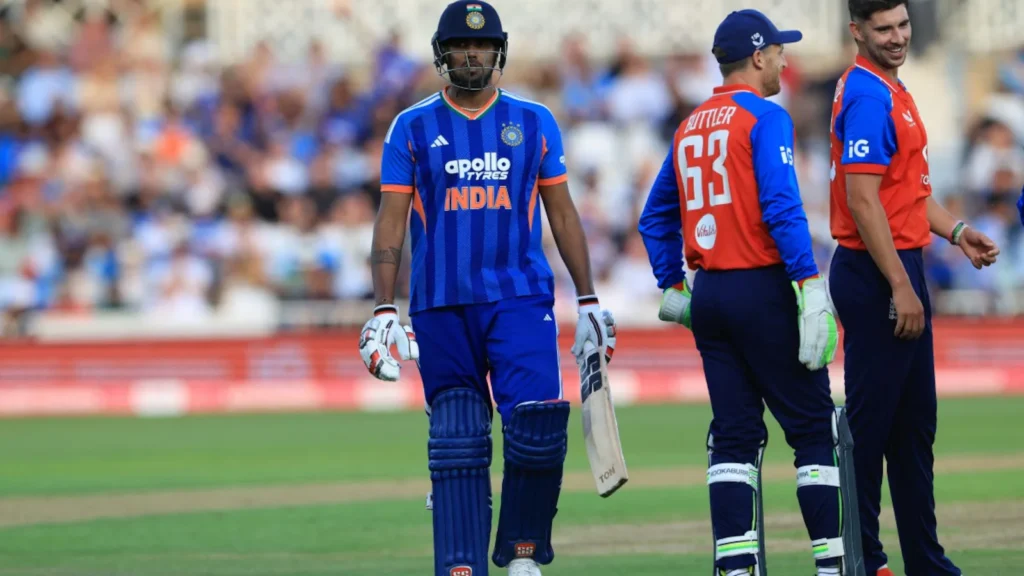
England celebrates after India’s batting collapse in the third T20I at Trent Bridge. Image Credit: NDTV Sports
India vs England 3rd T20I: India were handed a humiliating 125-run defeat by England in the third T20I at Trent Bridge, Nottingham, on Wednesday, July 8, 2026, in a result that immediately raised questions about the team’s batting depth and game management. England posted 201/7 after Phil Salt led the way with a fluent 70, and India were then bundled out for 76 in a chase that never looked under control.
The margin of defeat was not just big — it was historic. This was India’s worst-ever loss by runs in T20I cricket, surpassing their previous biggest defeat of 80 runs against New Zealand in 2019. The result also means England now lead the series 2-0, while India’s recent batting struggles have deepened. Yeh match kaafi alarming hai because it was not a close failure; it was a complete breakdown.
What Went Wrong for India
India’s collapse began with the pressure of a steep target, but the deeper issue was that the batting order never settled into a chase. On a surface widely considered batting-friendly, a target of 202 was challenging but far from impossible. What made the defeat so severe was the way India lost wickets in clusters and failed to build partnerships. This story is also covered by NDTV Sports.
Vaibhav Sooryavanshi and Ishan Kishan emerged as India’s joint top-scorers with just 13 runs each, which tells the story of the innings almost by itself. When your highest individual score in a chase of 202 is 13, the batting unit has clearly not adapted to the conditions or the moment. England’s bowlers kept attacking smartly, hitting the right areas and not allowing India any breathing room.
This is where momentum matters in T20 cricket. Once wickets fall early, the side chasing begins to panic, and the required rate becomes irrelevant because survival takes over. India never found a way out of that spiral. The innings looked fragile from the start and only got worse.
England’s Batting Set the Tone
England’s total of 201/7 was built around Phil Salt’s aggressive 44-ball 70, an innings that gave the hosts early control. Salt’s knock mattered because it combined speed and stability. In T20s, that is often the ideal opening contribution: score quickly without losing rhythm.
England did not need every batter to fire because Salt had already laid the foundation. Once India were forced to chase a large target, England’s bowling attack could use the scoreboard as pressure. That is often how modern T20 matches are won — not by one spectacular spell alone, but by combining a strong total with disciplined bowling.
The innings total also reflected England’s ability to recover after pressure moments and still finish above 200. On a good batting pitch, that was a par-plus score, and it proved too much for India once their top order failed to respond.
India’s Recent Form Problem
This defeat was especially concerning because it marked the first instance of India failing to win any of their last five T20I matches. That is not a small stat. It suggests something more structural than a one-off bad day. When a team of India’s talent goes five games without a win, fans and analysts naturally start asking whether the combination, form or planning needs to change.
Recent form matters a lot in international cricket because momentum carries confidence. A team that keeps losing tends to play with hesitation, while the opposition senses vulnerability. For India, the issue now is not just one poor batting performance. It is the pattern that seems to be forming around it.
There is also the pressure of expectation. India is used to being judged not only by wins and losses but also by how convincingly they play. A 125-run defeat in a T20I is not just a defeat; it is a statement of collapse. That makes the result harder to absorb.
Background and Context
India had entered this series with a lot of attention on squad selection, younger players and the direction of the T20 setup. But once the game moved into competitive conditions, England were the side that looked more settled and more adaptable. That is often the difference in bilateral series: one team looks like it has a plan, the other looks like it is still searching for one.
The Trent Bridge pitch was supposed to help batting, which makes India’s total of 76 even more disappointing. On such surfaces, teams are expected to score freely if they settle in. Instead, India never converted the conditions into anything usable. England’s bowlers exploited every mistake and India’s shot selection came under scrutiny.
This result also has to be viewed against India’s broader white-ball calendar. When a team is expected to compete strongly across formats, repeated failures in one format create concern about planning, selection and roles. The batting unit will now face more questions than answers.
Timeline
England innings: Phil Salt scores 70 off 44 balls to help England post 201/7.
India chase begins: India lose wickets early and fail to build partnerships.
Middle overs: England’s bowlers keep India under pressure and prevent any recovery.
End of chase: India are bowled out for 76.
Result: England win by 125 runs and take a 2-0 series lead.
Post-match reflection: India register their heaviest-ever T20I defeat by runs.
Also Read: Sanju Samson Left Out of India’s T20I Squad for Zimbabwe Tour as Shivam Dube Returns to ODI Set-Up
Why This Matters
This matters because record losses shape public and team perception immediately. A 125-run defeat is not just a bad scorecard; it changes the conversation around the squad. Yeh issue kaafi important hai because results like this can influence selection, confidence and even future tactical decisions.
It also matters because T20 cricket is supposed to reflect sharp preparation and adaptability. When a batting unit collapses this badly, it suggests that the plan for the chase either did not exist or did not work under pressure. That is a serious concern for any international side.
For Indian fans, the impact is emotional as well. Supporters expect fight, even in defeat. A collapse to 76 after chasing 202 feels especially harsh because it leaves little room for positives. The team now have to answer not just how they lost but also why they lost so completely.
India Angle
For Indian cricket followers, this result will sting because it happened in a format where India usually expects to stay competitive. In Hinglish, seedhi baat yeh hai: jab target 202 ho, toh 76 all out dekh kar fans ko shock lagta hai. The margin makes the defeat much bigger than a normal off day.
There is also a broader national sporting angle. India’s T20 side has often been judged as one of the strongest in the world, especially after recent tournament success. So when the batting fails this badly, it naturally becomes a talking point across media, social platforms and cricket circles.
From an Indian perspective, this loss may also trigger discussion about role clarity. Are the openers settled? Are the middle-order batters under pressure? Is India still experimenting too much? These are the kind of questions that will dominate post-match analysis back home.
Analysis
My opinion is that this result is more concerning than a narrow loss because it points to a deeper batting issue. A team can lose by a close margin and still feel encouraged. But when the chase collapses this badly, it suggests poor shot selection, low adaptability and weak resistance under pressure. That is not easily dismissed.
I also think England deserves credit for applying pressure at the right moments. Their bowlers did not allow India to settle, and that is exactly how a big total is defended in T20 cricket. Salt’s innings gave them the platform, but the bowlers finished the job with control and discipline.
Another important point is the psychological effect. Once India began losing wickets, the target became less of a chase and more of a burden. Good T20 teams break that burden early by stringing together partnerships. India never did that, and that is why the defeat became so severe.
What Next
The immediate next step is for India to regroup quickly and assess what went wrong in the batting order. The coaching staff will likely review shot selection, batting positions and the approach against England’s attack. If the team is rotating players, clarity around roles will become even more important.
England, on the other hand, will take confidence from a 2-0 lead and a dominant team effort. They now have control of the series and can look to close it out with further authority. India will need a stronger response in the remaining games to avoid carrying this form into future assignments.
For India, the next match becomes much more than another fixture. It becomes a chance to show that this defeat was a one-off rather than a trend. If the batting fails again, concerns will only grow louder.
Conclusion
India’s 125-run defeat to England in the third T20I at Trent Bridge was a crushing result and a record-breaking low for the team in T20Is. England’s 201/7, powered by Phil Salt’s 70, proved far too much as India collapsed to 76 all out, deepening worries about batting form and recent consistency. With England now leading 2-0, India face an important test of character, planning and confidence. This was not just a loss — it was a warning sign.
Written by A. Jack