Three JPSC members have resigned and Chief Minister Hemant Soren has promised transparent justice, but students will march to the State Assembly on Monday unless the government orders an independent CBI probe.
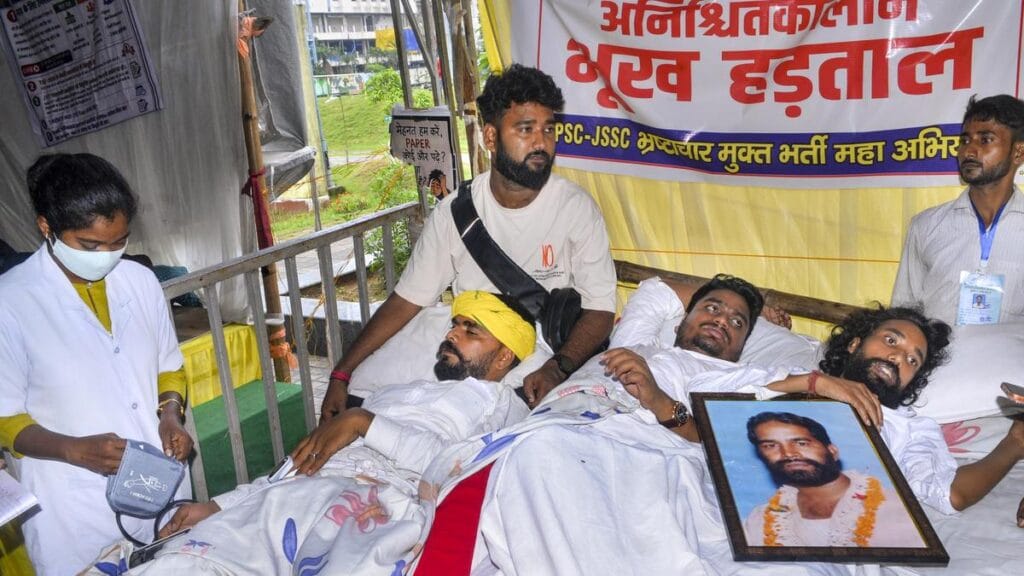
Jharkhand students gather in Ranchi during their prolonged protest demanding cancellation of disputed JPSC examinations. Image Credit: The Hindu
The Jharkhand government on Sunday, August 9, agreed to cancel three JPSC examinations after prolonged protests by government job aspirants in Ranchi. The decision covers the 14th JPSC Combined Civil Services preliminary examination and the JPSC backlog examinations conducted in 2023 and 2025.
The announcement came after approximately six hours of discussions between government representatives and protesting student groups. It was the biggest concession made by the state since the agitation began.
However, the decision did not end the protest. Students said they would continue their movement until the government orders a CBI investigation into the alleged irregularities. They also announced a march to the Jharkhand Assembly on Monday, August 10.
Three JPSC members resigned amid the controversy. Chief Minister Hemant Soren assured the protesters that “justice will be delivered with full transparency”, while the government said it would pursue investigations and reforms.
The disagreement now centres on the investigating agency. The government has proposed state-level enquiries, including CID and Enforcement Directorate investigations in relevant matters, but students insist that only a CBI probe or an external judicial inquiry can restore their confidence.
Which examinations have been cancelled?
The government has agreed to cancel:
The 14th JPSC Combined Civil Services preliminary examination is held in 2026.
The JPSC backlog examination conducted in 2023.
The JPSC backlog examination conducted in 2025.
The 14th examination is at the centre of the current controversy. Candidates had alleged irregularities in the results, answer sheets and recruitment process after the preliminary results were announced.
The backlog examinations were also brought under scrutiny because they were linked to the same recruitment system and examination process. The decision to cancel all three is intended to remove uncertainty and provide candidates with a fresh opportunity. This story was also covered by The Hindu.
However, the JSSC Combined Graduate Level examination remains a separate issue. Students have demanded action in that case as well, but the government has said it cannot simply cancel the examination because the process is connected to directions and legal proceedings involving the High Court and Supreme Court.
This distinction may become a major point of discussion in Monday’s Assembly march. Students are expected to ask why the government can cancel the JPSC examinations but cannot take similar action in the JSSC-CGL matter.
What the government said
Higher and Technical Education Minister Sudivya Kumar Sonu said the government had agreed to cancel the 14th JPSC examination and the backlog examinations from 2023 and 2025.
The government has described the decision as part of a broader two-pronged approach:
Cancelling examinations facing serious allegations.
Conducting investigations into the alleged irregularities and the agencies involved.
The government also claimed that around 98% of the students’ demands had been addressed or accepted. It said the remaining issues required legal and administrative consideration.
Chief Minister Hemant Soren assured the protesting candidates that the state would act transparently.
“Justice will be delivered with full transparency,” Soren said.
The government has also announced a dedicated email address to collect suggestions from students and stakeholders on reforms in JPSC and JSSC. The administration says the feedback will help create a new policy for recruitment examinations.
For the government, the cancellation decision is a major response to the protesters. But for students, it is only one part of the solution.
Why students are still protesting
The students have welcomed cancellation of the three JPSC examinations but said the protest will continue until the CBI probe is ordered.
They have argued that the allegations involve state recruitment bodies, officials and private agencies connected with the examination process. Because the state government is overseeing the existing inquiry, aspirants fear that the investigation may not be fully independent.
The students say cancellation alone creates another problem: they must prepare again and wait for a fresh schedule. Without a clear timetable, the announcement may create more uncertainty.
Yeh issue kaafi important hai because students have achieved cancellation of the exams but still do not trust the investigation process.
Resignation of three JPSC members
Three members of the Jharkhand Public Service Commission resigned amid the examination controversy. Reports identified them as Ajita Bhattacharya, Anima Hansda and Jamal Ahmed. Their resignations were accepted after a recommendation from the state government.
The resignations add to the pressure on the recruitment commission. JPSC chairman L Khiangte had already resigned on July 22, before the latest government decision.
The departures mean that the Commission will need to rebuild its leadership at a time when confidence in the recruitment process has weakened. The new members will face the difficult task of supervising fresh examinations, explaining previous decisions and ensuring that candidates believe the new process is reliable.
The resignation of officials does not establish guilt. Their role and responsibility will need to be examined through a proper inquiry.
Background to the protest
The agitation began after the results of the 14th JPSC preliminary examination were announced. Candidates raised questions about answer sheets, evaluation patterns and the selection of successful applicants.
Some aspirants alleged that answer sheets circulated online showed unusual discrepancies. These claims have not yet been conclusively established by an independent investigation, but they triggered widespread suspicion.
The state government ordered a CID investigation. More than a dozen people were reportedly arrested in connection with the wider allegations. The Commission postponed the Main examination, and students began an indefinite protest in Ranchi.
The movement continued for more than two weeks despite rain and hunger strikes. Student leader Devendra Nath Mahto’s health deteriorated during an indefinite fast, adding urgency to the negotiations.
Actor and singer Piyush Mishra also visited the protest site, spoke about the students’ suffering and sang “Aarambh Hai Prachand”. His participation increased national attention around the agitation.
Timeline
April 2026: The 14th JPSC Combined Civil Services preliminary examination is held.
July 2026: Results are announced; candidates raise allegations about irregularities.
July 22: JPSC chairman L Khiangte resigns.
July 25: Student protest begins in Ranchi.
July 29: Aspirants start an indefinite sit-in at Jaipal Singh Munda Stadium.
Early August: Hunger strikes begin; several people are arrested during the investigation.
August 7–8: The Government holds multiple rounds of discussions with different student groups.
August 9: The Government agrees to cancel the 14th JPSC and 2023 and 2025 backlog examinations.
August 10: Students plan a march to the Jharkhand Assembly while continuing to demand a CBI probe.
Also Read: Jharkhand Exam Stir: Government Announces Fresh Talks as Student Leader’s Health Deteriorates
Why This Matters
This matters because cancellation of a government examination affects thousands of candidates who have already spent months or years preparing.
A fresh examination may give students a fair opportunity, but it also creates new costs. Candidates must repeat their preparation, pay for travel and coaching again and wait longer for appointments.
The cancellation also raises questions about age eligibility. Students who cross the maximum age limit during the delay may need special relief or an additional attempt. The government will need to clarify whether age relaxation will be provided.
The issue matters for Jharkhand’s public administration as well. Recruitment delays mean vacancies remain unfilled in departments such as education, health, police and administration.
For the students, the fight has now shifted from cancellation to accountability. They want to know who was responsible for the alleged irregularities and whether the recruitment system will be reformed.
In simple Hinglish, exam cancel hona relief hai, lekin justice aur future schedule clear hona bhi zaroori hai.
India angle
For Indian readers, the Jharkhand development reflects a broader national crisis involving competitive examinations. Students across the country have protested over paper leaks, disputed results, delayed recruitments and weak grievance systems.
Government jobs remain a major source of financial security in India. In smaller cities and rural areas, a government appointment can change the economic position of an entire family.
The demand for a CBI probe also reflects a growing mistrust of state investigations. Students often believe that a central agency or judicial panel will be less vulnerable to local political pressure.
The cancellation of the JPSC examinations could set a precedent for how states respond to recruitment disputes. It may encourage other student groups to demand fresh examinations when they suspect irregularities.
At the same time, governments must ensure that cancellation is based on evidence and does not unfairly punish candidates who qualified through legitimate effort.
Analysis
However, refusing or delaying a CBI probe may keep the protest alive. The central issue is no longer only whether the exams were irregular; it is whether students trust the agency investigating the allegations.
The government should consider appointing an independent panel of retired High Court judges, examination experts and cyber-forensic specialists if a CBI investigation is not possible. The panel should have a clear mandate, access to records and a fixed deadline.
The state must also publish a fresh examination calendar. Students cannot be asked to prepare again without knowing when the tests will be held. Age relaxation and protection from financial loss should also be considered. If the system failed, candidates should not be forced to bear the entire cost of the failure.
The government’s claim that 98% of demands have been addressed will have little value unless the remaining demand—the independent probe—receives a credible response.
What Next
The immediate next step will be the student march to the Jharkhand Assembly on Monday. The administration will need to manage the demonstration peacefully and maintain communication with organisers.
The government must issue formal notifications cancelling the three examinations and publish details of the fresh recruitment process. It should clarify the examination syllabus, schedule, eligibility rules and age-relaxation policy.
An investigation into the alleged irregularities will also proceed. The state may use the CID, ED or another agency to examine different parts of the case, while students continue to demand a CBI probe.
JPSC will need to appoint or nominate new members after the resignation of three commissioners. The reconstituted body will face the challenge of conducting fresh examinations under strict monitoring.
Long term, Jharkhand should introduce secure question-paper systems, independent evaluation, digital tracking, third-party audits and a transparent complaint mechanism.
Conclusion
The Jharkhand government’s decision to cancel the 14th JPSC preliminary examination and the 2023 and 2025 backlog examinations is a major development in the student protest. After six hours of discussions, the state accepted one of the movement’s most important demands.
But the protest will continue because students want an independent CBI investigation into alleged irregularities. Three JPSC members have resigned, the chairman had already stepped down and Chief Minister Hemant Soren has promised justice with full transparency.
The next challenge is to ensure that cancellation leads to a fair and timely fresh examination rather than another cycle of uncertainty. The government must also address age limits, recruitment schedules and accountability.
For the students, this is not only about a retest. It is about restoring trust in Jharkhand’s recruitment system. Until the investigation becomes credible and the future timetable is clear, the agitation is likely to continue.
Written By A. Jack