
Students continue to demand cancellation of the 14th JPSC examination and an independent probe, while one faction has accused the government of “political manoeuvring” by holding separate talks with different protest groups.
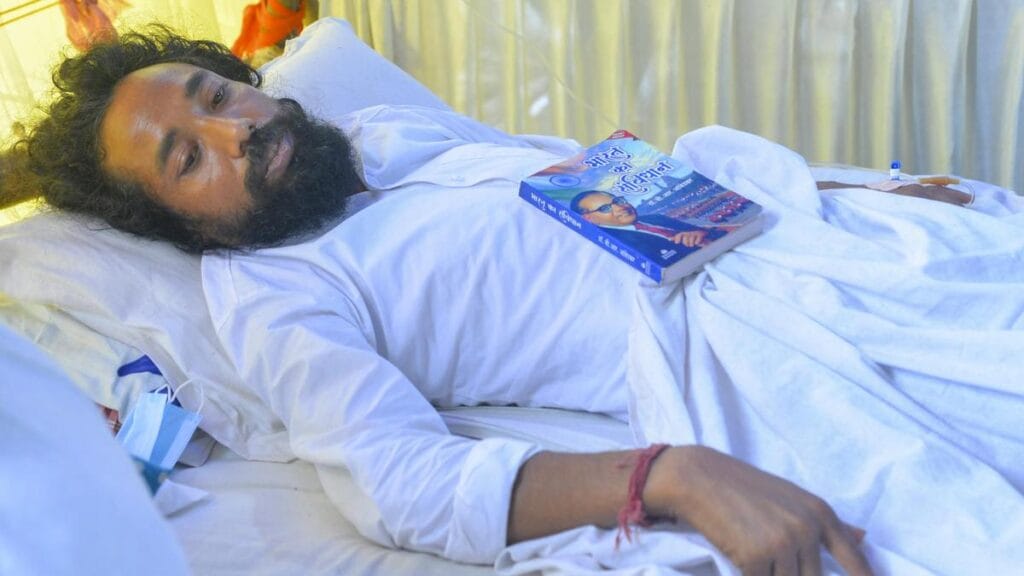
The health of student leader Devendra Nath Mahto, who has been on an indefinite hunger strike for nearly a week. Image Credit: The Hindu
Jharkhand’s recruitment examination protest has entered a critical phase. The state government has announced fresh talks with student representatives for Sunday, but the move comes amid growing frustration among protesters and serious concern over the health of student leader Devendra Nath Mahto, who has been on an indefinite hunger strike for nearly a week.
The protest, centred at Jaipal Singh Munda Stadium in Ranchi, has continued for 16 days. Students are demanding cancellation of the 14th Jharkhand Public Service Commission Combined Civil Services preliminary examination, an independent investigation into alleged irregularities and reforms in the recruitment process.
The government has held meetings with multiple student groups, but the discussions have not produced an agreement. The main protest faction has accused the administration of attempting to divide the movement by engaging with separate delegations instead of holding a single, decisive negotiation with the leadership of the agitation.
The government has said it is ready to listen to all groups and is considering the students’ demands sympathetically. However, protesters have made clear that the agitation will continue until they receive a concrete decision.
Why fresh talks were announced
The decision to hold another round of talks was taken after several meetings on Friday night and throughout Saturday failed to resolve the dispute. The government reportedly met different student organisations, including candidates’ forums and youth groups associated with the broader movement.
The meetings were intended to identify common ground and understand the demands of different sections of the protest. But the process created fresh tension because the principal protest group said it had not received a final decision on its core demands.
The government has reportedly described Sunday’s meeting as a final or decisive round of talks. The meeting is expected to take place around noon and may include representatives of the main protesting group. This story was also covered by TheHindu.
The administration hopes that a new discussion will allow it to present a roadmap on:
The future of the 14th JPSC examination.
The status of the ongoing investigation.
The possibility of an independent inquiry.
Reforms in JPSC and JSSC.
Measures to protect candidates from further delays.
The government’s plan to collect suggestions from students.
The students, however, want more than an assurance that their concerns will be examined. They want a written commitment and a time-bound process.
Yeh issue kaafi important hai because repeated talks without a clear decision can deepen distrust instead of resolving it.
Student faction alleges political manoeuvring.
The JPSS-JSCC Reform Manch has described the decision to hold talks with different student factions as “political manoeuvring”. The group alleges that the government is attempting to create divisions within the protest movement and divert attention from the main demands.
The criticism comes after the government held separate meetings with multiple organisations. Student leaders say the movement has a common set of demands and that separate negotiations could lead to conflicting assurances.
The government has defended its approach by saying that all student groups deserve to be heard. It has also released a dedicated email address to collect suggestions from students and stakeholders on recruitment reforms.
The email-based consultation is intended to create a broader reform policy, but the principal protest group believes the immediate issue must be addressed first. Students want the state to decide whether the 14th JPSC preliminary examination should be cancelled and conducted again.
The division between factions could become a major challenge during Sunday’s talks. If one group accepts the government’s offer while another continues the protest, the movement may become fragmented.
The health of Devendra Nath Mahto deteriorates.
The health of student leader Devendra Nath Mahto has become a serious concern. He has been on an indefinite hunger strike for almost a week at the protest site.
Medical personnel reportedly recorded his blood glucose level at 53 early Sunday morning. He has also been reported to be suffering from low blood pressure, low blood sugar, dehydration and a chest infection. Doctors have advised hospitalisation, but Mahto has refused to end his fast until the students’ demands are addressed.
The hunger strike has increased pressure on the government because the prolonged fast could pose a serious threat to Mahto’s health.
Mahto has said he will continue the fast until talks produce a meaningful result. His condition has also prompted appeals from political leaders and other public figures for the government to resolve the dispute quickly.
Six protesters have reportedly participated in hunger strikes at different points during the agitation. At least one other student leader was hospitalised after his health deteriorated.
What are the students demanding?
The protesters’ demands centre on the 14th JPSC examination and the broader recruitment system.
Students say the controversy is not limited to a single examination. They have raised concerns about delays, changes in schedules, recruitment agencies, result publication and the lack of effective grievance redressal.
The allegations have not yet been established by a completed independent inquiry. The purpose of the investigation would be to determine whether the examination process was compromised and whether candidates were unfairly affected.
Background to the protest
The agitation began after the results of the 14th JPSC preliminary examination were announced. Some candidates questioned the selection process and circulated claims about answer sheets and the performance of successful applicants.
The state government ordered a Criminal Investigation Department investigation. Several people were arrested in connection with the broader allegations, while JPSC chairman L Khiangte resigned on July 22.
The Commission postponed the Main examination after the controversy grew. That decision prevented the process from moving forward but did not answer whether the preliminary results themselves were valid.
The protest later widened to include allegations relating to JSSC examinations and other recruitment tests. Aspirants say the dispute reflects years of delays and a lack of transparency across the state’s recruitment system.
The arrival of actor and singer Piyush Mishra at the protest site, where he sang “Aarambh Hai Prachand”, brought additional national attention to the movement. His visit reflected the growing public and cultural support for the students, but it did not alter the legal or administrative dispute.
Timeline
April 2026: The 14th JPSC Combined Civil Services preliminary examination is held.
July 2026: Results are announced; candidates raise allegations about the examination process.
July 22: JPSC chairman L Khiangte resigns.
July 25: Students begin an indefinite protest in Ranchi.
July 29: Aspirants gather at Jaipal Singh Munda Stadium.
August 2: Devendra Nath Mahto begins an indefinite hunger strike, according to reports.
August 7–8: The Government holds multiple meetings with different student groups, but no agreement is reached.
August 8: The Government announces fresh talks after the protest enters its 15th day.
August 9: Further talks scheduled as the agitation enters its 16th day and Mahto’s health worsens.
Also Read: Piyush Mishra Joins Jharkhand Students’ Protest, Sings ‘Aarambh Hai Prachand’ in Ranchi
Why This Matters
This matters because government examinations decide the careers of thousands of young people. Candidates spend years preparing and families often invest significant money in coaching, travel and study materials.
A disputed examination can damage the future of both selected and unsuccessful candidates. Those who believe they were unfairly excluded want a fresh chance, while those who qualified fairly may fear losing the benefit of their performance if the exam is cancelled.
It also matters for the functioning of the state government. Vacancies in departments such as education, health, policing and administration can affect public services.
The health crisis at the protest site raises an additional concern. A democratic government must engage with student representatives before hunger strikes become life-threatening. The longer the dispute continues, the greater the risk of medical complications and further public anger.
In simple Hinglish, students ka protest sirf marks ya result ka issue nahi hai; yeh unke career aur trust ka issue hai.
India angle
For Indian readers, the Jharkhand agitation reflects a nationwide problem involving exam integrity and youth employment. Students in different states have protested against paper leaks, delayed results, disputed answer keys and recruitment cancellations.
Government jobs remain highly valued because they provide stability, regular income and social security. In states with limited private-sector opportunities, a recruitment examination may be one of the most important chances available to young people.
The demand for a CBI probe also highlights the growing reliance on central agencies when state-level institutions are viewed with suspicion. While a CBI investigation is not automatically a guarantee of fairness, the demand shows the depth of distrust among the aspirants.
The Jharkhand government’s dedicated email for suggestions could contribute to long-term reform, but it cannot replace an independent inquiry into a disputed examination. The administration must address both issues: immediate accountability and future system improvement.
Analysis
A successful negotiation requires a single, transparent platform. The government should invite representatives from all major groups, record the discussion and issue a written summary of the decisions.
The administration could consider forming an independent committee of retired judges, examination experts and technical specialists. Such a committee could examine question-paper security, answer sheets, evaluation patterns and the role of contracted agencies.
The question of cancellation should be decided on evidence. If there is proof of widespread irregularity, a re-examination may be necessary. If the evidence does not support cancellation, the government must explain the findings publicly and allow candidates to challenge the decision through a fair process.
Mahto’s health adds urgency. No political or administrative dispute should be allowed to reach a point where a protester’s life is placed at severe risk. Medical intervention and dialogue must happen together.
What Next
The government is expected to hold another round of talks with student representatives at noon on Sunday. The meeting may focus on the 14th JPSC examination, the proposed investigation and recruitment reforms.
If the government offers a written timeline and agrees to an independent mechanism, the protest may enter a new phase. Students could suspend the hunger strike while monitoring implementation.
If the talks produce only another assurance, the protesters are likely to continue the agitation. The Assembly march announced for August 10 could increase pressure on the administration.
Authorities will also need to monitor Mahto’s health and other fasting protesters. Doctors may again advise hospitalisation if blood sugar, blood pressure or dehydration worsens.
Long term, the state will need to reform JPSC and JSSC through secure question-paper handling, independent audits, fixed calendars, digital tracking and a time-bound grievance system.
Conclusion
The Jharkhand exam protest has entered a critical stage as the government prepares for fresh talks on Sunday and student leader Devendra Nath Mahto’s health deteriorates during his hunger strike. After several meetings with different student groups failed to end the deadlock, the administration is under pressure to produce a concrete decision.
Students continue to demand cancellation of the 14th JPSC examination, an independent probe and reforms across the recruitment system. One faction’s allegation of political manoeuvring shows that trust between the government and the protest leadership remains weak.
The success of Sunday’s talks will depend on whether the government moves beyond assurances and presents a written, time-bound plan. For the students, this is a fight for fair recruitment and future opportunity. For the government, it is a test of accountability, dialogue and crisis management.
Written By A. Jack