A horrific LPG tanker explosion at a toll plaza in Uttar Pradesh’s Kaushambi district claimed five lives and left several others injured after the vehicle crashed into a divider and leaked highly flammable gas, with newly surfaced CCTV footage revealing the terrifying moments before the blast.
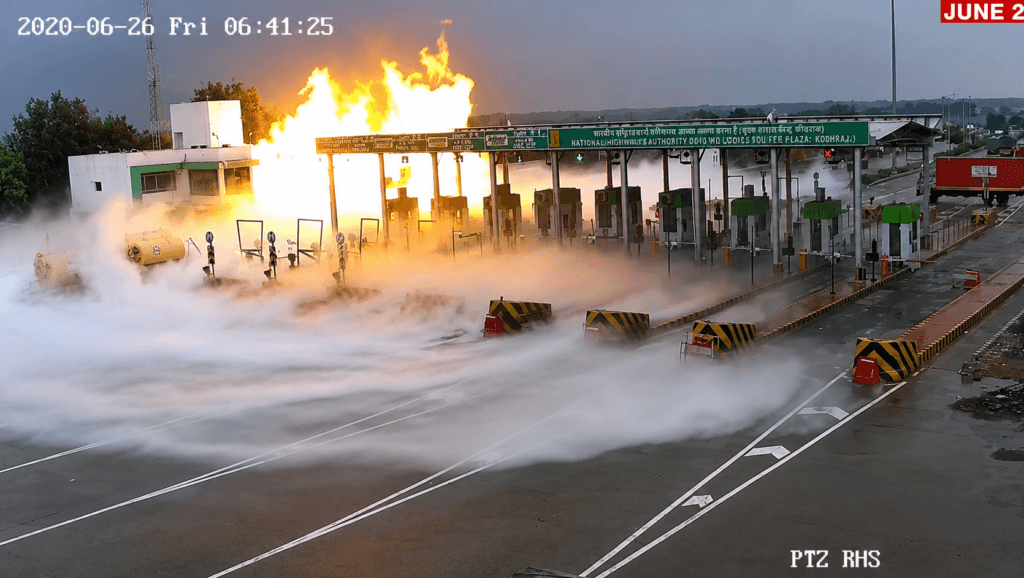
Burning LPG tanker at a damaged toll plaza in Kaushambi, Uttar Pradesh, after a deadly explosion that claimed five lives and injured several people. | Image taken from CCTV
A tragic road accident in Uttar Pradesh’s Kaushambi district has once again highlighted the perils of carrying hazardous materials on Indian highways. Five people died and several others were injured when a liquefied petroleum gas (LPG) tanker rammed into a toll plaza and exploded on the morning of June 26. A few days after the incident, CCTV footage of the crash appeared on the web, providing a chilling visual record of the final moments before the devastating explosion.
The incident occurred around 6:40 AM when the LPG tanker coming from Kanpur to Pratapgarh allegedly lost control near a toll plaza. A 24-second CCTV footage shows two heavy tankers heading towards the toll plaza and then one of them suddenly swerves and hits a divider before crashing into the toll booth. The damaged tanker soon began leaking LPG gas and eventually caused a huge explosion that engulfed the toll plaza in flames and thick black smoke.
The incident not only took a tragic toll of lives but also created panic among the commuters and toll employees at the spot. An investigation into the cause of the crash has been launched by authorities as emergency response teams rushed to put out the fire and rescue survivors.
How the Accident Happened
Initial reports suggested that the LPG tanker was en route to Pratapgarh with the liquefied petroleum gas from Kanpur when it reached the toll plaza in Kaushambi district in the early hours of the morning.
CCTV footage shows two tankers approaching adjacent toll lanes at normal speed. “Out of nowhere one of the tankers appeared to lose its balance or control, swerved unexpectedly, rammed into the central divider and crashed straight into the toll plaza infrastructure.
The force of the impact badly damaged the tanker and large quantities of LPG were leaking out into the surrounding area. LPG is very flammable and heavier than air and spread quickly around the toll plaza before it caught fire.
In seconds, there was a huge explosion and a fireball went up several meters in the air. The explosion destroyed parts of the toll plaza, damaging nearby vehicles and trapping several people who had little time to escape.
Investigators are looking at a number of possibilities, including mechanical failure, excessive speed, brake failure, driver error or other technical problems that may have contributed to the loss of control. Authorities have not confirmed the exact cause of the accident.
CCTV Footage Reveals the Horror
The tragedy has been brought back into focus with the release of the CCTV footage.
The 24-second clip shows what appears to be a normal morning at the toll plaza. In the footage, vehicles are shown driving normally before the LPG tanker abruptly veers off its lane.
The tanker strikes the divider and the toll structure and panic ensues among the toll workers and motorists in the vicinity. Seconds later gas starts leaking from the tanker and the footage ends just before the explosion.
The footage has been widely shared on TV channels and social media, reminding viewers how quickly hazardous cargo accidents can turn into catastrophic disasters.
Safety experts say the footage could also help authorities in the investigation to reconstruct what happened in the lead-up to the blast.
Rescue Operations and Emergency Response
Following the blast, local police, fire department staff, district administration officials and medical emergency teams rushed to the accident spot.
It took firefighters several hours to bring the intense blaze under control. Ambulances rushed the injured to nearby hospitals for emergency treatment.
Authorities closed off the highway area to avoid further crashes and help rescue efforts. Traffic continued to be disrupted along the route as officials cleared damaged vehicles and checked the structural integrity of the toll plaza.
Families were being notified and post-mortem procedures were being organized, authorities said, with all victims being identified.
Rescue officials praised the quick response by emergency teams and said timely action had likely prevented further casualties despite the force of the blast.
Statements from Officials
The district officials said it was one of the worst highway accidents to have occurred in the district in recent years.
The investigation will look at what caused the crash and whether proper safety procedures were followed in the transport of hazardous materials, a senior police officer said.
Fire safety experts also pointed out that accidents involving LPG tankers require very specialized emergency handling, since spilled gas can spread rapidly before ignition to create very dangerous conditions.
Transport safety officials said drivers of hazardous cargo vehicles should be trained regularly and strictly observe the prescribed safety measures.
Background: Risks Associated with LPG Transportation
Liquefied Petroleum Gas is an important element of the domestic and commercial energy basket in India. Thousands of LPG tankers ply national and state highways daily, carrying fuel to bottling plants and distribution centers.
LPG transport accidents are particularly dangerous because the gas is stored under high pressure, even though the industry has strict safety standards.
A relatively small leak from a damaged tanker can create a large, flammable vapor cloud. An explosion can be devastating if the cloud contacts an ignition source.
There have been a number of serious accidents involving fuel, chemical and LPG tankers in India over the years. There have been many calls over the years for better highway safety, better training of drivers and stricter enforcement of laws governing the transport of hazardous goods.
The Kaushambi tragedy is yet another reminder of how quickly such incidents snowball into large-scale disasters.
Timeline of Events
The incident took place around 6.40 am on June 26 when the LPG tanker was nearing a toll plaza in the Kaushambi district.
The tanker hit the divider and toll booth a few moments after it went out of control, spilling LPG.
Then there was a massive explosion, and flames engulfed the toll plaza.
Emergency services arrived promptly, put out the fire, rescued survivors and transported injured persons to hospitals.
In the days that followed, the authorities launched a formal investigation and released the CCTV footage of the accident into the public domain, giving both the investigators and the public a clearer picture of how the tragedy had unfolded.
Why it’s important
The incident is significant because it raises serious questions about highway safety, transportation of hazardous cargo and emergency preparedness in India.
Every day, thousands of fuel and gas tankers pass through busy highways, toll plazas and densely populated areas. One hazardous materials accident can result in devastating loss of life and property.
This is very important, because the infrastructure that allows the transport also has to be ready for emergencies involving dangerous goods.
The tragedy also underscores the need for preventive maintenance, monitoring of driver health, vehicle inspection and strict compliance with transport regulations.
Accidents like these remind commuters, toll workers and people living nearby that road safety is much more than traffic management; it is also about planning comprehensively for the risk of hazardous cargo.
India Angle
The expanding network of highways in India has facilitated the transport of industrial goods, petroleum products, and LPG across the country to a large extent.
“There are thousands of hazardous cargo movements every day in states like Uttar Pradesh, Maharashtra, Gujarat, Tamil Nadu, Rajasthan and Karnataka.
The safe transportation of these materials is critical to public safety as well as economic growth.
The Kaushambi incident may compel transport authorities, petroleum companies and highway operators to review the existing emergency response systems, strengthen inspection procedures and improve safety infrastructure at toll plazas.
The tragedy highlights the need for public education in emergency evacuation in chemical or gas-related accidents.
Analysis
The Kaushambi LPG tanker explosion highlights the growing need to overhaul India’s hazardous goods transport framework from a road safety and public policy perspective.
The cause of the crash is not yet known and investigations are ongoing but the evidence so far suggests that once the tanker lost control, the outcome was almost inevitable given the highly flammable nature of the cargo it was carrying.
The new CCTV footage is likely to be crucial in determining whether the accident was caused by speed, driver reaction, a mechanical failure or the road conditions.
And this tragedy should also prompt wider discussions about improving emergency infrastructure at toll plazas. Just think if you had fire suppression systems, specialized hazardous material response equipment, dedicated emergency lanes and regular disaster drills.
Tanker drivers too need to be constantly trained as they carry dangerous cargo across the length and breadth of India’s highways with a huge responsibility. Transport authorities should continue to focus on regular vehicle inspections, fatigue management and compliance monitoring.
Ultimately, the prevention of such disasters depends on the concerted efforts of transport companies, highway operators, petroleum agencies, regulators, and emergency services.
What Next?
Authorities are expected to continue their investigation by looking at the damaged tanker, CCTV footage, talking to witnesses and carrying out technical inspections.
Transport officials can determine whether the vehicle complied with mandatory safety standards and whether negligence played a role in the accident.
The state government may also want to examine emergency preparedness protocols at toll plazas that have hazardous cargo traffic.
Families of the victims are to be compensated under applicable government policies and injured survivors are still undergoing medical treatment.
The investigation’s findings could ultimately trigger calls for changes to road safety regulations so that similar tragedies do not happen again. Also covered by NDTV.
Conclusion
The Kaushambi LPG tanker explosion is one of the most devastating highway accidents witnessed in Uttar Pradesh in recent months. Five people died and several others were injured, highlighting the enormous risk in the transportation of dangerous goods and the devastating consequences of accidents.
While the exact cause of the crash is still under investigation, the incident has already ignited fresh debates on road safety, vehicle maintenance, emergency preparedness and hazardous cargo management across India’s burgeoning highway network.
The CCTV footage remains in circulation and is a stark reminder to investigators and the public alike that an ordinary journey can turn into an extraordinary tragedy in the blink of an eye. To prevent similar disasters in the future, safety standards must be improved, infrastructure strengthened and strict adherence to transport regulations ensured.