
Residents said ordinary locals carried out the first rescue effort before specialist teams arrived. Many say they were denied access to get their belongings and received no government aid for hours after they got out.
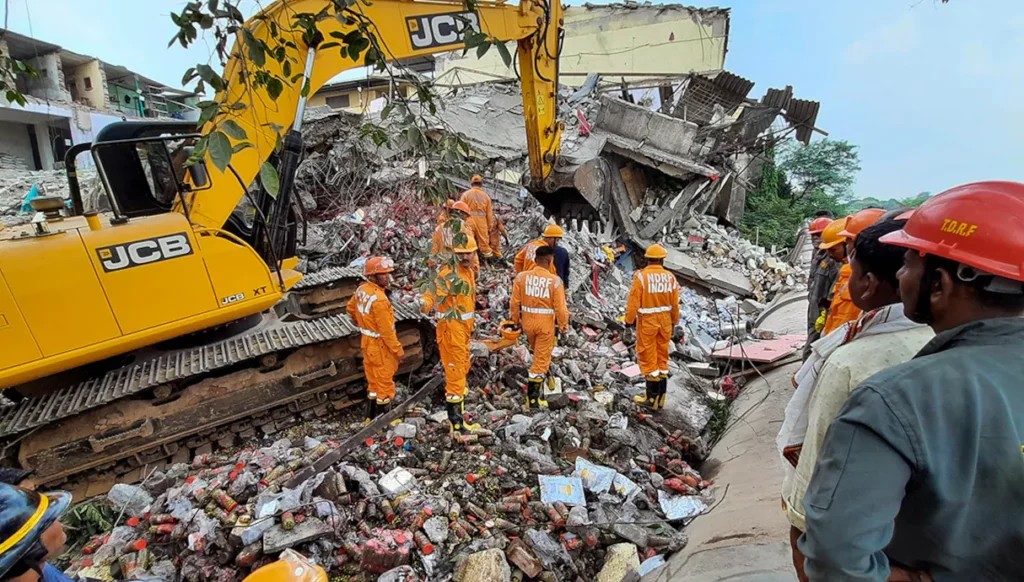
The Bhiwandi building collapse sits beside the debris. Image Credit: NDTV
In the shadow of a collapsed building in Bhiwandi’s Balaji Nagar area, survivors of the tragedy are recounting harrowing escapes and a desperate aftermath marked by hunger, thirst and uncertainty. The four-storey structure, classified as C1 — meaning dilapidated and beyond repair — caved in late Thursday night, killing nine people and injuring four others. But for the dozens of families who lived in adjacent wings and temporary settlements, survival came at the cost of losing everything they owned.
Even as rescue teams work through the rubble, many residents say they have received no food, no water and no official communication since fleeing their homes. “Since last night, no one from the government has spoken to us. There has been no food, no water. We’ve only eaten one roti since then,” said Priya Jaiswal, whose family of four spent the night on the roadside after escaping the dust and debris.
What survivors say
For many residents, the collapse happened without warning in the middle of the night. Priya Jaiswal recalled that her family had just finished one roti and was about to take another when the structure gave way. “Suddenly there was a loud thud. Dust engulfed the entire area. We covered our faces with cloth and escaped through another route. Everything else, our belongings, our clothes, remained inside,” she said.
Just a few metres away, another woman recounted how narrowly her family escaped. “We were getting ready to sleep when a portion of the structure fell onto our house. It was raining and the door was shut. I pushed my son out first and told him, ‘You should live. I can die. ‘My son and daughter got out, then my husband and I escaped,” she said. This story was also covered by NDTV.
For many, survival came at the cost of everything they owned. “Our cash was inside. Our jewellery was inside. We left everything because saving our lives was more important,” said another resident. When some families later attempted to retrieve their belongings, they allege they were prevented from doing so. “The police hit us with lathis and told us not to enter,” alleges Jaiswal.
How the collapse happened
The administration maintains that the tragedy occurred despite repeated warnings. Maharashtra minister Girish Mahajan said the building, constructed around 2007-08, had been classified as a C1 structure, meaning it was beyond repair, and that the municipal corporation had issued notices asking residents to vacate on multiple occasions. According to him, nearly 30 families had already been evacuated before the collapse.
“The building next to this will also be demolished. We have been appealing to people for a long time to vacate dangerous buildings, but many do not leave. Cluster redevelopment will have to be considered in the future,” he said, adding that illegal constructions remain a serious issue in Bhiwandi.
Thane District Collector Krushna Panchal also attributed the collapse to unauthorised repair work. “This was a C1 building, which means it was beyond repair. The corporation had issued several notices. Yesterday, without permission, the contractor started repair work. When the ward officer learnt about it, around 30 families were evacuated,” Panchal said.
However, according to Panchal, workers and a few onlookers later entered the building, after which it collapsed. “The NDRF reached the site within about 40 minutes. A woman and a child were rescued during the initial operation,” he said.
Locals led the first rescue.
Long before specialised rescue teams reached the site, locals say the first rescue operation was carried out by ordinary residents. “As soon as the building collapsed, everyone from the locality rushed here,” says Dilip Kumar, who remained at the site until nearly 2 am. “People were trying to jump from the building. We brought ladders and helped many climb down. Even those who managed to escape turned around and started rescuing others.”
He points to neighbouring structures, many of which bear visible cracks. “These buildings are also weak. They could collapse anytime.”
That account highlights a recurring pattern in urban disasters in India: before cranes and specialised teams arrive, it is often neighbours who pull people from the rubble. In Bhiwandi, that meant using ladders, makeshift ropes and bare hands to help residents escape from collapsing floors and trapped rooms.
Background and context
Bhiwandi, located in the Thane district, is a major power loom hub with a dense concentration of residential and commercial buildings. Over the years, several old structures in the area have been identified as unsafe due to age, poor maintenance and the heavy load of occupants and equipment.
The C1 classification is given to buildings that are dilapidated and beyond repair, typically requiring demolition or major structural intervention. Municipal corporations are supposed to issue notices and evacuate residents from such buildings, but enforcement is often delayed due to logistical, legal or political challenges.
This incident follows a pattern seen in other parts of Maharashtra, where old or dilapidated buildings have caved in during monsoon seasons or after warning signs were ignored. In many cases, civic bodies identify dangerous buildings, but evacuation and demolition orders are delayed, leaving residents at risk.
Timeline
2007-08: The building is constructed in Bhiwandi’s Balaji Nagar area.
Later years: The structure is classified as C1 (dilapidated and beyond repair) by the municipal corporation.
Before collapse: Notices are issued asking residents to vacate; nearly 30 families are evacuated.
Thursday night: Unauthorised repair work reportedly begins; workers and onlookers enter the building.
Late night: A portion of the building collapses; locals carry out initial rescue before NDRF arrives.
Friday: Nine deaths confirmed; four injured; families displaced and waiting for relief.
Also Read: 9 Killed, Many Feared Trapped as Building Collapses During Repair in Bhiwandi
Why This Matters
This matters because it shows how quickly a known risk can turn into a tragedy. When a building is already flagged as dangerous, the priority should be complete evacuation and swift action to prevent habitation. Any delay can cost lives.
It also matters because the victims are often low-income families who have limited options for alternative housing. In powerloom towns like Bhiwandi, many workers live in compact, multi-room buildings where rent is affordable but safety is compromised. When such buildings collapse, the human cost is borne by the most vulnerable.
For Maharashtra’s urban governance, the incident is another reminder that structural audits, timely demolition and proper rehabilitation are not optional. In simple Hinglish, jab building ko dangerous declare kiya gaya ho, toh evacuation mein deri nahi honi chahiye.
India angle
For Indian readers, this story is directly relevant because building collapses are a recurring issue in many Indian cities, especially in older, densely populated areas. From Mumbai to Kolkata to smaller industrial towns, unsafe structures pose a constant risk, particularly during monsoons or when repair work is underway.
The India angle also includes the regulatory challenge. Civic bodies often identify dangerous buildings, but enforcement can be slow due to legal processes, lack of alternative housing or political pressure. That gap between identification and action is where tragedies often occur.
There is also the labour angle. In towns like Bhiwandi, many residents are powerloom workers who depend on proximity to their workplaces. When affordable housing is unsafe, they face a cruel choice: risk living in dangerous buildings or move far away and lose income opportunities.
Analysis
My opinion is that the most alarming part of this incident is that the building had already been declared dangerous. That means the risk was known, yet people were still inside when it collapsed. Whether that was due to delayed evacuation, lack of alternative housing or non-compliance by occupants, it points to a systemic failure.
I also think the timing — during repair work — needs careful investigation. If repairs were being done without proper shoring or supervision, that could have contributed to the collapse. A structural audit of the repair plan and the contractor’s credentials will be essential to understand what went wrong.
What Next
The immediate next step will be the continuation of the rescue operation to locate and recover any survivors still trapped under the debris. As rubble is cleared, the final death toll may rise, and authorities will work to identify the victims and inform their families.
Parallel to that, a formal inquiry is likely to be ordered into the structural condition of the building, the repair work underway and the enforcement of the civic body’s dangerous-building declaration. Questions will be asked about why residents were still inside and whether evacuation orders were properly issued and enforced.
Longer term, this incident may prompt a wider drive to identify and clear dangerous buildings in Bhiwandi and other parts of the Mumbai Metropolitan Region. If authorities act decisively, it could lead to more structural audits, faster demolition of unsafe structures and better rehabilitation plans for affected residents.
Conclusion
The collapse of the C1-classified building in Bhiwandi has left nine people dead and several others feared trapped, underscoring the deadly consequences of living in structures that have been declared dangerous. Despite warning sounds and local evacuation efforts, the ‘B’ wing caved in late at night, trapping residents inside.
The rescue operation is ongoing, but the tragedy is already a stark reminder of the gaps in urban building safety enforcement. For Maharashtra, the challenge is not just to respond to this incident but to ensure that known risks are addressed before they turn into future disasters.
Written By A. Jack