
The accident happened at about 3 a.m., after an earlier ethanol tanker crash that caused a rerouting of traffic on the motorway. The fire was spreading fast and the stretch was a death trap to both vehicles.
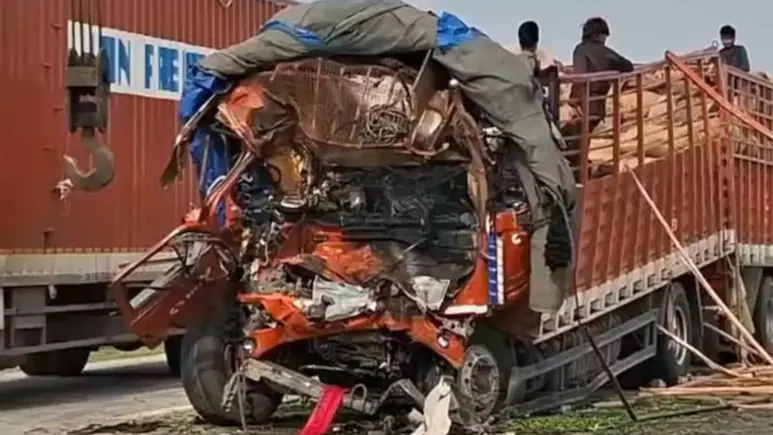
Truck engulfed in flames after a deadly collision on the Samruddhi Mahamarg near Wardha in Maharashtra. The image is only for illustrations. Image Credit: NDTV
A devastating road accident on the Samruddhi Mahamarg in Wardha district, Maharashtra, claimed six lives in the early hours of Monday, leaving an entire family and two truck occupants burnt to death. The tragedy unfolded around 3 am when a speeding truck loaded with chillies rammed a car from behind after traffic had already been diverted because of an earlier accident involving an overturned ethanol tanker.
The car, travelling from Pune to Wardha, was crushed under the truck and both vehicles caught fire almost immediately. The four people in the car were members of the same family from Salod in Wardha, returning home after dropping one of their daughters off at Pune for her MBA course. The crash has once again put the spotlight on highway safety on the Samruddhi Expressway, one of Maharashtra’s most ambitious road projects.
What Happened on the Highway
The sequence of events is what made this crash so deadly. According to the information available, a truck carrying ethanol had overturned earlier on the Mumbai-to-Nagpur carriageway, spilling fuel and forcing authorities to divert traffic to the other lane. That diversion created a temporary traffic queue on the expressway. This story was also covered by NDTV.
Amidst this disruption, the Pune-to-Wardha car reached the stretch and was struck from behind by a speeding container truck loaded with chillies. The force of the impact was so severe that the car became trapped under the truck, and the two vehicles burst into flames. The people inside had little to no chance of escape once the fire spread.
This is one of those accidents where multiple factors combine into a catastrophe. A prior crash, a diverted lane, a heavy truck at speed and a highly combustible situation all came together in seconds. When such conditions align, even a modern expressway can become extremely dangerous. Yeh issue kaafi important hai because it shows how one accident can trigger a chain reaction with tragic consequences.
Victims and Their Journey Home
The victims in the car were identified as Rajesh Tiple, his wife Sushma Tiple, their daughter Jahnvi, and their driver Ankush Raut. All four were residents of Salod, in the Wardha district. They were reportedly returning home after taking one of their daughters to Pune for her MBA admission.
The other two victims were truck driver Sanjay Kumar and cleaner Samarjit Pal. Both were also killed in the fire after the truck rammed into the car and caught flame. This makes the tragedy especially painful because it was not only a road accident but also a family loss, with a normal journey home turning into a fatal disaster.
From a human perspective, the detail about the family returning after helping a daughter with her education makes the incident even more heartbreaking. It reminds readers that highway accidents often do not affect faceless passengers; they affect families doing ordinary, everyday things. Seedhi baat yeh hai: this was a journey that should have ended at home, not in flames.
Rescue and Response
Teams from the Highway Safety Patrol, Wardha Police, the fire brigade and the Maharashtra State Road Development Corporation rushed to the spot shortly after the accident. Their immediate tasks were rescue, fire suppression, body recovery and clearing the stretch so that traffic could move again.
The rescue operation on such a scene is always complicated because the vehicles are often badly damaged and the fire may spread quickly due to fuel or cargo. In this case, the overturned ethanol tanker had already made the area more dangerous because of the flammable spill. That likely slowed the restoration work and increased the urgency for emergency teams.
Officials later sent the bodies for autopsy and began the investigation into the sequence of crashes. Police are expected to examine speed, vehicle condition, traffic diversion arrangements and the exact distance between the earlier tanker accident and the fatal truck-car collision. Those details matter because they may determine whether the tragedy was caused by reckless driving, poor visibility, inadequate caution, or a combination of all three.
Why the Fire Spread So Fast
A major reason this crash became fatal so quickly was the fire. Once a truck and a car collide at speed, the chances of ignition rise sharply, especially if fuel has spilt on the road or if the vehicles carry flammable material. Here, the earlier ethanol tanker accident created a highly vulnerable setting.
Ethanol is a highly inflammable substance, and even though the fatal crash involved a chillies-loaded truck, the earlier spill likely made the entire stretch riskier. Traffic had been diverted, which means vehicles were already moving under abnormal conditions. In such situations, drivers need to be more alert than usual. Any lapse in braking distance or speed control can prove deadly.
This is why highway safety experts often stress that the aftermath of the first crash is sometimes more dangerous than the crash itself. When roads are closed, lanes are switched and emergency crews are working on the ground, the risk of a second collision increases. That is exactly the kind of chain reaction that appears to have played out here.
Background and Context
The Samruddhi Mahamarg has been hailed as a modern six-lane expressway connecting Mumbai and Nagpur, but it has also seen a worrying number of accidents. According to PTI, citing highway police data, the expressway recorded 185 accidents in 2025, up 35 per cent from 137 in 2024. That is a troubling rise for a highway meant to improve speed and connectivity.
This incident adds to that larger concern. High-speed corridors are often designed for efficiency, but they demand disciplined driving, strict enforcement and strong incident management systems. A road that encourages faster travel can also magnify the cost of one mistake. That tension is what makes the Samruddhi Expressway a key road safety story in Maharashtra right now.
The earlier diversions and the long stretch of expressway also mean emergency response times can become critical. If a crash happens in the middle of the night on a high-speed corridor, every minute matters. In this case, the fire and the collision happened at around 3 am, a time when traffic may be lighter but visibility and reaction time can be weaker. Yeh bhi important hai because night-time highways always carry extra risk.
Timeline
Around 12:30 am: An ethanol tanker overturns on the Mumbai-bound carriageway, spilling fuel and blocking traffic.
After the tanker crash: Traffic is diverted to the other lane while clearance work begins.
Around 3 am: A speeding truck loaded with chilies rams into a car travelling from Pune to Wardha.
Immediately after impact: The car is crushed under the truck and both vehicles catch fire.
Soon after: Rescue teams, police, the fire brigade and MSRDC officials rush to the spot.
Later: Six bodies are recovered and sent for autopsy.
Also Read: Speeding Porsche Crashes Into Divider on Mumbai Coastal Road, Driver Escapes Unhurt
Why This Matters
This matters because it shows how fragile highway safety can be when multiple incidents happen close together. A single road crash is tragic, but when a diversion from one accident contributes to another fatal collision, it becomes a system-level warning. The tragedy is not just about one driver or one truck; it is about the way traffic, enforcement and emergency response interact on a fast-moving expressway.
It also matters because the victims were ordinary people on an ordinary family trip. Their deaths highlight how quickly a routine journey can turn into a catastrophe on India’s highways. For commuters, this is a reminder that high-speed roads are not forgiving. One reckless driver, one sudden diversion or one missed brake can change lives forever. Yeh issue kaafi important hai because it touches every Indian who uses highways for work, family travel or education-related trips.
The rise in accidents on the Samruddhi Expressway is also a warning for infrastructure planners. A modern road is only as safe as the discipline around it. Without strong monitoring, speed control and emergency protocols, even a world-class highway can become a danger zone.
India Angle
For Indian readers, this tragedy connects directly to a wider road safety crisis. Across the country, highway deaths remain a serious problem, especially on expressways where speed is high and driver fatigue is common. In Hinglish, seedhi baat yeh hai: road kitni bhi modern ho, agar driving careless hai toh accident ka risk bahut high rehta hai.
Maharashtra’s Samruddhi Mahamarg is one of the most high-profile road projects in India, so every major crash on it gets national attention. Families in cities like Pune, Nagpur and Wardha use these roads frequently for education, business and personal travel. That means the safety of the expressway is not just a regional issue; it is a concern for a large number of Indian households.
The fact that one of the victims was a family returning after a daughter’s MBA admission also resonates strongly with Indian middle-class aspirations. These are the kinds of journeys that symbolize progress and sacrifice. When such a journey ends in tragedy, it hits home for readers across the country.
Analysis
My opinion is that this case shows the danger of treating expressway travel as automatically safe just because the road is new or wide. High-speed highways require even more caution than regular roads, especially at night. The presence of diverted traffic, a fuel spill and a speeding truck created a perfect storm. That combination should push authorities to review how such incidents are managed in real time.
I also think the rising accident numbers on the Samruddhi Expressway should not be ignored. A 35 per cent increase in accidents in one year is not a small fluctuation; it is a pattern. That should prompt questions about speed enforcement, truck monitoring, lane discipline and night-time safety checks. A road built for convenience cannot become a recurring source of grief.
From an editorial perspective, this is also a human story of devastating loss. The details about the family, the daughter’s college admission and the return trip give the article emotional depth without exaggeration. Readers relate to that because many Indian families make similar journeys every week. That relatability is what makes the story powerful and widely shareable.
What Next
The next step will be the investigation into both accidents: the overturned ethanol tanker and the fatal truck-car collision that followed. Police and highway authorities will likely study speed, visibility, traffic diversion timing and whether warning systems were adequate. If negligence is established, action may follow against those responsible.
Officials may also review highway safety protocols on the Samruddhi Mahamarg, especially around night-time accident management. There could be a call for better barricading, faster lane closure systems, improved signage and more aggressive enforcement against speeding trucks. If the accident data continues to rise, pressure for policy changes will only grow.
For commuters, the practical advice is to stay alert, avoid speeding and follow route advisories carefully. On a road like this, the margin for error is very small. That message may sound simple, but it is exactly what prevents future tragedy.
Conclusion
The Wardha crash on the Samruddhi Mahamarg is a heartbreaking reminder of how quickly a chain of events can turn deadly on an expressway. An overturned ethanol tanker led to a diversion, a speeding truck loaded with chillies slammed into a car, and six people lost their lives in the resulting fire.
The victims included a family returning from Pune and two truck occupants, making the tragedy even more painful. As the investigation continues, the incident raises urgent questions about highway safety, night-time driving and the rising accident count on Maharashtra’s flagship expressway. The road may be modern, but safety still depends on discipline, enforcement and quick emergency response.
Written By A. Jack