The protest movement is being watched closely in north India as traffic restrictions, barricades and alternative route advisories affect commuters across the border region. The standoff has once again turned the Punjab-Haryana boundary into a key protest flashpoint.
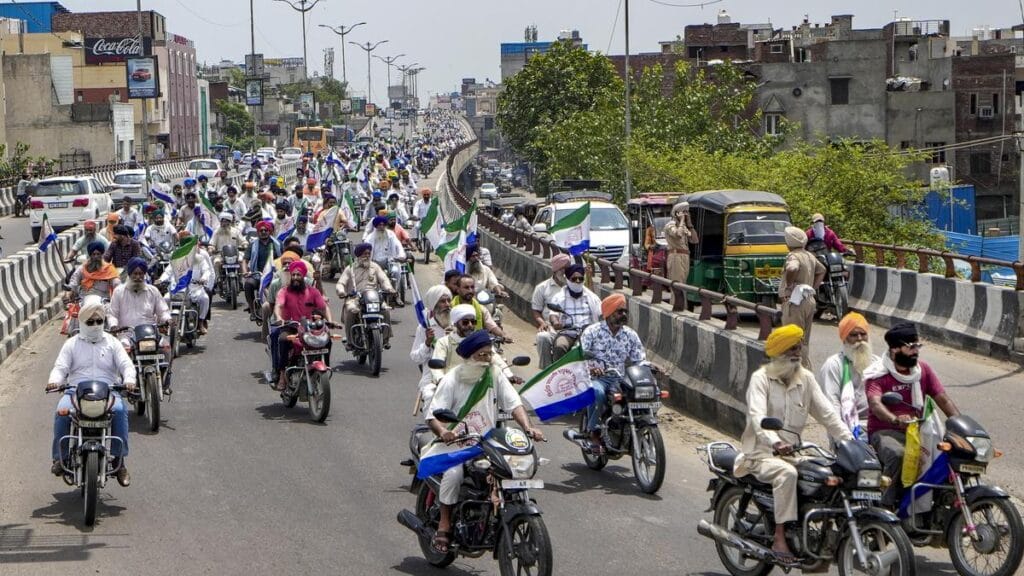
Farmers gathered near the Punjab-Haryana border after police stopped their vehicles on the way to Delhi for a rally against the proposed India-U.S. trade deal. Image Credit: TheHindu
Punjab-based farmers, along with supporters from Haryana, were stopped by police on Tuesday at the Shambhu-Ambala and Khanauri-Jind border points while trying to reach Delhi for a rally against the proposed India-U.S. trade deal. The gathering was organised under the banner of the Desh Bachao Morcha, and several farmers were seen proceeding on foot after their buses and vehicles were blocked.
The situation quickly became a traffic and security issue as authorities tightened movement at the inter-state boundary. With a traffic advisory already in place and alternative routes suggested, the border belt again became the centre of farmer mobilisation and state response. Yeh issue kaafi important hai because it sits at the intersection of agriculture, trade policy, protest rights and public movement.
What Happened at the Border
The farmers had set out for Delhi to take part in a Kisan Mahapanchayat linked to the proposed India-U.S. trade deal. Police, however, stopped their convoys at the Punjab-Haryana boundary, especially at Shambhu-Ambala and Khanauri-Jind, which are among the most sensitive entry points between the two states. Once vehicles were halted, several farmers from Haryana reportedly continued on foot toward Delhi. This story was also covered by The Hindu.
That detail matters because it shows the protest was not completely stopped, only redirected and slowed. In protest situations, when vehicles are blocked, foot movement often becomes a symbolic act of determination. Seedhi baat yeh hai: the farmers were trying to show that even if transport is blocked, the protest itself does not stop.
The police action appears to have been aimed at preventing a large-scale rally from moving into Delhi without prior clearance or open routing. Such measures are not unusual when the capital is facing a possible crowd movement. Border checkpoints, barricades and route diversions are standard tools used to manage both security and traffic.
Why the Protest Was Launched
The rally is being held against the proposed India-U.S. trade deal, which farmer groups fear could hurt domestic agriculture and weaken local interests. For many farmer organisations, the concern is not just about one agreement, but about what it could mean for pricing, market access and the long-term position of Indian farmers in a globalised trade environment.
Trade deals often become politically sensitive when they touch agriculture, because farming in India is tied to livelihoods, minimum support prices and rural stability. Even the idea of opening markets more widely can trigger anxiety among cultivators who worry about competition from imported goods or policy shifts that may not protect them. That is the deeper reason why this rally has attracted attention beyond just the protest route.
Farmer leaders have also increasingly framed such movements as a defence of sovereignty and local economic control. That framing gives the protest a stronger political tone than a typical sectoral demand. It is not only about prices or procurement; it is also about who gets to shape India’s agricultural future. Yeh bhi important hai because rural India does not see trade policy as an abstract economic issue — it sees it through the lens of survival.
Traffic Advisory and Public Impact
A traffic advisory was issued in connection with the rally, with alternative routes recommended for commuters. This is important because even when protests are legitimate and peaceful, they can still affect the daily lives of ordinary people. Commuters, transport operators and local businesses in border districts often feel the impact first.
When major roads near the Punjab-Haryana boundary are blocked, the disruption can extend well beyond the protest site. Goods transport slows down, buses are delayed and people travelling between Punjab, Haryana and Delhi face uncertainty. In the broader picture, that creates a ripple effect through supply chains and daily movement patterns.
For residents of the region, this kind of disruption is familiar. The Punjab-Haryana border has often turned into a protest corridor whenever farmer groups mobilise. That history means traffic advisories are not just routine notices; they are part of a larger pattern of recurring tension between public order and protest rights. In simple terms, jab bhi border pe movement rukti hai, iska asar sirf protestors tak limited nahi rehta — poori public ko feel hota hai.
Background and Context
This protest should be seen against the backdrop of earlier farmer agitations that used the same border points as strategic gathering sites. Shambhu and Khanauri have emerged as symbolic and logistical centres for farmers’ movements because they sit on the path to Delhi and can be used to build pressure on the Centre.
The use of the Desh Bachao Morcha banner also signals an attempt to broaden the issue beyond a narrow trade-policy complaint. Farmer groups are trying to present the rally as a national issue rather than a local one. By choosing Delhi as the destination, they are making a familiar political statement: decisions made in the capital can directly affect life in the villages.
There is also a historical layer here. Farmers in north India have repeatedly marched toward Delhi whenever they feel policy decisions threaten their interests. That pattern has made the national capital a recurring endpoint for agricultural protest. The current movement fits that tradition, but with a fresh trigger in the proposed India-U.S. trade deal.
Timeline
July 15, 2026: Farmers stage motorcycle rallies in Punjab, Haryana and Himachal Pradesh against the proposed trade deal.
Tuesday morning: Farmers under Desh Bachao Morcha begin moving toward Delhi for a Kisan Mahapanchayat.
During the journey: Haryana Police stop vehicles and buses at Shambhu-Ambala and Khanauri-Jind.
Later Tuesday: Some farmers from Haryana start walking toward Delhi on foot.
Same day: Traffic advisories and alternative routes remain in place for commuters.
Also Read: Abhijeet Dipke Apologises to CJP Supporters After Police Violence at Sansad Chalo Protest
Why This Matters
This matters because the protest is not just about one trade agreement; it is about how India balances global economic deals with domestic agricultural concerns. Farmers form one of the most politically important groups in the country, and any deal perceived as threatening their interests can quickly become a national issue. Yeh issue kaafi important hai because it can influence policy debate, rural politics and public trust all at once.
It also matters because border blockades and route restrictions affect daily life. People who are not part of the protest still face delays, detours and uncertainty. In an area like the Punjab-Haryana belt, where movement between states is common, even a few hours of disruption can affect workers, traders and transport networks.
At a deeper level, this is a reminder that farmers remain a powerful force in Indian politics. Their mobilisation can pressure governments, shape media narratives and force trade or agricultural policy to be explained in public. When farmers choose Delhi as their destination, the political message is always larger than the road they travel.
India Angle
For Indian readers, this story matters because it touches the future of farming, local markets and trade policy. In Hinglish, seedhi baat yeh hai: agar farmers ko lagta hai ki deal se unka nuksan hoga, toh woh chup nahi baithenge. That kind of mobilisation is a core part of India’s democratic fabric.
The protest also shows how state boundaries can become political boundaries in practice. Punjab, Haryana and Delhi are tightly connected through agriculture and transport, so any movement at the border has a direct national effect. The fact that some farmers continued on foot shows how determined the group is to keep the issue visible.
For the broader Indian audience, the key question is simple: how will the proposed trade deal affect agriculture, prices and rural livelihoods? That question will continue to drive discussion as long as the government does not clearly explain the deal’s terms and safeguards. Rural audiences, especially in north India, will be watching closely.
Analysis
My opinion is that the most important part here is not just the stoppage at the border but the message it sends. When farmers are blocked from reaching Delhi, the protest becomes a struggle over visibility. The authorities want to contain movement; the farmers want to create pressure. That tension is what makes this kind of story newsworthy.
I also think the government will need to communicate more clearly about the proposed trade deal if it wants to reduce panic. In India, trade policy can seem distant until farmers frame it as a livelihood threat. Once that happens, the issue becomes political very fast. The protest at the border is a signal that the deal has already entered the public debate in a serious way.
From an editorial angle, this is a well-rounded story because it has a human element, a policy trigger and a strong regional setting. The image of farmers walking toward Delhi after their buses were stopped is especially powerful. It shows both resistance and vulnerability — two things that often define farmers’ protests in India.
What Next
The next step will depend on whether the farmers are allowed to proceed in some form, whether the rally at Kisan Ghat goes ahead, and how the authorities manage the border. If the protest remains peaceful, the administration may try to control it through route restrictions rather than direct confrontation.
Farmer leaders are likely to continue pushing their anti-trade-deal messaging and may use the stoppage as proof that their voices are being restricted. If the movement gains more support from neighbouring states, it could expand further. That would increase pressure on the Centre to clarify its position on the trade agreement.
Commuters should expect continued route diversions and possible delays around the Punjab-Haryana border and parts of Delhi. For now, the situation remains fluid, and both the protest and the traffic impact are likely to continue through the day.
Conclusion
The stoppage of farmers at the Punjab-Haryana boundary shows how quickly a protest against a proposed trade deal can become a border-control and traffic-management issue. With vehicles blocked, some farmers moving on foot and a traffic advisory already in place, the rally has already made its political point: the trade deal is being watched closely and resisted loudly. At the same time, the episode highlights the recurring role of the Punjab-Haryana border as a flashpoint in India’s farmer politics. The next phase will depend on whether the movement remains contained or grows into a larger national campaign.
Written By A. Jack