
Mumbai’s Chhatrapati Shivaji Maharaj International Airport is shutting both runways for six hours on Thursday from 11:00 AM to 5:00 PM for annual pre-monsoon maintenance, forcing major airlines including Emirates, Air India, British Airways, Qatar Airways, Lufthansa and Singapore Airlines to reschedule flights.
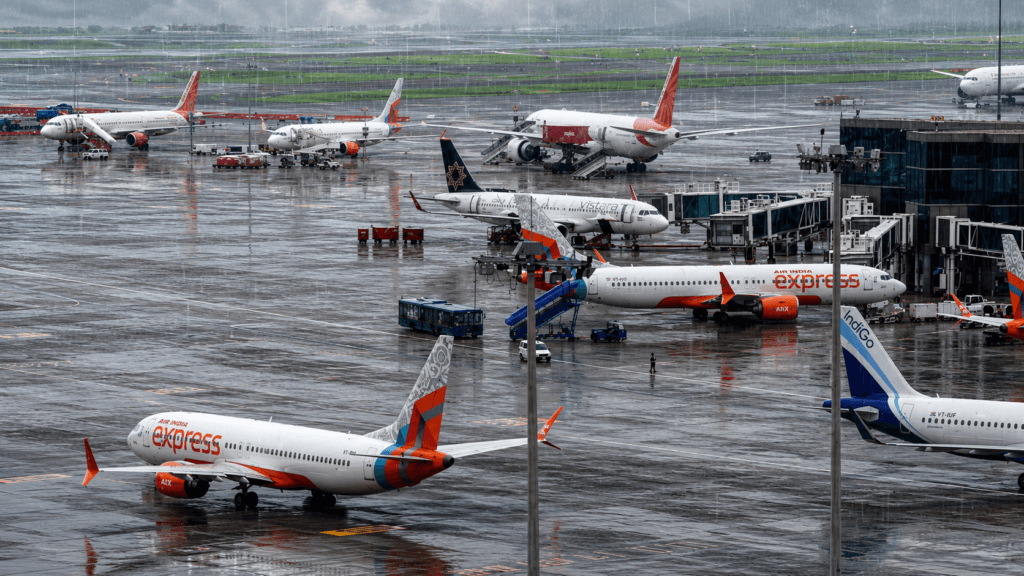
Engineers are doing safety work at Mumbai airport before the monsoon season, which includes cleaning the drainage, removing rubber, and checking the systems. [A.I. Generated Image]
Mumbai Airport Runway Shutdown
Mumbai’s CSMIA is set for a major operational disruption on Thursday, as both runways — 09/27 and 14/32 — go offline simultaneously from 11:00 AM to 5:00 PM for essential monsoon preparation. The temporary closure will pause all flight movements during the window while terminal activity continues and airlines scramble to manage schedules, rebook passengers, and reduce delays.
What Happened
The shutdown affects one of India’s busiest aviation hubs, which handles more than 1,000 air traffic movements every day. In a rare move, both the primary runway and the secondary runway are being closed at the same time, leaving no active runway for arrivals or departures during the maintenance window. The airport has planned the closure as part of its annual pre-monsoon safety program, a routine but highly sensitive exercise at a city where heavy rains can quickly disrupt aviation operations. NEWS18 has covered the full story.
The announcement has already forced airlines to act fast. Emirates has rebooked affected passengers to earlier departure slots, British Airways has adjusted its outbound schedule, and Air India has changed some domestic timings to protect international connections. Qatar Airways is rerouting operations around the shutdown, Lufthansa is allowing passengers to reschedule without extra cost, and Singapore Airlines has increased customer support capacity to handle passenger queries and fallout.
Why The Closure Is Needed
The six-hour stoppage is not a random disruption; it is a planned safety step. During monsoon season, Mumbai airport faces intense rain, waterlogging risk, reduced visibility, and runway stress, so maintenance teams are carrying out rubber removal, drainage cleaning, and Instrument Landing System repairs to keep operations safe. These tasks are critical because even a small issue on a wet runway can become a major aviation risk.
From an operational perspective, this kind of closure is a balancing act. Airport authorities must choose between short-term inconvenience and long-term safety, and in this case they are prioritizing preventive work before the rains intensify. The logic is simple: if maintenance is delayed now, the impact later could be far bigger, with more cancellations, diversions, and safety concerns.
Airline Response And Passenger Impact
Airlines have responded in different ways depending on route structure and passenger load. Some have pushed flights earlier, some have shifted connections, and some are offering flexible rebooking policies to avoid penalties for affected travelers. For international passengers, especially those connecting through Mumbai, even a six-hour shutdown can create a chain reaction across several airports and time zones.
For domestic travelers, the impact may appear smaller at first, but the ripple effect can be serious. A delayed Mumbai leg can disrupt onward flights to Delhi, Bengaluru, Kolkata, Dubai, London, or Singapore, which is why carriers are trying to protect connection banks. In simple terms, yeh closure sirf Mumbai tak limited nahi hai—it can affect the wider network across India and abroad.
Background And Timeline
The Mumbai airport regularly conducts pre-monsoon maintenance because the city’s weather makes aviation planning more complex than in many other metros. The airport’s runway system is especially important because it supports a very high volume of movements every day, and any maintenance window must be timed carefully to avoid peak passenger disruption.
Timeline
Before Thursday: Airlines begin informing passengers, adjusting slots and revising schedules.
Thursday, 11:00 AM: Both runways shut down simultaneously.
11:00 AM to 5:00 PM: No flight operations take place while maintenance work is carried out.
5:00 PM onward: Operations are expected to resume after a mandatory safety check.
This is a textbook example of how big airports manage seasonal risk. Pre-monsoon work is not just about cleaning; it is about making sure the runway remains safe under heavy rain, strong wind, and low-visibility conditions. Mumbai has learned over the years that ignoring this preparation can lead to much larger operational chaos during peak monsoon weeks. Also Read: Mumbai Court Rejects Bail to Telecom Agent in Over 100 SIM Card Cyber Fraud Case
Why This Matters
This matters because Mumbai is not just another airport—it is a core aviation gateway for India. A shutdown here affects business travelers, tourists, cargo schedules, crew rostering, and aircraft rotations, so the disruption has both economic and passenger-facing consequences. For companies and frequent flyers, even a few hours can mean missed meetings, missed connections, and additional costs.
It also matters for safety. The pre-monsoon maintenance program is a reminder that airports must prepare before weather becomes severe, not after problems start. For passengers, this means a temporary inconvenience today can help prevent a more dangerous or disorderly situation later, and that is a fair trade-off when handled transparently.
India-Focused Angle
For Indian travelers, especially those flying out of Mumbai, this is a good reminder to check schedules early and avoid reaching the airport without confirmation. In a country where weather-linked disruptions are common during the monsoon, proactive planning saves time, money, and stress. Airlines also need to communicate clearly in English and simple Hindi so passengers understand rescheduling, refunds, and alternate options without confusion.
There is also a larger lesson for Indian aviation: monsoon readiness is not optional. Airports in coastal and high-rain regions must plan ahead with strong drainage, runway upkeep, and robust passenger communication because public confidence depends on reliable operations. Mumbai airport’s move may feel disruptive, but it is part of keeping the system safe and functional.
Analysis
My view is that the real story here is not the shutdown itself, but the way airlines and airport operators manage the disruption. Emirates, British Airways, and others moving quickly to rebook passengers shows that aviation recovery has become as important as aviation operations. A well-managed six-hour closure can actually strengthen trust if passengers feel informed, protected, and not left stranded.
What Next
The next step is the completion of the safety check at 5:00 PM, after which runway operations are expected to restart. In the hours after reopening, airlines will likely monitor delays, reposition aircraft, and normalize schedules gradually rather than instantly.
If the maintenance work goes smoothly, Mumbai airport may avoid more serious monsoon-related incidents later in the season. Passengers should still expect some knock-on effects even after reopening, because once a major hub pauses, the system often takes time to fully recover. The best outcome will be a stable restart with minimal cancellations and clear communication from airlines.
Conclusion
Mumbai airport’s six-hour runway closure is a major but necessary move ahead of the monsoon season. It will briefly disrupt hundreds of passengers and force airlines to reorganize schedules, but the larger goal is to keep one of India’s busiest aviation hubs safe and resilient.
For travelers, the message is clear: check your flight status, stay alert to rescheduling updates, and plan extra buffer time. For the airport and airlines, this is a test of coordination, and how well they handle it will shape passenger confidence in the weeks ahead.
Written By A. Jack