
A short circuit suspected as the Mahadev Travel bus erupts in flames during peak hour; Metro services briefly halted, and WEH traffic snarled for three hours
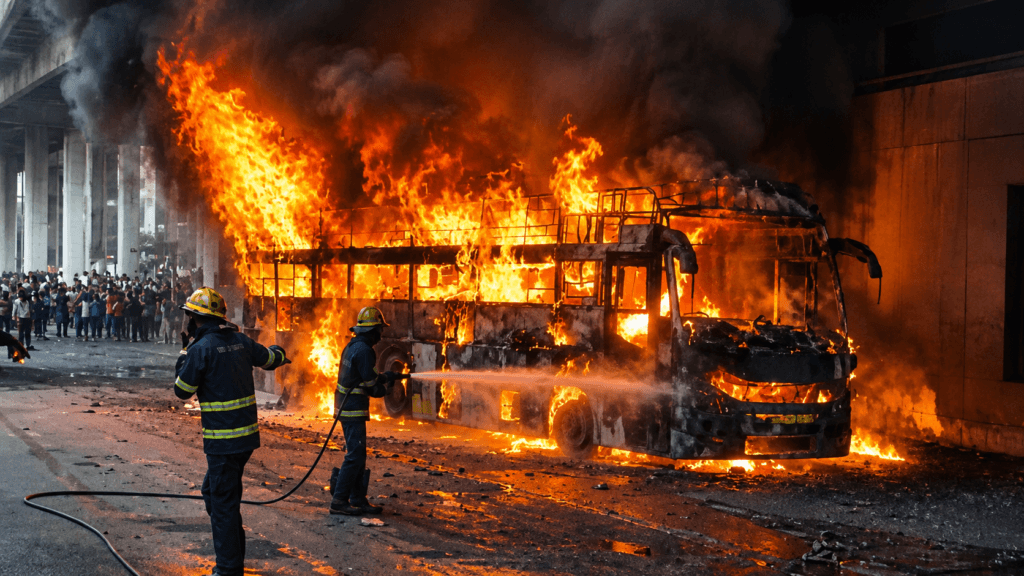
A Mahadev Travel intercity bus engulfed in flames beneath the Oberoi Garden City (Aarey) Metro Station. This image is AI generated.
A private intercity bus travelling from Mumbai to Gujarat caught fire beneath the Aarey Metro Station (also known as Oberoi Garden City Metro Station) in Goregaon East on Friday evening, triggering panic, disrupting Metro Line 3 services, and causing massive traffic snarls on the Western Express Highway (WEH) during peak-hour rush.
The incident was reported at approximately 6:15 PM near the Cheknaka signal, directly under the elevated Metro station structure. According to officials, the Mahadev Travel bus had seven passengers on board, all of whom were evacuated safely before the vehicle was completely gutted by flames. No injuries or casualties have been reported, but the fire generated thick smoke that spread into the Metro station area, forcing authorities to temporarily halt train services at Aarey Station as a precautionary measure.
Teams from the Mumbai Fire Brigade (MFB), Vanrai Police, 108 ambulance services, and Metro personnel rushed to the spot following a citizen alert. Firefighters brought the blaze under control by around 7:15 PM, but traffic movement on the northbound carriageway remained affected for nearly three hours as emergency crews worked to clear the burnt vehicle from the highway.
Why and How
According to preliminary investigations by Mumbai Fire Brigade officials, the fire was likely triggered by an electrical short circuit in the bus’s wiring system. The exact cause is still under investigation, but initial assessments point to a technical defect rather than external factors like collision or arson.
The bus, identified as a Volvo tourist vehicle bearing registration number MJ 01 AN 1695, was operated by Mahadev Travel (also referred to as Mahadeo Traveler in some reports). It was en route from Mumbai to Gujarat with five to seven passengers on board, depending on varying official accounts. Driver Nijar Kapadia was also in the vehicle when the fire broke out.
Eyewitnesses described a scene of chaos as flames quickly engulfed the bus, sending thick plumes of black smoke rising toward the Metro station above. A motorcyclist passing by noticed smoke and promptly alerted the driver, allowing all passengers to exit safely before the vehicle was consumed by fire. This story was also covered by The Mid-Day.
“The fire was doused by around 7:15 PM, and the process of clearing the burnt vehicle from the road was underway,” a Mumbai Traffic Police officer said. Around 7 PM, some lanes of the highway were temporarily closed to facilitate firefighting operations, causing significant congestion on both sides of the WEH.
Official Statements and Emergency Response
A spokesperson for the Maha Mumbai Metro Operation Corporation Limited (MMMOCL) issued a statement assuring passengers that the Metro station structure itself was not damaged by the fire. “The fire occurred beneath the station premises and did not affect the station structure. However, smoke from the burning bus entered the station area, prompting Metro authorities to move passengers outside as a precautionary measure,” the spokesperson said.
As a temporary safety measure to prevent smoke from entering trains, Metro services were briefly operated without halting at Aarey Station until the smoke cleared. “We would like to assure passengers that the Metro station premises have not been affected by this incident. However, the fire generated a lot of smoke in the area, and therefore, we moved our passengers outside the station premises for their safety,” the statement read.
Metro services at Aarey Station resumed by around 7 PM, and normal operations were restored shortly thereafter. Traffic movement gradually improved after the fire was brought under control and the damaged bus was removed from the carriageway.
The Brihanmumbai Municipal Corporation (BMC) confirmed that no injuries or casualties were reported in connection with the incident. “According to the information provided by the BMC, no injuries or casualties have been reported so far,” an official statement said.
Bus Fires and Metro Safety in Mumbai
This is not the first time a bus fire has disrupted traffic and Metro operations along the Western Express Highway. In recent years, multiple incidents of vehicles catching fire beneath elevated Metro stations have raised concerns about fire safety protocols, emergency response coordination, and the vulnerability of electrical systems in aging vehicles.
In a similar incident on September 4, 2026, a BEST bus caught fire below the Goregaon Metro Station on Metro Line 7, causing thick smoke to spread into the station area and forcing passengers to evacuate. That incident also affected traffic movement on the WEH and prompted temporary alterations to Metro services.
The frequency of such incidents highlights a broader issue: many intercity and tourist buses operating in Maharashtra are older vehicles with outdated electrical systems that are prone to short circuits, especially during monsoon season when moisture can exacerbate wiring faults. The Regional Transport Office (RTO) mandates periodic fitness certificates and safety inspections for commercial vehicles, but enforcement remains lax, and many operators cut corners to save costs.
From First Smoke to Traffic Normalcy
September 4, 2026, 6:15 PM: A Citizen reports a fire in a private bus beneath the Oberoi Garden City (Aarey) Metro Station near the Cheknaka signal, Goregaon East.
6:15–6:30 PM: Mumbai Fire Brigade, Vanrai Police, 108 ambulances, and Metro personnel mobilized; passengers and the driver evacuated safely.
6:30–7:00 PM: Firefighters work to douse flames; thick smoke spreads into Metro station; passengers move outside as precaution; trains skip Aarey Station.
7:00 PM: Fire brought under control; Metro services resume halting at Aarey Station; some highway lanes reopened.
7:15 PM: Fire fully extinguished; burnt bus removal begins; traffic movement gradually improves.
9:00–10:00 PM: Highway fully cleared; normal traffic flow restored; Metro operations back to complete normalcy.
Also Read: Delhi CNG Pump Blast: 3 Killed, 3 Injured as Truck Cylinder Explodes Near Tikri Kalan Metro
Why This Matters
Yeh issue kaafi important hai for multiple reasons. First, it underscores the vulnerability of Mumbai’s critical transport infrastructure to seemingly routine incidents like vehicle fires. The Western Express Highway is one of the city’s busiest arteries, carrying lakhs of commuters daily. A fire during peak hour doesn’t just disrupt traffic—it creates a cascade of delays affecting offices, schools, hospitals, and emergency services.
Second, the proximity of the fire to an elevated Metro station raises serious safety questions. While the station structure was not damaged this time, smoke infiltration forced evacuation and service disruption. What if the fire had been more intense? What if it had occurred directly beneath a station with higher passenger density?
Third, the incident highlights gaps in vehicle safety enforcement. Short circuits are preventable with regular maintenance and timely replacement of aging wiring. Yet, operators often prioritize profits over safety, and regulatory oversight is weak.
For daily commuters, the impact is immediate and personal. Three hours of traffic snarls during peak hour means missed appointments, delayed commutes, and added stress. For Metro passengers, the sudden evacuation and service disruption create anxiety and erode confidence in public transport reliability.
India Angle
For readers across India, yeh sirf Mumbai ki problem nahi hai—yeh ek national pattern ban chuka hai. From Delhi to Bengaluru, from Pune to Hyderabad, bus fires and Metro disruptions due to vehicle incidents are becoming alarmingly common. The root causes are similar: aging fleets, poor maintenance, lax enforcement, and inadequate emergency preparedness.
Agar aapko lagta hai ki yeh issue sirf private operators ko concern karta hai, toh sochiye dobara. Even government-run fleets like BEST and state transport corporations face similar challenges. Budget constraints, bureaucratic delays in procurement, and corruption in maintenance contracts all contribute to the problem.
The Metro angle is particularly relevant for India’s rapidly urbanizing cities. As Metro networks expand in Delhi, Bengaluru, Chennai, and other metros, the risk of such incidents increases. Integrated emergency response protocols, fire-resistant station designs, and real-time monitoring systems are essential—but often missing.
Analysis
The fact that all passengers escaped safely is a testament to quick thinking by the motorcyclist who alerted the driver and the efficiency of emergency responders. But luck should not be our primary safety strategy. Relying on bystanders to notice smoke and alert drivers is not a sustainable model for preventing casualties.
The Metro response was commendable—evacuating passengers, skipping the station, and resuming services quickly shows operational agility. But the incident also reveals a design flaw: elevated stations directly above busy highways are inherently vulnerable to vehicle fires, smoke, and debris. Future Metro expansions should incorporate fire barriers, enhanced ventilation systems, and dedicated emergency lanes beneath stations.
From a regulatory standpoint, the RTO and transport departments need to tighten enforcement. Mandatory installation of automatic fire suppression systems in commercial vehicles, stricter fitness certification protocols, and random inspections could prevent many such incidents. Operators who repeatedly violate safety norms should face license cancellation, not just fines.
What Next
In the immediate term (next 7–14 days):
Fire investigation: Mumbai Fire Brigade will submit a detailed report on the exact cause of the short circuit and whether any safety norms were violated by the operator.
Operator scrutiny: RTO may summon Mahadev Travel officials to review the bus’s fitness certificate, maintenance records, and compliance with safety regulations.
Metro safety review: MMMOCL may conduct a safety audit of all elevated stations along WEH to assess vulnerability to vehicle fires and smoke infiltration.
Traffic management: The Mumbai Traffic Police may review emergency lane protocols and coordinate with the Fire Brigade for faster response times during peak hours.
Longer-term (weeks to months):
Policy recommendations: BMC and state transport departments may propose mandatory fire suppression systems for intercity buses and stricter enforcement of fitness certificates.
Infrastructure upgrades: Future Metro station designs may incorporate fire-resistant materials, enhanced ventilation, and dedicated emergency access routes beneath elevated structures.
Public awareness campaigns: Transport authorities may launch campaigns educating commuters on emergency protocols, evacuation procedures, and how to report vehicle fires.
Insurance and compensation: Affected passengers may be eligible for compensation from the bus operator’s insurance; BMC may also review victim relief funds for such incidents.
For commuters using the Western Express Highway near Aarey and Dindoshi, officials advise expecting occasional delays during peak hours as clearance operations continue. Metro passengers are assured that services have returned to complete normalcy but should remain vigilant and follow station announcements during emergencies.
Final Thoughts
The Aarey Metro bus fire was a lucky escape—no lives lost, no serious injuries, and services restored within hours. But luck is not a strategy. Every bus fire, every Metro disruption, and every traffic snarl is a warning sign that our urban infrastructure is operating on borrowed time.
For Mumbai—a city that prides itself on resilience—this incident should be a catalyst for change, not just another headline. Stricter enforcement, better infrastructure design, and proactive emergency planning are not optional; they are essential.
For commuters, the message is clear: stay alert, report hazards, and demand accountability from authorities. For operators and regulators, the message is even clearer: safety cannot be compromised for profit.
Written By A. Jack