
A crane being installed for a MHADA eviction-and-demolition operation fell onto nearby homes in Kurla East around 3 am; all eight injured are stable, while goods trains on the Kurla–Trombay route were affected.
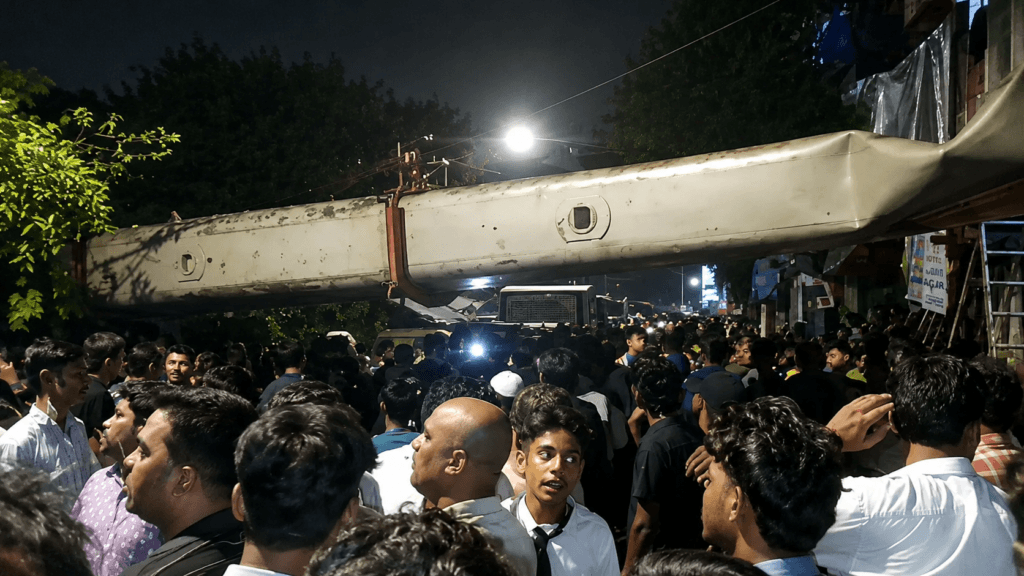
Rescue and civic teams at the Kurla East site, where a crane toppled during preparations for a MHADA eviction and demolition operation at Buntara Bhavan. Image Credit: NDTV
Eight people were injured after a crane toppled onto nearby houses in Mumbai’s Kurla East early on Friday, August 21, 2026, during preparations for an eviction and demolition operation linked to an MHADA building.
The incident occurred around 3 am at Buntara Bhavan, located behind Galaxy Apartment in Indira Nagar. According to Brihanmumbai Municipal Corporation (BMC) L-ward staff present at the site, the Maharashtra Housing and Area Development Authority (MHADA) was preparing to begin an eviction-and-demolition operation when the crane being mounted for the work toppled onto surrounding homes.
Six injured persons were admitted to Sion Hospital, while two were shifted to Bhabha Hospital in Kurla. Hospital authorities said all eight were stable.
The accident also disrupted goods-train movement on the single-line Kurla–Trombay route of Central Railway after a portion of the crane fell on overhead wires.
How the Crane Accident Happened
The crane was reportedly being installed at the Buntara Bhavan site to support a planned eviction and demolition operation. The exact stage of the mounting process, the load being handled and the technical reason for the collapse have not yet been officially established.
During the installation activity, the crane lost balance and toppled onto nearby houses, injuring eight people. The incident happened in a dense residential setting, which increased the danger because homes, narrow access lanes and railway infrastructure were located close to the demolition site.
The BMC L-ward staff said MHADA was preparing for an operation at the building when the accident occurred. At this stage, authorities have not confirmed whether the crane collapsed because of ground instability, improper mounting, mechanical failure, overloading, inadequate site assessment, operator error or another cause. This story was also covered by NDTV.
A formal technical inquiry will be necessary to determine the sequence of events.
Rescue Operation and Medical Response
Following the crane collapse, emergency services were mobilised rapidly. Personnel from the Mumbai Fire Brigade, Mumbai Police, 108 ambulance service and BMC ward teams reached the scene for rescue and relief operations.
The first priority was to remove injured people from the affected houses and ensure that no one was trapped under the fallen crane or debris. The narrow, congested nature of the Kurla East neighbourhood would have made access and movement of rescue equipment more difficult.
The eight injured people were divided between two civic hospitals:
| Hospital | Number of injured admitted | Condition |
|---|---|---|
| Sion Hospital | 6 | Stable |
| Bhabha Hospital, Kurla | 2 | Stable |
Officials said all the injured were stable as of the latest update. However, medical observation remains important in such incidents because crush injuries, fractures and trauma can sometimes require further treatment even when patients are initially described as stable.
Rail Movement Affected
The accident had an additional impact on railway operations. Part of the crane fell on overhead wires along the single-line Kurla–Trombay goods corridor of Central Railway. As a result, goods-train movement was affected on the route. The Kurla–Trombay line is important for freight operations and industrial supply movement in the Mumbai region.
The impact on the overhead equipment also highlights the risk of allowing heavy demolition machinery to operate close to rail infrastructure without adequate safety clearance and coordination.
Railway teams are expected to inspect the overhead wires, remove damaged equipment and restore safe movement only after the site is fully secured. While the report specifically mentions disruption to goods trains, any incident involving overhead lines requires careful electrical and structural checks before operations can resume.
Statements and Official Position
According to civic officials at the scene, MHADA was preparing to launch an eviction and demolition operation at Buntara Bhavan when the crane was being mounted.
“The crane was being mounted for the operation when it toppled onto nearby houses, leaving eight persons injured,” the official said. Officials confirmed that Mumbai Fire Brigade, police, ambulance teams and local ward staff were mobilised for the rescue operation.
The authorities have not yet publicly released a detailed cause-of-accident report. This means claims about exactly why the crane fell should be treated with caution until the technical inquiry examines the equipment, site conditions and operating procedures.
Demolition in Dense Mumbai Neighbourhoods
Mumbai frequently undertakes demolition, redevelopment, eviction and structural-safety operations because of ageing buildings, redevelopment projects, dangerous structures and land-use pressures.
But such operations are especially risky in dense neighbourhoods like Kurla, where buildings are packed closely together and access roads are often narrow. Heavy machinery such as cranes, excavators and demolition equipment must operate close to homes, pedestrians, electrical lines, pipelines and rail corridors.
Before any demolition or eviction operation, authorities and contractors are expected to assess:
Structural condition of the building
Stability of the ground for crane placement
Load capacity and condition of equipment
Distance from adjacent homes and roads
Proximity to railway lines and overhead wires
Evacuation of residents from risk zones
Emergency access for ambulances and fire engines
Weather conditions and visibility
Communication with residents, civic officials and police
The Kurla incident raises questions about whether these safeguards were adequately planned before the crane was brought in.
Yeh sirf machinery accident nahi hai. It is also a reminder that urban demolition work can turn dangerous within seconds if planning, supervision and safety zones are weak.
Timeline
Before August 21, 2026: MHADA prepares an eviction and demolition operation at Buntara Bhavan, a building behind Galaxy Apartment in Indira Nagar, Kurla East.
Around 3 am, August 21: A crane is being mounted for the proposed demolition operation.
During crane mounting: The crane topples onto nearby houses, injuring eight people.
Immediately after the collapse: Mumbai Fire Brigade, police, 108 ambulance service and BMC L-ward staff are mobilised for rescue work.
Medical evacuation: Six injured people are admitted to Sion Hospital and two to Bhabha Hospital in Kurla.
Rail disruption: A section of the crane falls on overhead wires, affecting goods-train movement on the single-line Kurla–Trombay route.
Latest update: All eight injured persons are reported stable; technical investigation into the crane collapse is awaited.
Also Read: Fire Breaks Out at Mumbai’s Aayakar Bhavan in Churchgate; Evacuation Underway
Why This Matters
Yeh incident kaafi important hai because it combines three major urban safety concerns—demolition work, residential risk and railway infrastructure.
Eight people injured: The crane collapsed onto homes, showing how quickly demolition operations can affect nearby residents.
Safety of eviction drives: Eviction and demolition operations must protect residents, workers and bystanders before machinery is deployed.
Dense urban living: In Mumbai, a construction or demolition accident can immediately impact adjoining houses because buildings are so closely packed.
Railway risk: Damage to overhead wires disrupted goods movement, proving that the accident extended beyond the worksite.
Accountability: The cause of the crane’s fall must be independently established to identify whether there were failures in equipment, planning, permissions or supervision.
The fact that all injured are stable is a relief. But the incident could have been much worse, especially if the crane had fallen during daytime when more people might have been in the surrounding area.
India Angle
India’s cities are witnessing large-scale redevelopment, Metro construction, road widening, slum rehabilitation and demolition of unsafe buildings. Mumbai is at the centre of this transformation.
However, every redevelopment project must balance speed with safety. Eviction drives and demolition operations cannot be treated as routine administrative exercises when heavy cranes and machinery are involved.
Across Indian cities, authorities should ensure:
Certified cranes and trained operators
Mandatory pre-operation site safety audits
Structural and soil-stability assessment
Clear exclusion zones around machinery
Resident evacuation from danger areas
Coordination with railways, electricity providers and traffic police
Real-time supervision by qualified engineers
Emergency medical and fire services on standby
A crane collapse in a congested locality can become a mass-casualty event. Isliye “kaam jaldi khatam karna hai” should never override “kaam safely karna hai”.
Analysis
Crane failures often involve a chain of factors rather than one single mistake. These can include:
Improper crane assembly
Inadequate load distribution
Uneven ground
Failure of outriggers or stabilisers
Poor communication between operator and ground crew
Insufficient clearance from structures
Inadequate assessment of nearby railway infrastructure
Weak site barricading and evacuation planning
The inquiry should examine all of these elements. It should also clarify whether the demolition operation had all required permissions and whether an independent safety engineer was present at the site.
In my view as a news writer, Mumbai should treat this incident as a warning. The city’s redevelopment boom will continue, but public confidence depends on visible accountability whenever heavy machinery causes harm.
What Next
Several actions are likely to follow:
Technical inquiry: MHADA, BMC and police may examine crane records, operator credentials, site permissions and structural safety plans.
Equipment inspection: The crane’s stabilisers, lifting system, hydraulic mechanism and mounting process are likely to be inspected.
Railway restoration: Central Railway will need to repair and certify damaged overhead wires before normal goods movement resumes.
Medical updates: Authorities may issue further updates on the condition of the eight injured people.
Compensation: Residents or occupants of damaged homes may seek compensation for injuries, property damage and disruption.
Demolition review: The planned eviction and demolition operation may be paused until the site is declared safe.
Safety audit: Civic authorities may face pressure to audit similar demolition projects across Mumbai.
Conclusion
The Kurla East crane collapse has injured eight people and disrupted railway goods movement, turning a planned MHADA eviction and demolition operation into a major urban safety incident.
All the injured are currently stable, which is a significant relief. But a crane toppling onto homes in a densely populated neighbourhood raises serious questions about planning, equipment safety and protection of residents.
The exact reason for the collapse is still unknown. The investigation must establish whether the crane was properly mounted, whether the ground was safe, whether adequate exclusion zones were created and whether railway risks were considered.
Mumbai’s redevelopment is necessary, but it must be carried out with care. Kurla ka yeh accident clearly shows that demolition work is not just a civic procedure—it is a high-risk operation that demands strict engineering discipline and human safety at every stage.
Written By A. Jack