
Basement blaze at the seven-storey Income Tax office building sends thick smoke through upper floors; around 20 fire tenders deployed and no injuries have been reported so far.
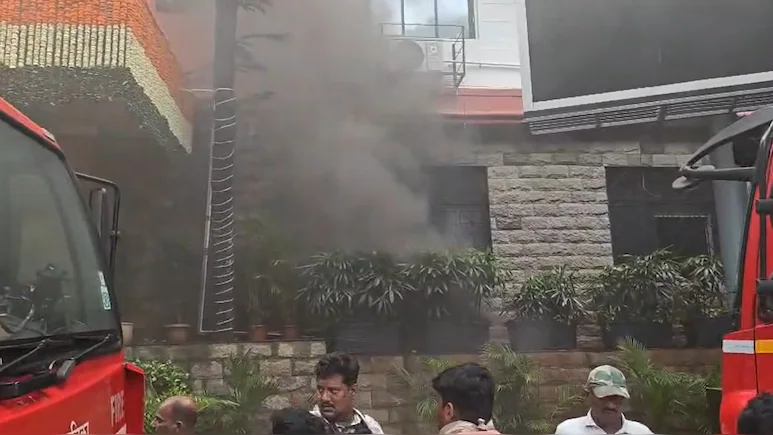
Thick smoke rises from Aayakar Bhavan, the Income Tax Department office building on Maharshi Karve Road in Churchgate, Mumbai. Image Credit: NDTV
A fire broke out in the basement of Aayakar Bhavan, the Income Tax Department office building on Maharshi Karve Road in Mumbai’s Churchgate area, on Monday afternoon, August 18, 2026.
The Mumbai Fire Brigade received the first call at 2.01 pm and immediately launched a major response. Thick plumes of smoke were seen billowing from the building and spreading across several floors above the basement, prompting emergency evacuation of people from the upper storeys.
No injury or casualty has been reported so far. Around 20 fire tenders, along with other firefighting and rescue vehicles, were deployed to control the blaze and safely evacuate employees and visitors.
What Happened at Aayakar Bhavan
The fire was reported from the basement of Aayakar Bhavan, a major government office complex that houses Income Tax Department offices in south Mumbai’s busy Churchgate district.
The building has a basement, a ground floor and seven upper floors. Smoke from the basement moved upward through the structure, affecting multiple levels and making the evacuation operation more difficult.
Officials said firefighters were working to contain the blaze and prevent it from spreading to higher floors. The smoke, rather than visible flames alone, was one of the immediate concerns because it can quickly reduce visibility and make stairwells unsafe in a multi-storey building. This story was also covered by NDTV.
The exact cause of the fire is not yet known. A detailed fire investigation is expected after the situation is fully controlled, cooling operations are completed, and fire officials are able to inspect the origin point in the basement.
Emergency Response
The Mumbai Fire Brigade mounted a large emergency response after receiving the distress call at 2.01 pm. At least four fire engines and several supporting vehicles were rushed initially, while the overall deployment increased to around 20 fire tenders as the operation continued.
Multiple agencies arrived at the site, including:
Mumbai Fire Brigade teams
Brihanmumbai Electric Supply and Transport (BEST) personnel
Ambulance services
Brihanmumbai Municipal Corporation officials
Police and emergency support staff
Specialised equipment was also deployed for people trapped or stranded on higher floors. This included a turntable ladder and aerial ladder platforms, which allow firefighters to access upper storeys from outside when internal movement is affected by smoke or heat.
The evacuation was carried out as a precaution. No one was reported injured at the time of the latest update, but emergency teams continued to check floors, stairwells and offices to ensure all occupants had been safely moved out.
Statements and Official Updates
A fire brigade official said the alert was received at 2.01 pm regarding a fire in the basement of Aayakar Bhavan in Churchgate.
The official confirmed that multiple fire engines and firefighting vehicles had been deployed and that the blaze had not yet led to any reported casualty.
“Thick smoke was seen rising from the building, and teams were evacuating occupants from the upper floors,” the official said, according to initial reports.
Authorities have not yet confirmed whether the fire was linked to electrical equipment, stored material, parking infrastructure, generators, cables or another source in the basement. Any conclusion before a forensic assessment would be premature.
Background
Basement fires are among the most difficult types of urban building fires to control. Unlike open-area blazes, smoke and heat can accumulate in enclosed spaces, while ventilation is often limited.
In a large office building, basements may contain electrical systems, utility cables, parking areas, storage rooms, diesel generators, air-conditioning equipment, records or maintenance materials. Even a small ignition source can generate dense smoke that travels through shafts, stairwells, ducts and service corridors.
Aayakar Bhavan is located in Churchgate, one of south Mumbai’s busiest commercial and administrative zones. The surrounding area sees heavy pedestrian movement, office traffic, BEST buses, taxis and private vehicles throughout the day. Any emergency at a major government building in this district can affect traffic, public access and nearby office operations.
The incident also comes at a time when fire safety in commercial, institutional and high-rise buildings is under renewed scrutiny across Mumbai and the wider Mumbai Metropolitan Region. Dense construction, ageing structures, mixed-use buildings and intense daily footfall make preventive compliance especially important.
Timeline
August 18, 2026, 2.01 pm: Mumbai Fire Brigade receives a call about a fire in the basement of Aayakar Bhavan on Maharshi Karve Road, Churchgate.
Shortly after alert: Fire engines, firefighting vehicles, ambulances, BEST personnel and civic officials are sent to the location.
During rescue operation: Thick smoke is seen moving through parts of the building, affecting floors above the basement.
Evacuation begins: Emergency responders start moving occupants from upper storeys using internal and external rescue arrangements.
Special equipment deployed: A Turntable ladder and aerial ladder platform are used to assist evacuation from upper floors.
Latest update: Around 20 fire tenders are engaged in firefighting operations; no injuries or casualties reported so far.
Next stage: Cooling work and a forensic inspection are expected once firefighters fully contain the blaze and declare the building safe for investigation.
Also Read: Granite Stones Fall at Mumbai Metro 9 Site; MMRDA Fines Contractor, Consultants ₹12.5 Crore
Why This Matters
Yeh incident important hai because it involves a busy multi-storey government office building in the heart of south Mumbai.
Employee and visitor safety: Aayakar Bhavan likely has a large number of employees, taxpayers, consultants and visitors on a typical working day. Swift evacuation was essential.
Basement fire risk: Smoke can spread rapidly through closed utility shafts and staircases, making basement incidents more dangerous than they may initially appear.
Public services: The building houses Income Tax Department offices, so the fire could disrupt administrative work, document access and taxpayer-facing services.
Traffic impact: Churchgate is a high-density office district. Emergency vehicles and security cordons can affect road movement and pedestrian access in the area.
Fire preparedness: The incident will test whether evacuation routes, alarms, smoke-control systems and emergency coordination worked as intended.
No injuries have been reported, which is a major relief. Lekin thick smoke in a seven-storey office building is never a minor matter. The response in the first hour often decides whether an incident remains contained or escalates.
India Angle
The Aayakar Bhavan fire highlights a broader national issue: fire safety in high-footfall offices, government buildings and commercial complexes.
Across Indian cities, many large buildings face common risks:
Ageing electrical wiring and overloaded circuits
Basement storage of equipment or combustible materials
Inadequate ventilation in enclosed areas
Blocked stairwells or poorly maintained fire exits
Non-functional sprinklers, hydrants or smoke detectors
Delayed evacuation drills and poor awareness among occupants
Mumbai has a particularly complex challenge. It has heritage structures, old commercial buildings, modern towers and dense office clusters packed into limited urban space. As a result, fire services must often conduct operations under pressure, with narrow access routes and heavy traffic.
For public agencies, the lesson is clear: fire safety certificates cannot be treated as paperwork. Regular drills, electrical audits, basement inspections, clear exits and functional suppression systems are equally important.
Analysis
If the fire started due to an electrical failure, it could prompt scrutiny of maintenance systems and safety audits. If it originated in stored material or a utility area, questions may arise over whether the basement was being used according to approved safety norms. If it involved a generator, cable trench or parking-related infrastructure, the technical investigation will become even more important.
The evacuation itself is also a major point of assessment. The fact that no injuries have been reported suggests that the emergency response was prompt, but the scale of smoke spread will likely lead authorities to review ventilation, alarm systems and evacuation readiness.
In my view, the most important follow-up is not only whether the fire was doused quickly. It is whether the building can reopen safely, whether workers receive a transparent safety report, and whether this becomes a trigger for preventive audits across other government offices in Mumbai.
What Next
Several developments are expected after the firefighting operation:
Fire containment and cooling: Teams will continue to ensure there are no hidden hotspots in the basement or service ducts.
Cause-of-fire inquiry: Fire officials will inspect the basement to determine the point of origin and likely cause.
Electrical safety check: Power systems, utility lines and equipment may be examined before electricity is fully restored.
Structural and smoke assessment: Engineers could inspect affected floors for smoke damage, heat exposure and air-quality concerns.
Office operations: Income Tax Department officials may decide whether normal work can resume immediately or whether some services need to shift temporarily.
Fire safety audit: The incident could lead to an audit of alarms, hydrants, sprinklers, stairwells, ventilation and evacuation procedures at Aayakar Bhavan and similar buildings.
Traffic and access restoration: Road movement near the site will normalise only after emergency vehicles are withdrawn and police remove any cordons.
Conclusion
The fire at Aayakar Bhavan in Churchgate created a major emergency in one of Mumbai’s busiest business districts, but the absence of reported injuries so far is a significant relief.
The Mumbai Fire Brigade’s large deployment—around 20 fire tenders, aerial ladders, ambulances and multiple agencies—shows the seriousness with which the situation is being handled. Thick smoke spreading beyond the basement made evacuation from the upper floors necessary, even as teams worked to control the fire.
The exact cause remains unknown, and that investigation will determine the next course of action. For now, the focus must remain on full evacuation, smoke clearance, cooling operations and ensuring that the building is safe before normal activity resumes.
Churchgate ka yeh incident ek clear reminder hai: crowded city buildings need round-the-clock fire readiness, not just a response after flames appear.
Written By A. Jack