
The victims, Piyush Gupta and Om Ankush Singh, were rescued by fire brigade personnel from the water-filled quarry in Ketki Pada. Residents say it remains dangerously accessible with other routes in still being used by young people.
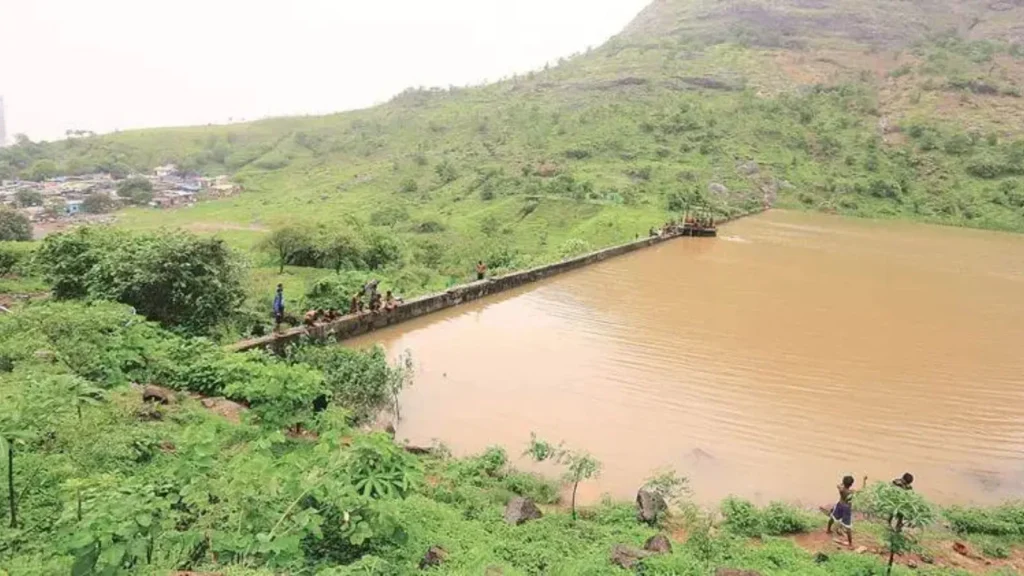
Rescue personnel at the abandoned quarry in Dahisar East after two college students drowned while swimming in the deep, water-filled pit. Image Credit: IndianExpress
Two college students, both 19, died after drowning in an abandoned quarry in Mumbai’s Dahisar East on Saturday morning in an incident that has once again put the spotlight on unsafe and unsecured mining pits in the city’s northern suburbs. The victims were identified as Piyush Gupta, a resident of Kandivali, and Om Ankush Singh, from Andheri. According to the Mumbai Fire Brigade, the emergency call came at 10.26 am from Shaikh Khadan in Ketki Pada, where the quarry had filled with water to dangerous depths.
Fire brigade personnel recovered both youths from the quarry, where they were submerged at an estimated depth of 10 to 15 feet, and rushed them to BDBA Shatabdi Hospital. Doctors declared them dead on arrival. Police said the two were part of a group of four college students who had gone there to swim, and the other two survived. The tragic incident has triggered fresh anger among local residents who say the site has witnessed repeated deaths over the years. Yeh issue kaafi important hai because it shows how a known danger can remain active even after warnings, barriers and past tragedies.
What Happened
The group of four college students reportedly entered the quarry to swim, likely treating the abandoned site like an informal waterbody rather than a hazard zone. That decision turned fatal when two of them drowned in the deep water. The quarry, according to the fire brigade, had water collected in it and a depth estimated at 10 to 15 feet where the boys submerged themselves.
Police are also examining whether alcohol consumption may have played a role, but officials have clearly stated that this has not yet been confirmed. That means the investigation is still at an early stage and no conclusion should be drawn too quickly. The immediate, verified facts are simpler and more tragic: two young men entered a dangerous quarry, drowned, and could not be saved despite rescue efforts. this story was covered by The indianExpress.
The presence of a warning system did not stop the incident. Residents say there is a check post and warning boards, but the quarry area is large and has multiple access points. If one route is blocked, people reportedly use another route through the hills. That kind of terrain makes enforcement difficult, especially when the site is spread out and old mining pits are scattered across a wide zone.
Why the Quarry Remains Dangerous
This tragedy happened because the abandoned quarry is not naturally safe just because water has collected in it. In fact, such pits are often more dangerous than they look. The water may appear calm, but the depth can change suddenly, edges can be unstable, and there may be no easy way out if someone slips or is unable to swim back to safety.
The deeper issue is that abandoned quarries often remain open long after mining operations have ended. Over time, they become informal spaces where people enter for recreation, photos or swimming, even when that is clearly unsafe. In this case, local residents say the pits are old and were left behind decades ago after mining activity stopped. That means the danger is not new; it is long-standing and well known.
The fact that repeated deaths have occurred here suggests a pattern rather than an isolated accident. If warning boards have already been installed and a check post exists, the next question is why access remains possible. That usually points to a gap between safety instructions and actual ground-level control. On paper, the site may be restricted. In reality, it may still be reachable.
Residents Speak Out
Local residents have reacted strongly to the deaths, saying they are tired of seeing young lives lost at the quarry. Prakash Poojari, a resident and Shiv Sena party member familiar with the area, said warning boards and a check post exist but people continue to enter through alternative routes. His point reflects a familiar urban safety problem: a signboard alone does not stop risk if the terrain is open and unenforced.
Poojari also said many of the people entering the quarry do not realize how deep the pits are because the site consists of old abandoned mining areas. That ignorance can be deadly. A quarry may look like a water hole from a distance, but once someone gets in, the actual danger becomes clear only too late.
He argued that the deeper pits should be filled with soil to prevent future deaths. That is not a small suggestion — it is a practical long-term safety measure. If the pits were levelled or made inaccessible, the risk of repeated drownings would reduce sharply. In his words, these are not just accidents; they are preventable deaths.
Background and Context
Abandoned quarries have long been a safety concern in Mumbai’s suburban belt, especially in areas where old mining activity left behind deep pits. These pits often fill with rainwater and become deceptively attractive to young people during hot weather or weekends. But they are extremely hazardous because there are no lifeguards, no rescue systems and no controlled access.
Dahisar East, especially Ketki Pada and the Shaikh Khadan area, has seen repeated complaints about this issue. Residents have long argued that warning signs are not enough and that stronger barriers or permanent closure measures are needed. The latest drowning death is therefore not being seen as an isolated event but as another failure in a problem that has already been known for years.
In urban safety terms, this is exactly the kind of incident that tends to repeat itself when known danger spots are not dealt with decisively. The site is not new, the risk is not new, and the complaints are not new. What changes each time is the victim and the grief left behind.
Timeline
Before Saturday morning: Four college students reportedly go to the abandoned quarry to swim.
10:26 am, Saturday: Mumbai Fire Brigade receives a report from Shaikh Khadan in Ketki Pada, Dahisar East.
Soon after: Fire brigade personnel rescue two youths from the water-filled quarry.
At BDBA Shatabdi Hospital: Doctors declare Piyush Gupta and Om Ankush Singh dead on arrival.
Following the incident: Police begin probing the cause, including possible alcohol consumption.
Later: Residents renew calls for stronger preventive action and permanent safety measures.
Why This Matters
This matters because it is a preventable youth tragedy. Two 19-year-old students lost their lives in a place that residents say has already been flagged as dangerous. When such deaths happen again and again, it means the system around the hazard is not working well enough. Yeh issue kaafi important hai because safety failures become public failures when warning signs exist but access is still possible.
It also matters because these incidents affect local communities far beyond the immediate victims. Families lose children, residents lose peace of mind and authorities face pressure to act. Each drowning also raises uncomfortable questions about responsibility: who is supposed to secure the site, who monitors access and who is accountable when another life is lost?
For cities like Mumbai, this is a reminder that urban danger does not always come from big disasters. Sometimes it comes from neglected spaces that everyone knows about but no one fully fixes. Quarries, open pits and abandoned mine sites can become silent traps if they are left unmanaged.
India Angle
For Indian readers, this is a very familiar and very serious kind of urban safety story. Across India, abandoned pits, waterlogged construction sites and unsecured natural depressions often become recreation spots for youngsters. In Hinglish, seedhi baat yeh hai: jab jagah dangerous ho aur access phir bhi easy ho, toh tragedy almost inevitable ho jaati hai.
The story also connects to a larger Indian urban issue—the gap between warnings and enforcement. Many localities have signboards, fences or occasional patrols, but those measures are not always enough when the area is large or the terrain is broken. If this can happen in Mumbai, one of India’s most monitored cities, it is easy to see why similar hazards in smaller towns can be even more dangerous.
It also has a social dimension. Young people often seek out such spots for swimming, photos or weekend outings without fully understanding the risk. Public awareness campaigns around abandoned quarries, old mines and deep water pits could help reduce future deaths. This is not just a Mumbai problem; it is a safety issue that many Indian cities should take seriously.
Analysis
My opinion is that the most alarming part is the repeat nature of the deaths. When residents say people keep dying there, the issue is no longer just one accident—it is a long-term failure to close or neutralize a known hazard. Warning boards are useful, but they are not a solution by themselves. A dangerous pit with multiple access routes needs physical prevention, not just cautionary messaging.
I also think the inquiry into alcohol consumption should be handled carefully. It may become a factor in the investigation, but it is not yet confirmed. The central story should remain the unsafe site and the lack of effective protection. Blaming behaviour alone can distract from the deeper environmental and civic problem.
From a policy perspective, the best response would likely include stronger fencing, closure of alternative access paths, better monitoring and, if feasible, filling the pits. If the area is truly as large and hazardous as residents say, then a more permanent engineering solution may be the only way to prevent further deaths.
What Next
The immediate next step will be the police investigation into how the four students entered the quarry, what happened in the water and whether any other factors were involved. Authorities will also likely examine whether alcohol played any role, though the result of that inquiry is still pending.
After the investigation, civic agencies may face pressure to strengthen safety controls in the area. That could mean better fencing, more patrols or even permanent closure measures for certain parts of the quarry zone. Residents are likely to continue demanding a long-term fix, not just a response after the fact.
There may also be renewed discussions about whether abandoned mining pits should be filled or otherwise reclaimed. If repeated drownings continue, public pressure could force more serious action. For now, the most urgent priority is to prevent another family from going through the same loss.
Conclusion
The drowning of two 19-year-old college students in an abandoned Dahisar quarry is a heartbreaking reminder that known hazards can still claim lives when access remains too easy. Piyush Gupta and Om Ankush Singh died after entering the water-filled pit with two other friends, while police continue to investigate the exact circumstances. Residents say the site has a history of repeated fatalities despite warning boards and a check post, which makes the tragedy feel even more preventable. The larger lesson is clear: dangerous abandoned sites cannot be left to signs alone—they need real, physical safety action before more young lives are lost.
Written By A. Jack