
Jaykumar Jaiswal died, and Urmila Jaiswal, 35, and Vinit Jaiswal, 9, were injured in the incident. Emergency rescue teams were rushed to the area and structural checks carried out. Officials have evacuated nearby homes as a precaution while they continue to assess the situation.
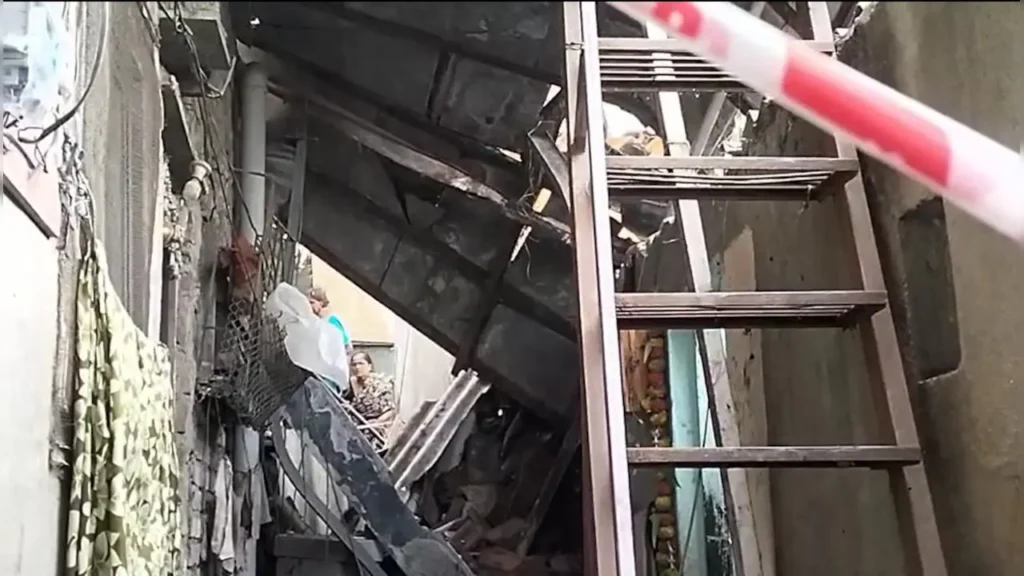
Madras Chawl in Thane after an old house collapsed onto a neighbouring home, killing a 12-year-old boy and injuring two others. Image Credit: NDTV
Thane House Collapse: A tragic house collapse in Maharashtra’s Thane on Friday afternoon claimed the life of a 12-year-old boy and injured two members of his family after an old structure gave way and crashed onto their home. The incident took place at around 3:35 pm at Madras Chawl in Azad Nagar, Brahmand, and led to an immediate rescue operation by emergency teams.
According to officials, the old ground-plus-one-storey building was around 25 to 30 years old, and preliminary information suggested that part of its gallery collapsed onto the adjacent house where the family was asleep.
The boy, identified as Jaykumar Jaiswal, suffered critical injuries and was taken to the Civil Hospital, but doctors declared him dead before treatment could begin. Two others, Urmila Jaiswal and Vinit Jaiswal, sustained head injuries and were admitted to Titan Hospital in Manpada. Yeh incident kaafi heartbreaking hai because it happened during a normal afternoon rest, turning an ordinary moment into a fatal tragedy.
What Happened
The collapse appears to have begun with a structural failure in the old house’s gallery. Preliminary reports suggest that a section of the gallery suddenly gave way and fell directly onto a neighbouring house where three members of a family were sleeping. That means the impact was not only sudden but also completely unexpected, leaving little or no time for escape. This story is also covered by NDTV.
The most tragic consequence was the death of 12-year-old Jaykumar Jaiswal. Even though he was rushed to the Civil Hospital soon after the collapse, his injuries were too severe, and he was declared dead on arrival. The other two injured family members, 35-year-old Urmila Jaiswal and 9-year-old Vinit Jaiswal, suffered head injuries and are currently under treatment.
Officials said that the structure involved was around 25 to 30 years old, which immediately raises concerns about ageing buildings in densely populated areas. In a city like Thane, where old chawl-style structures often exist close to each other, even a partial collapse can trigger a chain reaction. That is exactly what seems to have happened here.
Why the Collapse May Have Happened
At this stage, the exact cause of the collapse has not been formally established, but the age of the structure is already a major factor. Older buildings are more vulnerable to wear and tear, especially if they have not been properly maintained or structurally repaired. Over time, rain exposure, seepage, poor repairs and stress on weak portions like galleries and balconies can make parts of a structure unsafe.
The fact that the gallery collapsed onto an adjacent home suggests that the building may have had a weakened external portion or load-bearing issue. Galleries and projecting slabs often become risk points in older buildings because they are exposed to weather and can deteriorate faster than internal parts of the structure. If regular inspections are absent, such damage can go unnoticed until a failure occurs.
In areas like Madras Chawl, where homes are close together and space is limited, a small failure in one structure can directly affect another household. That is why this incident is not just a personal tragedy but also a civic safety concern. It shows how fragile older housing clusters can become when maintenance is delayed or ignored.
Rescue and Emergency Response
As soon as the collapse was reported, emergency teams rushed to the spot. The operation involved two fire engines, a rescue vehicle, a disaster management utility vehicle and an ambulance. That kind of response is standard for structural collapse incidents because every minute counts when people may be trapped or injured.
Officials also said that three adjacent houses in Madras Chawl have been vacated as a precaution. That is an important step because once one old structure fails, nearby houses may also be at risk if they share similar age, design or stress conditions. Clearing the area helps prevent a second disaster while structural assessments are carried out.
The Majiwada Ward Committee, the Public Works Department and the Encroachment Department are now involved in clearing and assessment work. That means the incident has moved beyond immediate rescue and into the stage of civic inspection and safety review. In simple terms, the first job was to save lives, and the next job is to make sure no other lives are in danger.
Background and Context
Thane, like many fast-growing Indian urban areas, has a mix of newer buildings and older chawls or low-rise structures that have aged unevenly. These areas often remain densely occupied even when the buildings themselves are decades old. That creates a constant safety challenge because ageing infrastructure does not always get the same level of attention as new development.
House collapses and partial structural failures are unfortunately not uncommon in older parts of Indian cities, especially during the monsoon or when maintenance has been neglected for years. While rainfall was not specifically identified as the trigger here, older structures in crowded localities often become weaker over time due to environmental exposure and local wear. The broader issue is familiar across India: many families still live in buildings that were not designed for today’s population pressure or long-term use without major reinforcement.
This incident also reflects a recurring urban truth — risk is often concentrated among people with the least room to move. In a packed chawl, a falling gallery is not just a building issue; it is a direct threat to sleeping families, children and neighbours. That is why the story matters beyond Thane itself.
Timeline
Around 3:35 pm, Friday: A portion of an old house collapses at Madras Chawl, Azad Nagar, Brahmand, Thane.
Immediately after the collapse: A section of the gallery crashes onto a neighbouring house where a family was sleeping.
Soon after: Emergency teams, including fire engines, a rescue vehicle and an ambulance, rush to the site.
Civil Hospital: Jaykumar Jaiswal, 12, is declared dead on arrival.
Titan Hospital, Manpada: Urmila Jaiswal and Vinit Jaiswal are admitted for treatment.
After rescue operations: Three adjacent houses are vacated as a precaution.
Following assessment: Civic departments begin structural checks and clearing operations.
Why This Matters
This matters because building collapses are not just accidental tragedies — they are also warnings. When an old structure in a crowded area gives way, it exposes the risk faced by thousands of families living in similar housing. Yeh issue kaafi important hai because safety cannot depend on luck. A child should not lose his life simply because an ageing structure was not checked in time.
It also matters because the impact goes far beyond the immediate victims. One collapse can force evacuations, disrupt neighbourhood life and create fear among nearby residents. For local authorities, it becomes a reminder that regular structural audits and maintenance are not optional. They are essential public safety measures.
For Mumbai Metropolitan Region towns like Thane, where urban expansion and older housing often coexist, this incident should trigger a serious review of vulnerable buildings. In areas with narrow lanes, closely packed homes and older construction, small weaknesses can become major hazards very quickly. That is why preventive action matters more than emergency response after the fact.
India Angle
For Indian readers, this is a story that hits close to home because many cities still have ageing residential pockets where families live in old structures with limited repairs. In Hinglish, seedhi baat yeh hai: jab building purani ho aur maintenance weak ho, toh risk badh hi jaata hai. This is not only a Thane issue; it is a common urban problem across India.
The incident also highlights the need for stronger municipal monitoring. Whether it is Thane, Mumbai, Pune, Kolkata or older parts of Delhi, cities across India face the same challenge — keeping old buildings safe while people continue to live in them. Residents often know when a building is weak, but the formal system does not always act early enough. That gap can be fatal.
This also matters for families living in dense chawl settlements. These neighbourhoods are often tightly knit and economically vulnerable, which means relocation and reconstruction are difficult. The tragedy therefore has both a safety and a social dimension.
Analysis
My opinion is that the most concerning detail here is the age of the building and the fact that a gallery gave way onto a neighbouring house. That suggests a wider structural vulnerability, not just an isolated break. When old buildings fail in this manner, the usual issue is not one single defective slab — it is a long chain of neglect, stress and lack of inspection.
I also think the civic response appears appropriate, at least in the immediate stage. Vacating nearby homes and bringing in multiple departments shows that authorities are treating the matter seriously. But the real test will be whether this leads to a proper structural review of other nearby houses. Too often, tragic collapses are met with temporary action and then forgotten. That would be the wrong outcome here.
In terms of reporting, this story should be handled with sensitivity because a child has died and two family members are injured. The facts are powerful enough on their own. The focus should remain on safety, accountability and prevention rather than sensationalism.
What Next
The next step will be a detailed structural assessment of the collapsed house and the surrounding buildings. Civic teams will likely examine whether the structure was already unsafe, whether repairs were neglected and whether similar buildings nearby face the same risk. If any additional danger is found, more homes may be evacuated.
There may also be further action from municipal departments if the building is found to have been in poor condition for a long time. In such cases, authorities often assess whether notices were issued earlier or whether any repair orders were ignored. That could become part of the formal inquiry.
For residents, the immediate priority is safety and medical care. Urmila Jaiswal and Vinit Jaiswal will need treatment and support, while the affected neighbourhood will need reassurance that no further collapse is likely. If the inspections reveal broader risk, long-term redevelopment or repair measures may be discussed.
Conclusion
The collapse of an old house in Thane has left a family shattered, with 12-year-old Jaykumar Jaiswal losing his life and two others injured while they slept. The incident is a painful reminder of how dangerous ageing structures can become in densely populated neighbourhoods if maintenance and inspections are not taken seriously.
With nearby homes now vacated and structural checks underway, the focus must shift from response to prevention. In a city where old buildings still shelter many families, this tragedy shows why safety audits, timely repairs and civic vigilance are absolutely essential.
Written By A. Jack