
Maharashtra FDA and Navi Mumbai Police bust expiry-date tampering racket at Turbhe warehouse; inkjet printers, thinners and fake stickers used to relabel expired products for export.
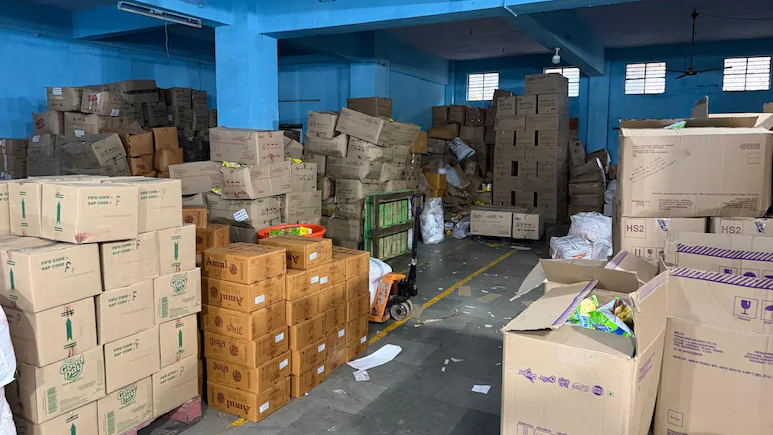
Packaged snacks and food products from major Indian brands. Image Credit: NDTV
A major food-safety crackdown in Navi Mumbai has uncovered a sophisticated racket in which manufacturing and expiry dates on packaged food products were being chemically altered, overwritten and relabelled before the goods were repackaged and prepared for export, authorities said.
Products bearing the names of some of India’s most recognisable food and beverage brands—including Lay’s, Kurkure, Maggi, Knorr, Rasoi, Hellmann’s, Thums Up and Limca—were among the stock seized during a joint operation by the Maharashtra Food and Drug Administration (FDA) and Navi Mumbai Police Crime Branch between August 24 and 29, 2026.
The FDA said 8,442 cartons linked to 10 exporter companies, with a declared value of ₹75,21,269, were seized from the premises of Sadhana Enterprises in the Turbhe TTC Industrial Area. An additional quantity of unlabelled stock and expired food products, valued at about ₹30,600, was recovered directly from the warehouse.
The total value of the seized material stood at about ₹75 lakh, according to the FDA, which has suspended the licence of Sadhana Enterprises and registered an FIR under the Food Safety and Standards Act and the Bharatiya Nyaya Sanhita (BNS).
The Turbhe Warehouse Raid
According to police and FDA accounts:
Location: M/s Sadhana Enterprises, Turbhe TTC Industrial Area, Navi Mumbai.
Dates of operation: Between August 24 and 29, 2026, with the main raid conducted on August 28–29.
Agencies involved: Maharashtra FDA (Thane/Navi Mumbai) and Navi Mumbai Police Crime Branch.
Seized stock: 8,442 cartons linked to 10 exporter companies; declared value ₹75,21,269; additional unlabelled/expired stock worth about ₹30,600.
Brands found: Lay’s, Kurkure, Fun Flips, Maggi Masala and Atta Noodles, Knorr Mushroom Soup, Rasoi curry pastes, Hellmann’s mayonnaise, Thums Up, Limca and others.
During inspections, officials allegedly found that the original manufacturing date and expiry/use-by date printed on the packaging of food items were being removed and replaced with newly printed dates. This story was also covered by NDTV.
FDA officials said they found inkjet printers, thinners and specially prepared stickers being used to erase or cover the original manufacturing information. Labels carrying information about ingredients and nutritional content were also being removed and replaced with new stickers.
Police and food-safety officials secured the warehouse during the operation, with security cordons placed around the premises.
Why and How the Racket Operated
While the full modus operandi will be established during investigation, preliminary findings point to a systematic process:
Sourcing expired or near-expiry stock: The warehouse allegedly stored food products from various export companies, including items that were past their shelf life.
Erasing original dates: Using thinners and solvents, operators allegedly wiped off or faded the original manufacturing and expiry dates printed on packets.
Overprinting new dates: Inkjet printers were used to print fresh-looking dates on the packaging, making expired products appear new.
Fake labels and stickers: Specially prepared stickers were used to cover old information or to replace labels carrying ingredient and nutritional details.
Repackaging for export: The altered stock was being prepared for dispatch to export markets, with documents showing declared values for customs clearance.
Investigators have also indicated that, besides Mumbai, export-import companies from Delhi and Noida are linked to the supply chain, though the full network is still being mapped.
Legal Action
The FDA has taken stringent administrative and legal action:
Licence suspended: The food licence of Sadhana Enterprises has been suspended with immediate effect.
FIR registered: A First Information Report has been filed under the Food Safety and Standards Act and the Bharatiya Nyaya Sanhita (BNS) against the operators.
Seizures:
8,442 cartons linked to 10 exporter companies, valued at ₹75,21,269.
Additional unlabelled and expired stock worth about ₹30,600 recovered from the premises.
The FDA’s stated policy is “zero tolerance” for tampering with food labels, especially when it involves expired products being passed off as fresh for domestic or export markets.
Quotes and Official Statements
Maharashtra FDA: “A racket involving tampering with expiry dates on food packaging has been busted in Navi Mumbai, and products of brands such as Maggi and Lay’s were among the seized stock.”
FDA press note: “During the inspection, it was found that the original Manufacturing Date and Expiry/Use By Date printed on the packaging of food products belonging to various well-known exporters were being removed and replaced with newly printed dates.”
Police account: “Besides Mumbai, export-import companies from Delhi and Noida are also involved… 8,442 cartons linked to 10 exporter companies were seized.”
Industry observer (general statement): “Tampering with expiry dates not only violates food-safety laws but also endangers consumers and damages India’s export reputation.”
These statements underline both the scale of the violation and the regulatory response.
Food-Safety Raids and Label-Tampering Cases
India has seen several high-profile cases of food-safety violations in recent years, including:
Adulteration scandals: Milk, spices, edible oils and sweets have repeatedly been found adulterated with harmful substances.
Expiry-date manipulation: Small-scale instances of relabelling near-expiry or expired products have been reported in local markets, but large export-orientated rackets are less common.
FDA crackdowns: Under Commissioner Tukaram Mundhe, the Maharashtra FDA has conducted multiple raids on warehouses, manufacturing units and labelling facilities in and around Mumbai, seizing adulterated or misbranded products.
The Turbhe case stands out because:
It involves multiple top brands across snacks, noodles, soups, condiments and beverages.
The operation appears geared towards export, raising questions about how such stock would clear customs and reach foreign buyers.
The use of industrial-grade printers, thinners and custom stickers suggests an organised setup rather than opportunistic tampering.
Also Read: Mumbai’s Famous AYUB’S Loses Food Licence as Maharashtra FDA Crackdown Intensifies
Timeline of the Operation
Before August 2026: Sadhana Enterprises operates as a packaging/labelling facility in Turbhe TTC Industrial Area, handling stock for multiple export companies.
August 24–29, 2026: FDA and Navi Mumbai Crime Branch conduct inspections and raids at the premises.
During raid: Officials find:
Expired and unlabelled food stock
Inkjet printers, thinners and fake stickers
Packets with erased and overprinted dates
Cartons marked for export to various destinations
August 28–29: Warehouse secured; 8,442 cartons seized; licence suspended; FIR registered.
August 31: The FDA publicly announces the bust, detailing brands, quantities and value of seized material.
Why This Matters
Yeh issue kaafi important hai because it touches on public health, consumer trust and India’s export credibility.
Health risk: Expired products can harbour harmful bacteria, toxins or degraded nutrients; consuming them can cause food poisoning and long-term health issues.
Consumer deception: Buyers—whether in India or abroad—expect labels to be truthful; tampering undermines that trust.
Export reputation: If such stock reaches foreign markets, it can damage “Made in India” branding and trigger import alerts or bans.
Regulatory signal: The FDA’s “zero tolerance” stance and swift licence suspension show that food-safety violations will be pursued aggressively.
Supply-chain accountability: The case highlights the need for stricter checks on third-party packaging and labelling units that handle stock for multiple exporters.
For ordinary consumers, this is a reminder to check packaging carefully and report suspicious products.
India Angle
India is a major exporter of processed foods, snacks and beverages. The Food Safety and Standards Authority of India (FSSAI) sets norms for labelling, shelf life and hygiene, while state FDAs enforce them on the ground.
Key issues highlighted by the Turbhe case:
Third-party packaging: Many exporters outsource labelling and repacking to independent facilities; these can become weak links if not audited regularly.
Inter-state networks: The alleged involvement of companies in Delhi and Noida shows how food-supply chains span multiple states, requiring coordinated enforcement.
Legal framework: The Food Safety and Standards Act, along with BNS provisions on cheating and endangering life, provides a strong basis for prosecution.
Consumer awareness: Indian buyers are increasingly alert to expiry dates, batch codes and packaging quality, but many still rely on trust in big brands.
Yeh case dikhta hai ki sirf brand ka naam kaafi nahi hai; packaging integrity aur regulatory oversight bhi utni hi zaroori hai.
Analysis
This incident is concerning not just because of the alleged acts but because of what they suggest about the system:
Scale and sophistication: Thousands of cartons, multiple brands and industrial equipment point to an organised operation, not a one-off violation.
Export orientation: The focus on export-bound stock raises questions about documentation, customs checks and buyer due diligence abroad.
Brand vulnerability: Even top brands can be misused if their expired or returned stock enters unregulated secondary markets.
In my view, this case should trigger:
Mandatory audits of third-party packaging and labelling units handling food for export.
Stronger traceability, including batch codes that can be verified by regulators and buyers.
Stricter penalties for operators who tamper with dates, including blacklisting from all food-business licences.
International coordination: that importing countries are alerted and can check suspicious consignments.
Without these, similar rackets may simply shift to other locations or commodities.
What Next
The case will now move through investigative and regulatory channels.
Likely developments:
Criminal investigation: Police will examine financial records, export documents, supplier lists and digital evidence to map the full network.
FDA action: Further inspections of linked exporters and packaging units are possible; additional seizures or licence cancellations may follow.
Brand responses: Affected companies may launch internal probes, tighten control over expired/returned stock and issue advisories to distributors.
Export scrutiny: Customs and FSSAI may increase checks on similar consignments, especially those passing through Navi Mumbai and JNPT.
Consumer alerts: FDA and FSSAI may issue guidance on how to spot tampered packaging and where to report suspicious products.
For consumers and businesses, practical steps include:
Check packaging: Look for smudged dates, mismatched fonts, uneven stickers or signs of chemical wiping.
Verify batch codes: Cross-check batch numbers and manufacturing details with company helplines if in doubt.
Report suspicions: Use FDA/FSSAI helplines and online portals to report questionable products.
Audit supply chains: Exporters should regularly audit third-party packaging units and maintain strict control over expired stock.
Conclusion
A large-scale racket altering manufacturing and expiry dates on packaged food products has been busted in Navi Mumbai, with ₹75 lakh worth of stock seized and the operator’s licence suspended.
Products from major brands, including Lay’s, Kurkure, Maggi, Knorr, Rasoi, Hellmann’s, Thums Up and Limca, were found at the Turbhe warehouse, where inkjet printers, thinners and fake stickers were allegedly used to relabel expired items for export.
The Maharashtra FDA and Navi Mumbai Police have registered an FIR under food safety and criminal laws, signalling a “zero tolerance” approach to such violations.
This case should be a wake-up call: every tampered date, every relabelled packet and every unchecked warehouse is a potential risk—and in this case, the stakes were public health and India’s export reputation.
Written By A. Jack