
A large portion of LBS Marg in Bhandup (West) caved in at an excavation site opposite Asian Paints on Saturday afternoon causing major traffic disruption. One vehicle fell into the pit, trees nearby collapsed with the impact and the area was quickly barricaded but no casualties were reported, officials said.
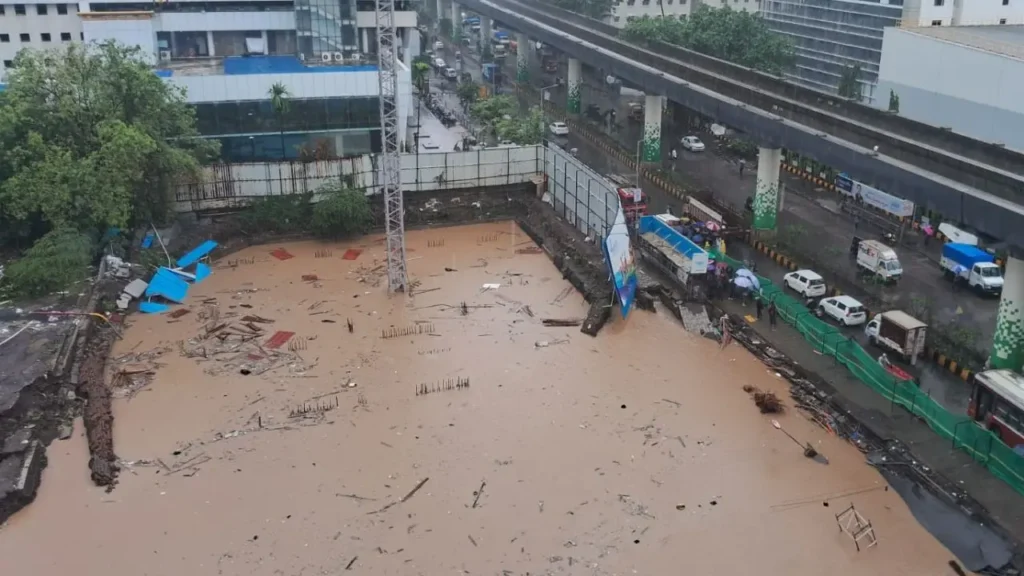
LBS Marg in Bhandup during Mumbai rains, while civic teams secure the excavation site and divert traffic. Image Credit: Mid-Day
A frightening road collapse on LBS Marg in Bhandup (West) disrupted traffic movement on Saturday afternoon after a large portion of the road caved in at an excavation site opposite Asian Paints. Officials said the incident was reported around 1.25 pm, and by 2.40 pm civic teams had issued updates and secured the area. One vehicle fell into the crater created by the cave-in, while nearby trees also collapsed due to the sudden sinking of the road.
The good news is that no casualties or injuries were reported. But the scene was still alarming, especially because the collapse took place during ongoing excavation work and amid severe rain-related stress across Mumbai. With the India Meteorological Department issuing a red alert for extremely heavy rainfall, the incident has once again highlighted how vulnerable the city becomes when rain, construction and weak ground conditions overlap. Yeh incident kaafi serious hai because it shows how quickly a routine road can turn into a danger zone.
What Happened in Bhandup
According to officials, nearly a 100-foot by 100-foot stretch of the road gave way at the excavation site. The collapse happened in an area where work was already in progress, which suggests the ground may have been weakened or destabilized by the ongoing digging. Once the road surface failed, one vehicle plunged into the pit, and the impact was strong enough to bring down trees in the immediate area. Mid-Day has covered the full story.
That kind of collapse is dangerous for a simple reason: people often cannot predict when a road will suddenly give way. From the outside, a street may look normal, but if excavation has disturbed the subsurface and heavy rain adds pressure, the structure can fail fast. In a city like Mumbai, where underground utilities, drainage lines and traffic loads all coexist in a tight space, even a single weak point can become a serious hazard.
Officials said the S Ward civic team reached the spot promptly and began safety and containment measures. The affected stretch was barricaded to keep traffic and pedestrians away, and the road has been kept closed until it is declared safe for public use after thorough inspection. That immediate response likely prevented a worse outcome.
Why the Collapse Happened
The main factor appears to be the excavation work underway at the site. Excavation weakens the natural stability of road surfaces, especially when the base layers are disturbed. If heavy rain then saturates the soil, water can seep into gaps, reduce support and trigger sudden sinking.
This is where Mumbai’s monsoon makes everything harder. Roads that are already under stress from construction become even more vulnerable when drains overflow and the ground remains soaked for long periods. In this case, the city was already under a red alert due to extremely heavy rainfall, and continuous rain had pushed drainage systems toward capacity. The overflow of Mogra Nala and other smaller drains added pressure across low-lying areas, making the environment even less stable.
So while the immediate cause was the road cave-in at the excavation site, the broader reason is a combination of construction disturbance, rainfall saturation and drainage strain. In urban safety terms, that is a high-risk combination. One weak patch can collapse suddenly, and the consequences can spread quickly.
Civic Response and Traffic Impact
Once the collapse was reported, the civic team secured the area and restricted movement. That was the correct immediate step because unstable ground can continue to shift after an initial collapse. Barricading the stretch helps prevent people or vehicles from entering a potentially dangerous zone.
Authorities also advised motorists to avoid the affected section and use alternate routes until repairs and stabilization are complete. That warning matters because road collapses are not just a one-time event; the surrounding ground can still be unstable. If the sub-surface remains weak, another portion of the road can cave in later.
The incident also came at a time when the Brihanmumbai Municipal Corporation had already temporarily closed several key roads because of waterlogging and traffic disruption. In practical terms, that means commuters were dealing with multiple layers of disruption at once: flooded streets, closed roads and now a collapsed stretch in Bhandup. For a city that relies heavily on road movement, even a few key blockages can create a chain reaction of delays and frustration.
Background and Context
Mumbai’s monsoon season often exposes the weak points in its infrastructure. Roads, drains, potholes, excavation pits and low-lying zones all become more dangerous when heavy rain continues for hours. The Bhandup collapse is part of that familiar pattern, where civic systems face pressure from both weather and construction activity.
The red alert issued by the IMD made the situation more urgent. Continuous rainfall caused Mogra Nala to overflow, and other drains connected to the drainage network also reached full capacity. Once that happens, stormwater has fewer places to go, and water accumulates quickly across roads. That not only slows traffic but also weakens the surface and hides structural problems beneath the water.
This is why Mumbai’s monsoon is always about more than just rain. It is about how the city’s road network, drainage system and construction work interact under pressure. When those systems are not aligned, incidents like the Bhandup cave-in become more likely. The pattern is worrying because it affects public safety, transport reliability and confidence in civic management.
Timeline
Saturday afternoon: A large section of road caves in on LBS Marg in Bhandup (West).
Around 1.25 pm: Authorities receive the first report of the collapse.
At the site: The incident occurs at an excavation area opposite Asian Paints.
Impact: One vehicle falls into the pit, and nearby trees collapse.
Around 2.40 pm: Civic authorities issue an update and secure the location.
Afterwards: The road is barricaded and closed to traffic until safety checks are completed.
Same day: BMC roads are also affected by widespread waterlogging amid a red alert.
Also Read: 2 Electrocuted as Water Tanker Touches Power Line in Maharashtra; 1 Dies in Sambhajinagar
Why This Matters
This matters because road collapses are not minor civic inconveniences; they are public safety incidents. In this case, a vehicle fell into the crater and trees collapsed, which could easily have caused serious injury or worse if people had been nearby. Yeh issue kaafi important hai because it shows how quickly normal city life can become unsafe when infrastructure fails.
It also matters because Mumbai’s roads are under constant pressure during monsoon season. Excavation work, drainage overflow and high traffic loads create a fragile environment. If safety checks are weak or if sites are not properly secured, the risk spreads beyond the construction zone itself.
For everyday commuters, these incidents mean more than headlines. They mean longer travel times, detours, fear of sudden collapses and reduced confidence in road safety. For the city, they raise tougher questions about how road work is planned and monitored during the rainy season.
India Angle
For Indian readers, the Bhandup collapse feels familiar because many cities across the country struggle with the same mix of rain, road works and drainage stress. In Hinglish, seedhi baat yeh hai: jab excavation chal raha ho aur baarish heavy ho, toh safety aur bhi important ho jaati hai. Mumbai may be the most visible example, but the issue is not limited to one city.
This is especially relevant in Indian metro cities where road widening, utility work and monsoon flooding often happen at the same time. If local authorities and contractors do not coordinate properly, even a busy road can suddenly become unsafe. That is why this story matters beyond Mumbai — it is a warning for every city balancing infrastructure work and monsoon conditions.
It also resonates with the public because Indian commuters are used to dealing with roadblocks, waterlogging and uneven road surfaces. But a road collapsing under a vehicle is a more serious escalation. It pushes the conversation from inconvenience into real danger.
Analysis
My opinion is that the most important detail here is not only the collapse itself but also the fact that it happened at an active excavation site. Excavation during heavy rains requires extra caution, stronger barricading and constant monitoring. If those safeguards are not robust enough, the risk of collapse rises sharply.
The quick barricading and closure of the stretch were the right moves, but the longer-term issue is prevention. Cities often respond well after a collapse, but the real test is whether they reduce the chances of the next one. That means tighter site inspections, better drainage management and stricter accountability for contractors and site supervisors.
I also think the timing of this collapse, amid a red alert and widespread waterlogging, makes it a reminder that urban resilience is not just about reacting to rain. It is about planning every excavation, every road repair and every drainage intervention with weather risk in mind. Without that, monsoon season keeps turning into a recurring safety crisis.
What Next
The next step will likely be a technical inspection of the collapse site to determine how much of the road base was weakened and whether excavation work was properly managed. Authorities may also review whether the area had adequate barricading, warning signage and structural support before the road gave way.
Repairs and stabilization will need to happen before the road is reopened. Depending on the damage below the surface, that process could take time, especially if drainage or utility lines were affected. Commuters should expect diversions until officials declare the stretch safe.
For the BMC and other civic bodies, the incident should trigger a wider review of excavation sites across Mumbai during the ongoing rains. If one road collapsed this way, other sites may also need urgent inspection before they become the next hazard.
Conclusion
The road collapse in Bhandup is a troubling reminder of how fragile Mumbai’s infrastructure can become during heavy rain. A large stretch caved in at an excavation site, a vehicle fell into the pit and trees collapsed, but prompt action by civic teams prevented injuries or fatalities. Still, the incident underscores a bigger truth: during monsoon season, excavation work and drainage pressure can turn routine roads into danger zones. Mumbai needs not only faster repairs but also safer planning, tighter monitoring and stronger accountability before the next collapse catches the city off guard.
Written By A. Jack