In a shocking incident of domestic violence, a young family in the Ranhola area of Delhi was torn apart after a 28-year-old man allegedly killed his wife with a battery after an argument over a phone call. He later took poison, told his sister he had committed the crime and died after being taken to hospital, police said.

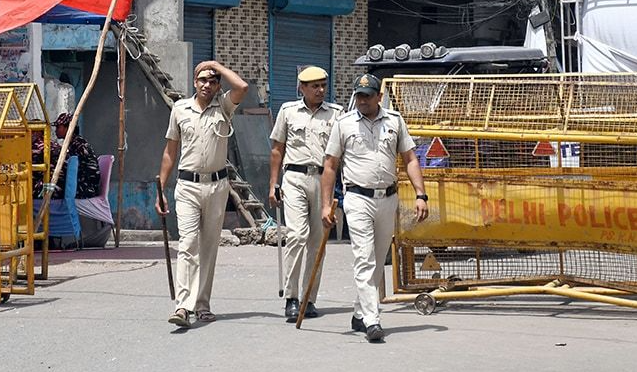
Delhi: Police and locals gather after a man allegedly killed his wife with a battery and committed suicide after consuming poison in the Ranhola area. Image Credit: PTI
Delhi Man Allegedly Kills Wife: A disturbing domestic tragedy in Outer Delhi has exposed once again how quickly suspicion, anger and unresolved conflict can turn deadly. According to police, Vinay, 28, allegedly bludgeoned his wife Nisha, 24, to death with an Exide battery after suspecting that she was speaking to someone on the phone. He then allegedly consumed aluminium phosphide, took their three-year-old daughter to his mother’s rented accommodation nearby, and confessed to his sister before the crime was reported to police.
The incident took place in Tilangpur Kotla village in the Ranhola area and came to light on July 2 after a PCR call regarding an attempted murder. When police and family members reached the room, Nisha was found critically injured with severe head wounds and was rushed to Sanjay Gandhi Memorial Hospital, where doctors declared her brought dead. Vinay was also taken to the same hospital and was declared dead on arrival. Yeh case kaafi disturbing hai because it shows how domestic suspicion can escalate into irreversible violence.
What Police Said Happened
According to investigators, the sequence began with a dispute after Vinay allegedly suspected Nisha of talking to someone on the phone. The suspicion reportedly triggered a violent confrontation inside the couple’s rented room. Police said Vinay then allegedly hit Nisha on the head with a battery, causing fatal injuries. NDTV has covered the full story.
After that, he allegedly consumed aluminium phosphide, a highly toxic poison. Instead of staying at the scene, he reportedly walked to his mother’s rented accommodation in Kotla Vihar Phase-I, roughly 150 yards away, and took their daughter with him. There, he allegedly told his sister Priya that he had killed his wife and had consumed poison. Priya then rushed to the couple’s room, found Nisha lying in a pool of blood, and alerted neighbours, who informed the police.
This detail is especially important because it suggests the crime was not only violent but also followed by a conscious admission. That confession, if established in the investigation, becomes a key piece of the timeline. It also explains how the matter reached authorities so quickly after the assault.
The Role of the Poison
Police said Vinay allegedly consumed aluminium phosphide after killing his wife. This substance is widely known as a dangerous pesticide and is extremely toxic if ingested. In many poisoning-related deaths, especially in India, such chemicals are a serious concern because they are often accessible and can be lethal very quickly.
The fact that he allegedly used poison after the assault suggests the incident may have involved both homicidal and suicidal intent. That does not reduce the gravity of the wife’s death; rather, it highlights a violent and tragic chain reaction within the same household. In cases like this, investigators usually look at whether there was any prior history of conflict, emotional instability or domestic stress.
At this stage, police have not publicly confirmed a motive beyond the suspicion over a phone call. However, such a trigger often points to deeper tensions already present in the relationship. In many domestic violence cases, the final act is only the most visible moment in a longer pattern of mistrust, control or conflict.
Preliminary investigation revealed that Nisha and Vinay had been married for five years and had a three-year-old daughter. The family had been living as tenants in the area for the last six or seven months. That background makes the case even more tragic because it involves a young child and a household that had apparently been trying to build a life in a rented home.
The child’s presence in the middle of the incident is especially heartbreaking. Vinay allegedly took the daughter to another accommodation before confessing to his sister, which means the child was physically close to the unfolding tragedy. While police have not released details about the child’s current care arrangement, the emotional impact on her and the wider family will be severe.
Cases like this are often remembered for the violence, but the after-effects are equally serious. A child who loses both parents in one night faces not only trauma but also immediate questions of custody, safety and long-term support. That is why the human cost extends far beyond the crime scene.
Official Action and Investigation
Police registered a case under Section 103(1) of the Bharatiya Nyaya Sanhita, which deals with murder, at Ranhola police station. Post-mortem examinations of both deceased persons have been completed, and the bodies were handed over to the family for last rites.
The investigation is still underway, and police will likely focus on gathering forensic evidence from the room, recording witness statements from family members and neighbours, and verifying the exact sequence of events. They may also examine mobile phone records, prior complaints, if any, and the circumstances leading up to the argument. In domestic violence cases, such evidence is important because it helps establish whether the act was sudden or part of a broader pattern.
The confession to the sister may also become relevant in the case file. If she provides a consistent statement, it could support the timeline already emerging from police findings. But even with that, the investigation will need to confirm details independently through evidence and post-mortem reports.
Why This Happened
Based on the available information, the immediate trigger appears to have been Vinay’s suspicion about his wife talking to someone on the phone. That suspicion escalated into violence. But as with many domestic killings, the real cause is often more complex than the final argument. Relationship stress, insecurity, anger and unresolved conflict can all build up over time.
Still, it is important not to romanticize or excuse the violence as a “moment of rage.” A person choosing to hit another with a battery and then consume poison is making catastrophic decisions under intense emotional pressure, but the outcome is still a deliberate act that caused two deaths. That is why this case is being treated as murder and not just a domestic dispute.
This is where society needs to pay attention. When a couple’s conflict is allowed to spiral without intervention, the consequences can be fatal. In some households, silence hides abuse until tragedy strikes. Yeh issue kaafi important hai because domestic violence often starts small and ends in irreversible loss.
Timeline
Five years ago: Nisha and Vinay got married.
Last six to seven months: The couple had been living as tenants in the Tilangpur Kotla area.
July 2: Police receive a PCR call about an attempted murder in Ranhola.
Around the same period: Vinay allegedly attacks Nisha with a battery after suspecting her of talking on the phone.
After the assault: Vinay allegedly consumes aluminum phosphide and leaves the room.
Soon after: He takes the three-year-old daughter to his mother’s rented accommodation and confesses to his sister.
Police response: Neighbors are alerted, police arrive, and both Vinay and Nisha are taken to the hospital.
Hospital outcome: Both are declared dead.
Following day: Post-mortems are conducted and bodies handed to family; the investigation continues.
Also Read: Dausa Bus Fire on Delhi-Mumbai Expressway Kills 7, Injures 22 in Horror Night Crash
Why This Matters
This matters because it is not just a crime story; it is a domestic violence story, a child welfare story and a public safety story all at once. When suspicion and control become normal inside a home, the risk of violence grows. That is why families, neighbours and local communities need to take warning signs seriously. Yeh issue kaafi important hai because prevention matters more than reaction.
It also matters because it highlights how quickly personal disputes can turn into police cases and fatalities. In urban areas like Delhi, where many families live in close-knit rented spaces, domestic tensions can remain hidden until a crisis happens. That makes early support systems essential.
Most importantly, this case leaves behind a surviving child who will have to live with the consequences of a night she could not understand. The legal case will move forward, but the emotional damage will last much longer. That human cost is what makes the story so painful.
India Angle
For Indian readers, the incident feels deeply familiar because domestic disputes, dowry-related violence, control issues and suspicion-based abuse remain serious concerns in many parts of the country. In Hinglish, seedhi baat yeh hai: ghar ke andar ka tension jab bahar tak nahi dikhta, tab log aksar samajh hi nahi paate ki danger kitna bada ho sakta hai.
Delhi, like many Indian cities, has a mix of dense housing, rented accommodations and families living under stress from work, finances and relationships. That environment can make domestic conflict harder to notice and harder to intervene in. This is why local awareness and support services matter so much.
The case also reminds readers that violence in the home is not always visible from the outside. A family may appear ordinary in a neighborhood while private conflict continues unchecked. That gap between appearance and reality is what makes domestic abuse so dangerous.
Analysis
My opinion is that the most disturbing part of this case is how a suspicion over a phone call allegedly became lethal within minutes. It is a reminder that violent control inside relationships can escalate fast when there are no safeguards or outside interventions. The battery as a weapon also shows how everyday objects can become deadly in moments of rage.
From an editorial perspective, the article should balance sensitivity with clarity. The facts are serious, but the language should avoid sensationalism. The main public value here is awareness: domestic violence is not just about visible bruises or loud arguments. It can end in fatal outcomes, and children are often the most vulnerable witnesses.
I also think the confession to the sister is one of the key details because it reveals how the matter came to light. Without that admission, the timeline may have been slower to emerge. That confession will likely be central to the police reconstruction of events.
What Next
The police investigation will continue with forensic analysis, witness statements and a closer look at the couple’s background and recent interactions. Investigators may also verify whether there were prior disputes or any signs of domestic stress that could help explain the escalation.
The child’s care and family support arrangement will also become important. With both parents dead, relatives will likely need to step in quickly. That part of the story may not make headlines, but it is crucial.
Legally, the murder case will move forward under the Bharatiya Nyaya Sanhita, and the police will file a more detailed report once the inquiry is complete. If more evidence emerges, it could further clarify whether the attack was impulsive or premeditated. But either way, the consequences are already devastating.
Conclusion
The Delhi case is a grim reminder of how suspicion, violence and despair can destroy a family in one night. According to police, Vinay allegedly killed his wife with a battery after suspecting her of talking on the phone, then consumed poison and later confessed to his sister before dying. Their three-year-old daughter is now left at the centre of a tragedy that has taken both parents away. As the investigation continues, the case stands as a painful warning about domestic conflict, emotional instability and the urgent need to treat warning signs seriously.
Written By A. Jack