
Big tree crashes on school bus in Chembur, Mumbai, killing 11-year-old student and injuring four other children in tragic accident Tuesday afternoon Mumbai Mayor Ritu Tawde has ordered an inquiry but residents alleged repeated complaints about dangerous trees were ignored.
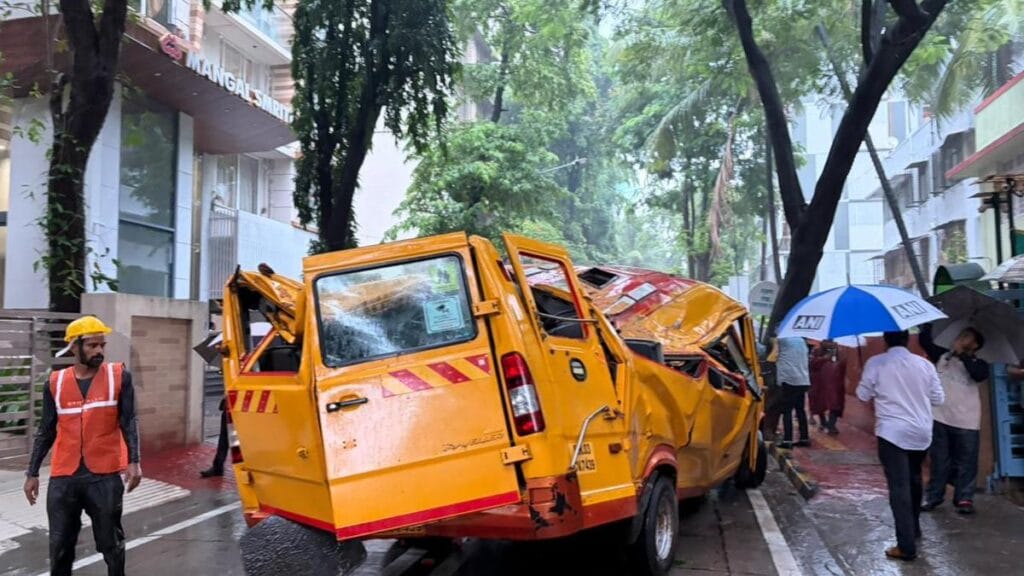
Rescue teams and local residents gather near a damaged school bus in Chembur after a tree fell on the vehicle, killing one child and injuring four others. Image Credit: The Hindu
A heartbreaking accident in Mumbai’s Chembur area claimed the life of 11-year-old Vihan Shrivastav after a large tree fell on a school bus carrying 13 children on Tuesday afternoon. The bus, belonging to Universal School, was travelling on Road No. 11 when the tree suddenly collapsed onto it, injuring five students and creating a frightening scene for parents, residents and rescue workers.
The injured children were rushed to Zen Multispeciality Hospital, where doctors later declared Vihan dead due to the severity of his injuries. Four other children sustained minor injuries and are now reported to be stable. The incident has triggered an official inquiry, with Mumbai Mayor Ritu Tawde saying the administration will not shield anyone if negligence is found. Yeh tragedy kaafi disturbing hai because it involves schoolchildren, a public road and a preventable safety concern.
What Happened
According to the details available, the school bus had 13 children on board when the tree came down in Chembur. The collapse struck the vehicle directly, trapping the students inside the wreckage. Quick response from the bus conductor and local citizens helped rescue the children before the Mumbai Fire Brigade reached the scene, which likely prevented even more serious casualties. NDTV has covered the full story.
The injured students included three boys and two girls, and they were all taken to Zen Multispeciality Hospital for emergency care. Hospital director Dr. Roy Patankar said two children underwent further medical examination, including CT scans, while the other two were also examined and found to be stable. Vihan Shrivastav suffered the most severe injuries and was later declared dead.
This sequence of events shows how fast a normal school commute can turn into a tragedy. A tree fall may look like a sudden accident, but in cities like Mumbai it often raises deeper questions about road safety, tree maintenance and municipal responsibility.
Why the Tree Fall Is Being Questioned
Residents have alleged that they had repeatedly warned the Brihanmumbai Municipal Corporation about dangerous trees in the area. According to them, complaints were made earlier and a similar incident had happened in the same locality before. They now say that despite repeated warnings, no action was taken to prevent such a disaster.
Mayor Ritu Tawde also pointed to this concern during her visit to Zen Hospital. She said that while the BMC claims the trees on the road were trimmed, locals have insisted that they had complained about hazardous trees. She added that the city needs a thorough audit of old trees, and if complaints were ignored, the strictest action should follow.
That is the central issue here: whether this was just an unfortunate natural collapse or a preventable civic failure. In Mumbai, where trees line many roads and monsoon-season accidents are not uncommon, this distinction matters a lot. If a tree is already weak, old or dangerous, then the responsibility for checking and removing it becomes a serious public matter.
Statements From Officials
Mayor Ritu Tawde’s remarks made the civic dimension of the incident very clear. She said she visited the hospital “as a mother” and described the parents as speechless in the face of the tragedy. She also said there would be “no scope for any excuses” if negligence is found and that the administration would not be shielded from accountability.
Dr Roy Patankar, the hospital director, confirmed that the children were treated immediately after arrival. His statement that two children had undergone CT scans while the others remained stable suggests that medical teams responded quickly and that the situation, while tragic, was at least controlled once the children reached hospital.
These statements matter because they show two parallel tracks: the emotional human response and the administrative response. One is about grief; the other is about accountability. Both will shape how this case develops in the coming days.
Background and Context
Tree falls in Indian cities often become major civic concerns because they expose the tension between urban greenery and public safety. Mumbai, in particular, has thousands of old trees along roads, in housing colonies and near schools. During heavy rain, strong winds or even due to internal decay, some trees can collapse without much warning.
Chembur is a densely populated part of Mumbai where school buses, private vehicles and pedestrians share narrow urban roads. When an accident involves children in a school bus, public outrage tends to rise quickly, and rightly so. Parents expect school transport to be among the safest daily activities, not one of the most vulnerable.
There is also a history angle here. Residents claim a similar incident had happened earlier in the same area, which strengthens the argument that this may not be a one-off event. If local complaints were indeed made before, then the tragedy raises serious questions about why preventive action was not taken earlier.
Timeline
Earlier complaints: Residents say they had written to the BMC about dangerous trees.
Tuesday afternoon: A school bus with 13 children travels through Road No. 11 in Chembur.
Sudden collapse: A large tree falls on the bus.
Immediate rescue: The conductor and nearby citizens help free the children before fire brigade arrival.
Hospital admission: Five children are taken to Zen Multispeciality Hospital.
Medical update: Four children are reported stable; one child, Vihan Shrivastav, dies.
Administrative response: Mayor Ritu Tawde visits the hospital and orders an inquiry.
Also Read: Chetan Not Man in Hoodie at Lohagad Fort; Police Plan Gait Analysis in Pune Murder Probe
Why This Matters
This matters because it involves the death of a child in what should have been a routine school journey. When a school bus is involved, the public naturally expects strong safety systems, regular checks and quick emergency response. Yeh issue kaafi important hai because even one missed warning can cost a life.
It also matters because it highlights civic accountability in urban India. If residents had repeatedly complained, then the system must answer why no preventive action was taken. Cities can only be safe when public grievances are taken seriously and acted upon quickly.
Beyond Mumbai, the incident is relevant to any Indian city with old roadside trees, school transport routes and limited municipal maintenance capacity. The lesson is simple: preventive inspection is cheaper and more humane than post-tragedy inquiry.
India Angle
For Indian families, this story hits very close to home because school bus safety is a daily concern. In Hinglish, seedhi baat yeh hai: parents apne bachchon ko school bhejte waqt trust karte hain, and that trust has to be protected. When a city fails to maintain basic roadside safety, the entire system feels unreliable.
Many Indian cities have similar risks, especially during monsoon and storm seasons. Old trees, weak branches and poor maintenance can become deadly. This Mumbai incident should therefore prompt other urban bodies across India to review their tree audits, school routes and roadside hazard checks.
The emotional impact is also very strong. A child’s death in a school transport accident is not just a local news item; it becomes a family tragedy and a civic warning. That is why people across India will connect with this story immediately.
Analysis
My opinion is that the inquiry must focus on prevention, not just blame after the fact. The key questions are whether the tree was visibly weak, whether complaints were logged, whether inspections were carried out, and whether action was delayed. If those answers point to negligence, then the city will need to acknowledge a serious failure.
The rescue story is also important. The conductor and local citizens acted quickly, and that likely reduced the number of casualties. In disasters like this, community response often becomes the difference between injury and a larger tragedy. But while we should appreciate that effort, it should not distract from the bigger question of why the tree was able to fall onto a school bus in the first place.
From an SEO and editorial perspective, this story needs careful handling because the emotional weight is high. It should be written with clarity, compassion and accuracy, while keeping the focus on the facts: one child dead, four injured, inquiry ordered, and residents alleging ignored warnings.
What Next
The next step is the official inquiry ordered by the Mumbai Mayor and civic authorities. That investigation will likely examine tree maintenance records, complaint logs, road inspection reports and the condition of the tree before collapse.
Medical follow-up will also continue for the injured children, especially those who underwent CT scans and further testing. Families will be waiting for a clearer picture of recovery and any long-term impact.
If negligence is established, there may be administrative action against responsible officials or contractors. There could also be a broader tree-audit drive across Mumbai, especially near schools and major roads. That would be the most meaningful response if the city wants to prevent another incident like this.
Conclusion
The Chembur tree-fall tragedy is a painful reminder that urban safety failures can have devastating consequences in a matter of seconds. An 11-year-old child lost his life, four others were injured, and a routine school journey turned into a scene of fear and grief. With Mayor Ritu Tawde ordering an inquiry and residents alleging ignored complaints, the case now demands not only sympathy but also accountability. The real measure of the city’s response will be whether it leads to stronger tree audits, better maintenance and safer school routes for children across Mumbai.
Written By A. Jack